QUESTION IMAGE
Question
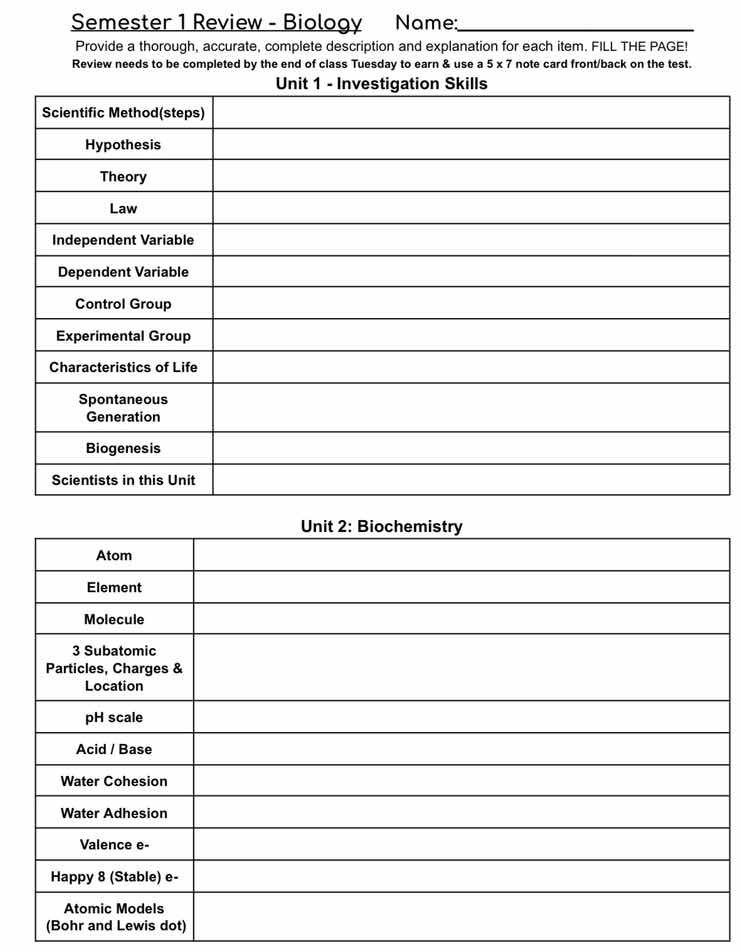
semester 1 review - biology name:
provide a thorough, accurate, complete description and explanation for each item. fill the page!
review needs to be completed by the end of class tuesday to earn & use a 5 x 7 note card front/back on the test.
unit 1 - investigation skills
scientific method(steps)
hypothesis
theory
law
independent variable
dependent variable
control group
experimental group
characteristics of life
spontaneous
generation
biogenesis
scientists in this unit
unit 2: biochemistry
atom
element
molecule
3 subatomic
particles, charges &
location
ph scale
acid / base
water cohesion
water adhesion
valence e-
happy 8 (stable) e-
atomic models
(bohr and lewis dot)
To answer this, we'll describe each term (using the Answer - Explanation Format as it's about Biology concepts, a subfield of Natural Science):
Unit 1 - Investigation Skills
Scientific Method(steps)
The scientific method has steps: 1. Observation: Notice a phenomenon. 2. Question: Ask about the observation. 3. Hypothesis: Propose a testable explanation. 4. Experiment: Test the hypothesis with controlled conditions. 5. Data Analysis: Analyze results (graphs, stats). 6. Conclusion: Determine if hypothesis is supported/rejected. 7. Communication: Share findings.
A hypothesis is a testable, tentative explanation for a scientific question. It's a prediction (e.g., "If plants get more light, they grow taller") that can be supported or refuted by experiment.
A theory is a well - supported, comprehensive explanation for a broad set of phenomena. It's based on extensive evidence (e.g., Cell Theory, Theory of Evolution) and is widely accepted in science. It's not a "guess" but a robust explanation.

Snap & solve any problem in the app
Get step-by-step solutions on Sovi AI
Photo-based solutions with guided steps
Explore more problems and detailed explanations
- Observation (identify a problem/question), 2. Question (formulate a testable question), 3. Hypothesis (proposed explanation), 4. Experiment (test hypothesis with variables), 5. Data Analysis (interpret results), 6. Conclusion (accept/reject hypothesis), 7. Communication (share findings).