QUESTION IMAGE
Question
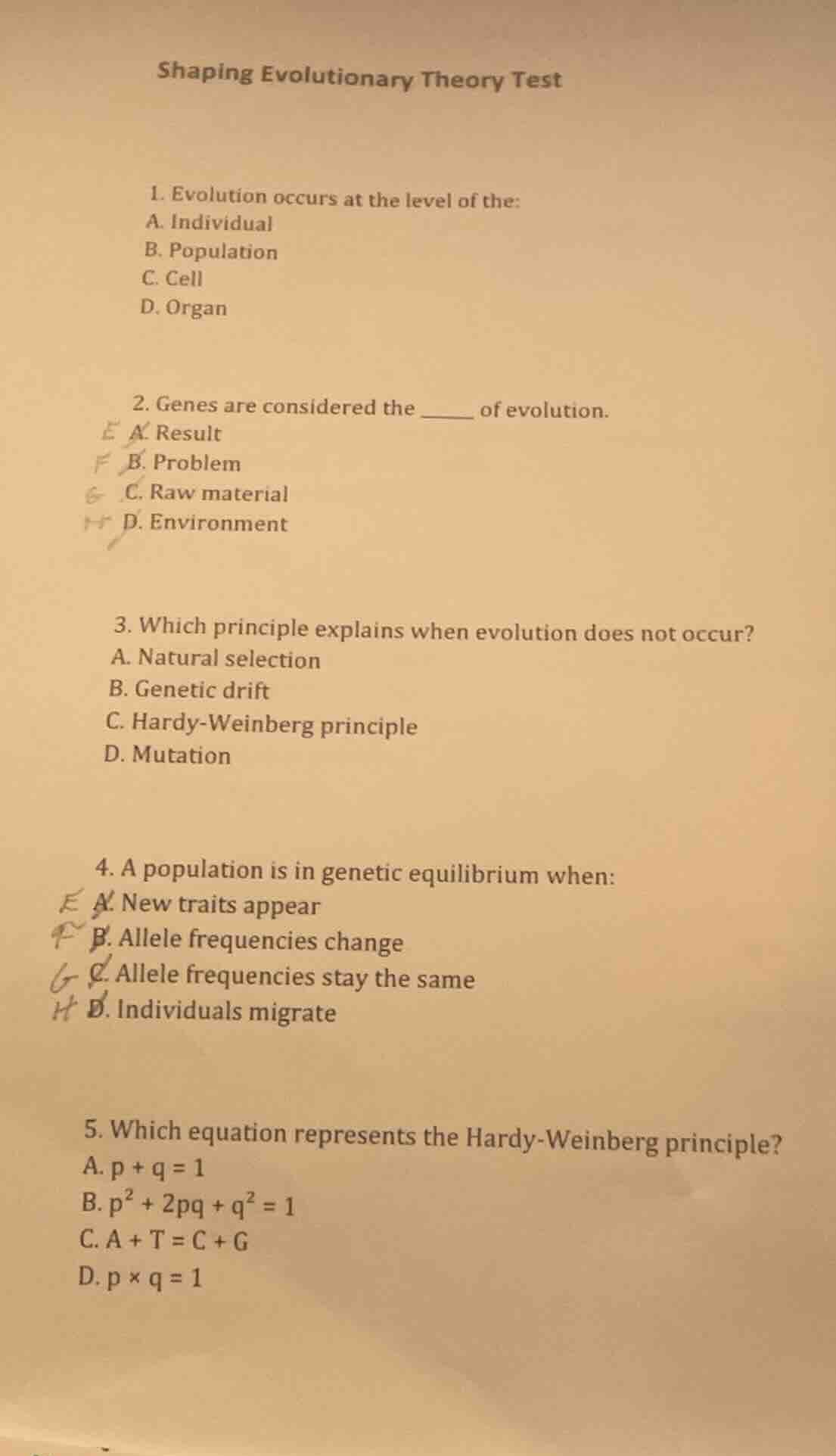
shaping evolutionary theory test
- evolution occurs at the level of the:
a. individual
b. population
c. cell
d. organ
- genes are considered the ____ of evolution.
a. result
b. problem
c. raw material
d. environment
- which principle explains when evolution does not occur?
a. natural selection
b. genetic drift
c. hardy - weinberg principle
d. mutation
- a population is in genetic equilibrium when:
a. new traits appear
b. allele frequencies change
c. allele frequencies stay the same
d. individuals migrate
- which equation represents the hardy - weinberg principle?
a. $p + q = 1$
b. $p^2 + 2pq + q^2 = 1$
c. $a + t = c + g$
d. $p × q = 1$
Brief Explanations
- Evolution is defined as changes in allele frequencies in a group of organisms over generations, which happens at the population level, not individuals, cells, or organs.
- Genetic variation (from genes) provides the raw material upon which evolutionary forces act to drive evolution.
- The Hardy-Weinberg principle outlines the conditions under which allele and genotype frequencies remain constant, meaning no evolution occurs.
- Genetic equilibrium, as defined by the Hardy-Weinberg principle, requires that allele frequencies in a population do not change across generations.
- The full Hardy-Weinberg equation for genotype frequencies is $p^2 + 2pq + q^2 = 1$, where $p^2$ is the frequency of homozygous dominant individuals, $2pq$ is heterozygous, and $q^2$ is homozygous recessive. The equation $p + q = 1$ represents allele frequency balance but is the simpler precursor, while the full genotype equation is the core principle representation.

Snap & solve any problem in the app
Get step-by-step solutions on Sovi AI
Photo-based solutions with guided steps
Explore more problems and detailed explanations
- B. Population
- C. Raw material
- C. Hardy-Weinberg principle
- C. Allele frequencies stay the same
- B. $p^2 + 2pq + q^2 = 1$