QUESTION IMAGE
Question
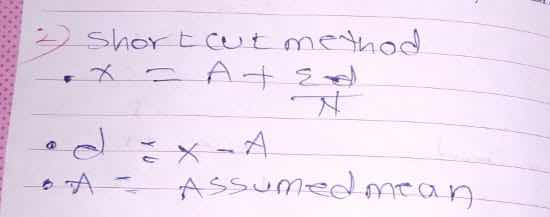
- shortcut method
- ( x = a + \frac{sum d}{n} )
- ( d = x - a )
- ( a = ) assumed mean
Step1: Identify the formula components
The given formulas are for the shortcut method (likely for mean calculation in statistics). The formula \( \bar{x} = A + \frac{\sum d}{N} \) where \( d = x - A \) and \( A \) is the assumed mean. Let's recall that in the step - deviation or shortcut method for finding the mean of grouped data, we use an assumed mean \( A \), find the deviations \( d_i=x_i - A \) (or sometimes \( d_i=\frac{x_i - A}{h} \) for step - deviation, but here it's a simpler form), sum these deviations \( \sum d \), and then divide by the number of observations \( N \) and add to the assumed mean \( A \) to get the mean \( \bar{x} \).
Step2: Explain the variables
- \( \bar{x} \): This represents the arithmetic mean of the data set.
- \( A \): This is the assumed mean. We choose a convenient value from the mid - points (in case of grouped data) or from the data values (in case of ungrouped data) as the assumed mean to simplify the calculation of the mean.
- \( d \): This is the deviation of each data point \( x \) from the assumed mean \( A \), so \( d=x - A \).
- \( \sum d \): This is the sum of all the deviations \( d \) for each data point.
- \( N \): This is the total number of observations in the data set.
For example, if we have a data set: Let's say we have data points \( x_1, x_2, \cdots, x_N \). We choose an assumed mean \( A \). Then we calculate \( d_1=x_1 - A \), \( d_2=x_2 - A \), \(\cdots\), \( d_N=x_N - A \). Then \( \sum d=\sum_{i = 1}^{N}(x_i - A) \). Then the mean \( \bar{x}=A+\frac{\sum_{i = 1}^{N}(x_i - A)}{N}=A+\frac{\sum x_i - NA}{N}=A+\frac{\sum x_i}{N}-A=\frac{\sum x_i}{N} \), which is the standard formula for the arithmetic mean. So this shortcut formula is just a re - arrangement to make the calculation easier, especially when dealing with large numbers, as subtracting a common assumed mean from each data point can reduce the size of the numbers we are working with.

Snap & solve any problem in the app
Get step-by-step solutions on Sovi AI
Photo-based solutions with guided steps
Explore more problems and detailed explanations
The formula \( \bar{x}=A + \frac{\sum d}{N} \) (where \( d = x - A \) and \( A \) is the assumed mean) is a shortcut method (usually for calculating the arithmetic mean) in statistics. Here, \( \bar{x} \) is the mean, \( A \) is the assumed mean, \( d \) is the deviation of each data point from \( A \), \( \sum d \) is the sum of deviations, and \( N \) is the number of observations.