QUESTION IMAGE
Question
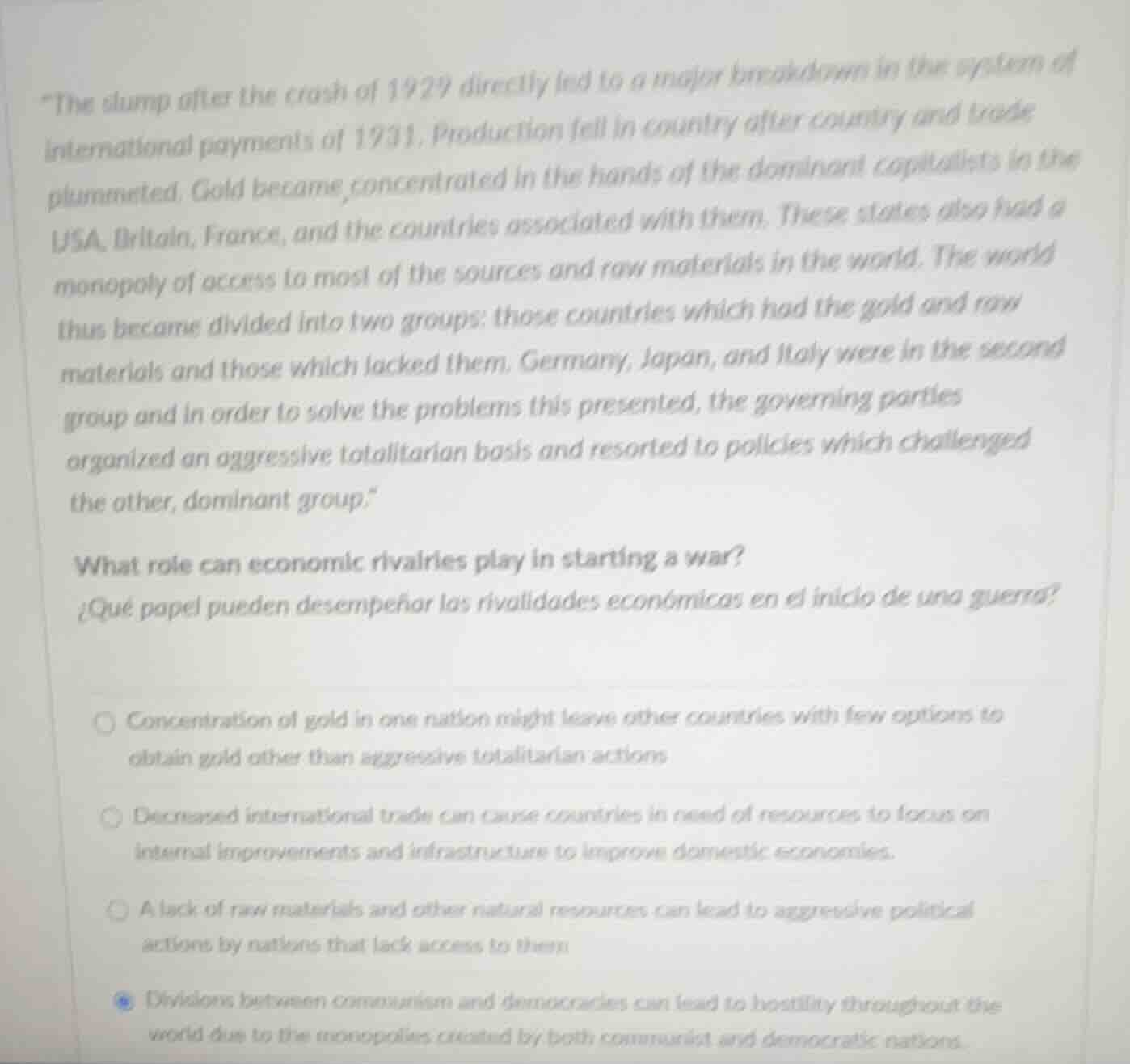
the slump after the crash of 1929 directly led to a major breakdown in the system of international payments of 1931. production fell in country after country and trade plummeted. gold became concentrated in the hands of the dominant capitalists in the usa, britain, france, and the countries associated with them. these states also had a monopoly of access to most of the sources and raw materials in the world. the world thus became divided into two groups: those countries which had the gold and raw materials and those which lacked them. germany, japan, and italy were in the second group and in order to solve the problems this presented, the governing parties organized an aggressive totalitarian basis and resorted to policies which challenged the other, dominant group. what role can economic rivalries play in starting a war? ¿qué papel pueden desempeñar las rivalidades económicas en el inicio de una guerra? concentration of gold in one nation might leave other countries with few options to obtain gold other than aggressive totalitarian actions decreased international trade can cause countries in need of resources to focus on internal improvements and infrastructure to improve domestic economies. a lack of raw materials and other natural resources can lead to aggressive political actions by nations that lack access to them divisions between communism and democracies can lead to hostility throughout the world due to the monopolies created by both communist and democratic nations.
The provided text links economic inequality (lack of gold/raw materials for some nations) to aggressive, war-provoking policies. Let's analyze each option:
- The first option incorrectly narrows the issue only to gold access, not the broader resource gap.
- The second option is wrong because the text states trade collapse pushed nations to aggressive external action, not internal improvement.
- The third option aligns with the text: nations lacking raw materials/gold adopted aggressive political (and ultimately warlike) policies to challenge dominant resource-holding states.
- The fourth option is irrelevant, as the text does not mention communism vs. democracy divisions.

Snap & solve any problem in the app
Get step-by-step solutions on Sovi AI
Photo-based solutions with guided steps
Explore more problems and detailed explanations
A lack of raw materials and other natural resources can lead to aggressive political actions by nations that lack access to them