QUESTION IMAGE
Question
small group: argument
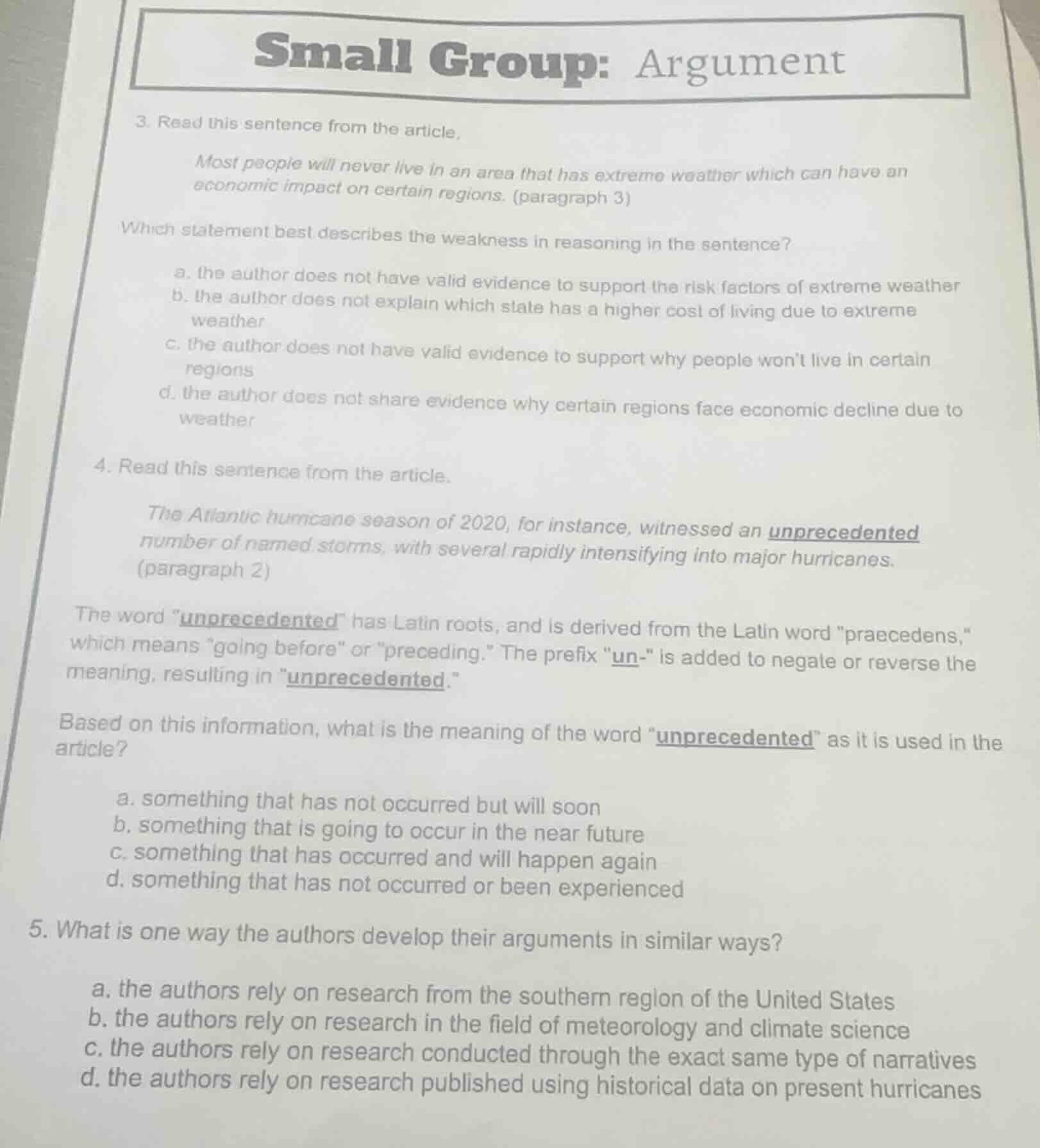
- read this sentence from the article.
most people will never live in an area that has extreme weather which can have an economic impact on certain regions. (paragraph 3)
which statement best describes the weakness in reasoning in the sentence?
a. the author does not have valid evidence to support the risk factors of extreme weather
b. the author does not explain which state has a higher cost of living due to extreme weather
c. the author does not have valid evidence to support why people wont live in certain regions
d. the author does not share evidence why certain regions face economic decline due to weather
- read this sentence from the article.
the atlantic hurricane season of 2020, for instance, witnessed an unprecedented number of named storms, with several rapidly intensifying into major hurricanes. (paragraph 2)
the word \unprecedented\ has latin roots, and is derived from the latin word \praecedens,\ which means \going before\ or \preceding.\ the prefix \un-\ is added to negate or reverse the meaning, resulting in \unprecedented.\
based on this information, what is the meaning of the word \unprecedented\ as it is used in the article?
a. something that has not occurred but will soon
b. something that is going to occur in the near future
c. something that has occurred and will happen again
d. something that has not occurred or been experienced
- what is one way the authors develop their arguments in similar ways?
a. the authors rely on research from the southern region of the united states
b. the authors rely on research in the field of meteorology and climate science
c. the authors rely on research conducted through the exact same type of narratives
d. the authors rely on research published using historical data on present hurricanes
For Question 3:
The sentence makes two linked claims: people avoid extreme weather areas, and this weather harms regions economically. The core weakness is lack of evidence for the first claim (why people won't live there). Option a focuses on extreme weather risks, not the residential claim. Option b is irrelevant (no state cost comparison is needed). Option d focuses on economic decline, not the residential choice. Only option c addresses the unsubstantiated reasoning about people's living choices.
For Question 4:
The word "unprecedented" comes from Latin "praecedens" (going before) with the negating prefix "un-". This means "not having been done or experienced before". Option a refers to future events, which is incorrect. Option b also refers to future events, which is wrong. Option c refers to repeated events, which is the opposite of the word's meaning. Option d matches the negated definition of "not occurred or been experienced".
For Question 5:
The passage references a 2020 hurricane season example, which relates to meteorology/climate science. Option a is too narrow (no focus on southern US only). Option c is incorrect (no indication of identical narrative research). Option d is inaccurate (the example is recent, not just historical data for present hurricanes). Option b correctly identifies that both authors would rely on meteorology/climate science research for extreme weather arguments.

Snap & solve any problem in the app
Get step-by-step solutions on Sovi AI
Photo-based solutions with guided steps
Explore more problems and detailed explanations
- c. the author does not have valid evidence to support why people won't live in certain regions
- d. something that has not occurred or been experienced
- b. the authors rely on research in the field of meteorology and climate science