QUESTION IMAGE
Question
social science. this passage is adapted from the book down on the bature by oliver a. houck (©2010 by university press of mississippi)
passage 9
this passage is adapted from the book down on the bature by oliver a. houck, focusing on issues related to the mississippi river and land use.
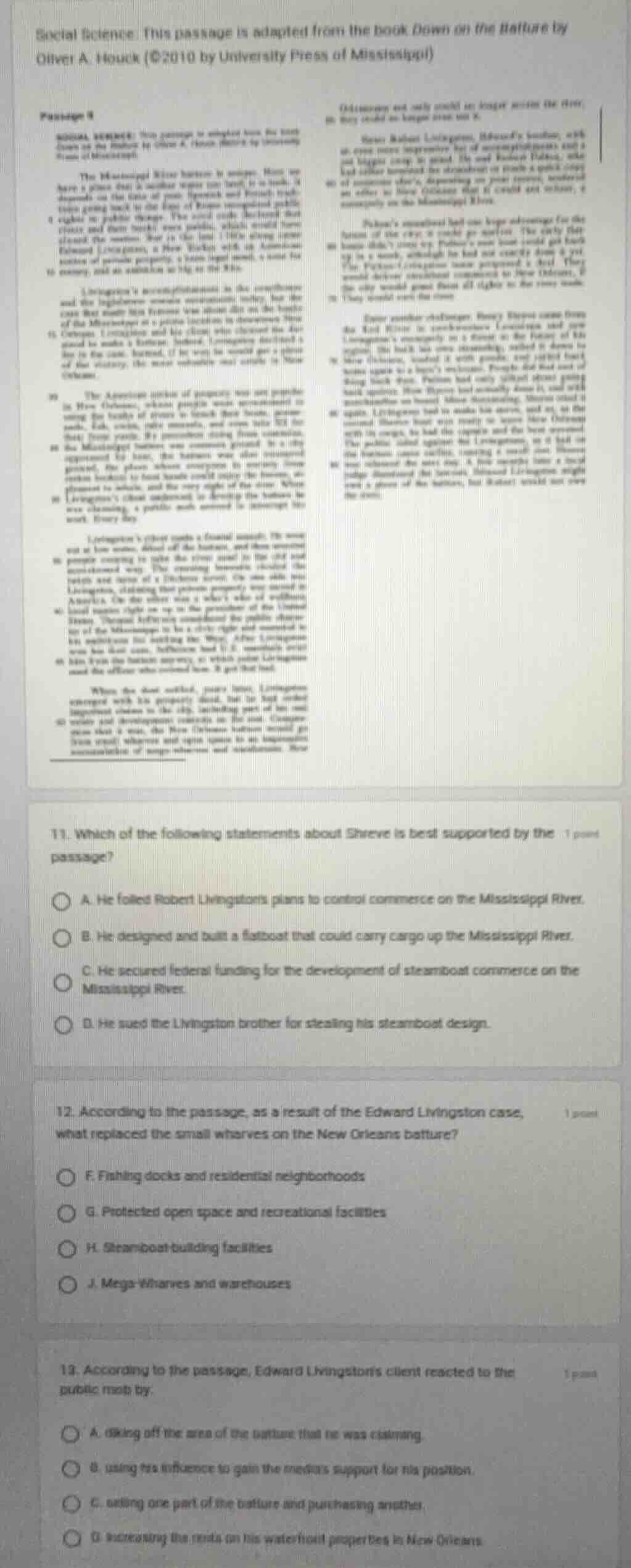
the mississippi river batture is unique. most riverfront is a place that is neither river nor land; it is both, depending on the rise of your levee and how much water is going to be in the river. the riverfront was once a place of public usage. that could include landing, storing, and then hooking over goods, which would have pleased the nation, but in the late 1700s, a man named edward livingston, a new yorker with an enormous sense of personal property, began to regard the batture as his own, and as an extension of his land on the river.
livingstons preoccupation with the riverfront and the high-handed means he used to secure it for his own use were not unique. others before him had done the same. but livingstons actions were different. he was a lawyer, and his client, who claimed the batture, made a fortune. his client was edward livingston himself. if he won, he would get a piece of the city; the more important was control of the riverfront.
the american notion of property was not popular in new orleans, where people were accustomed to using the batture for landing, storing, and even living. for years, the riverfront was a place of public usage. but livingston was coming from a city (new york) where property was privately owned. in new orleans, the batture was often considered public, the place where everyone in the city could land, store, and live. but livingston, in his effort to claim the batture as his own, was changing that.
livingstons client (himself) was a man of great wealth and influence. he was able to get the city to change its laws. the city council, under his influence, passed laws that gave him the right to the batture. this was a major change in the way the city used its riverfront.
when the dust settled, years later, livingston emerged with his property deed, but he had created important changes to the city, including the port of new orleans and development contracts. in the end, he was able to make sure that the new orleans waterfront would go from public usage to private ownership. the accumulation of large subtractions and expropriations. now, the riverfront was no longer a public space.
since robert livingston, edwards brother, with an even more impressive list of accomplishments and a large cargo to send, his and roberts actions led others to try to dominate or create a quick monopoly of someone elses. depending on your views, whether an offer to buy the batture that it could not refuse, a monopoly on the mississippi river.
fultons steamboat had one huge advantage for the owners of the city: it could go upstream. the early flatboats were a one - way trip; they could not come back up the river, although in bad water, they could get stuck. the fultons steamboat came prepared to deal. they would deliver goods upstream and go downstream. if the city would grant them all rights to the river trade, they would need the river.
every pioneer challenges. henry shreve came from the ohio river to new orleans. i assume, and was determined to monopolize the river. he built a steamboat, called it the enterprise, and was determined to break the monopoly. he started it steam - going, sailed it down to new orleans, loaded it with goods, and started back up the river. people did not go back up the river. fulton had only talked about it, and still, no one had actually done it. shreve did it, and with much difficulty, he was able to make the trip. he continued to run his steamboat on the river, much to the chagrin of the livingstons. but shreve had his own problems. he was arrested by the city, but he fought back. in the end, he was able to get the courts to rule that the livingstons monopoly was illegal. a few months later, a local judge dismissed the lawsuit. edward livingston might have a piece of the riverfront, but robert would not own the river.
- which of the following statements about shreve is best supported by the passage? (1 point)
a. he foiled robert livingstons plans to control commerce on the mississippi river.
b. he designed and built a flatboat that could carry cargo up the mississippi river.
c. he secured federal funding for the development of steamboat commerce on the mississippi river.
d. he sued the livingston brothers for stealing his steamboat design.
- according to the passage, as a result of the edward livingston case, what replaced the small wharves on the new orleans batture? (1 point)
f. fishing docks and residential neighborhoods
g. protected open space and recreational facilities
h. steamboat - building facilities
j. mega - wharves and warehouses
- according to the passage, edward livingstons client (himself) reacted to the public outcry by: (1 point)
a. giving up the area of the batture that he was claiming.
b. using his influence to gain the medias support for his position.
c. selling one part of the batture and purchasing another.
d. increasing the media on his waterfront properties in new orleans
Question 11
- Option A: The passage says Shreve's steamboat could go upstream, challenging Livingston's monopoly, but "foiled plans to control commerce" is not directly supported.
- Option B: The passage states "Henry Shreve came from the Red River to challenge Livingston... Shreve’s boat was steam - powered, and it could get back upriver. The hull... was not exactly a flatboat... Shreve’s innovation came to be a keelboat" and his boat could carry cargo up the river. This matches.
- Option C: There's no mention of federal funding for Shreve's steamboat commerce.
- Option D: No information about Shreve suing the Livingstons for stealing designs.
- Option F: The passage is about river commerce and wharves, not fishing docks or residential areas.
- Option G: The passage focuses on commercial development, not recreational facilities or open space.
- Option H: The passage doesn't mention steamboat - building facilities replacing small wharves.
- Option J: The passage says "the city would grant leases... mega - wharves and warehouses" as a result of the case. This is supported.
- Option A: The client didn't diked off the area; Livingston's client was cleaning the batture.
- Option B: There's no mention of media support.
- Option C: The passage says "On one side was America, on the other side a wharf - like extension of the batture... The client... bought the other side" which means selling one part and purchasing another. This matches.
- Option D: The passage doesn't say the client increased media on waterfront properties.

Snap & solve any problem in the app
Get step-by-step solutions on Sovi AI
Photo-based solutions with guided steps
Explore more problems and detailed explanations
B. He designed and built a flatboat that could carry cargo up the Mississippi River.