QUESTION IMAGE
Question
solve the problems.
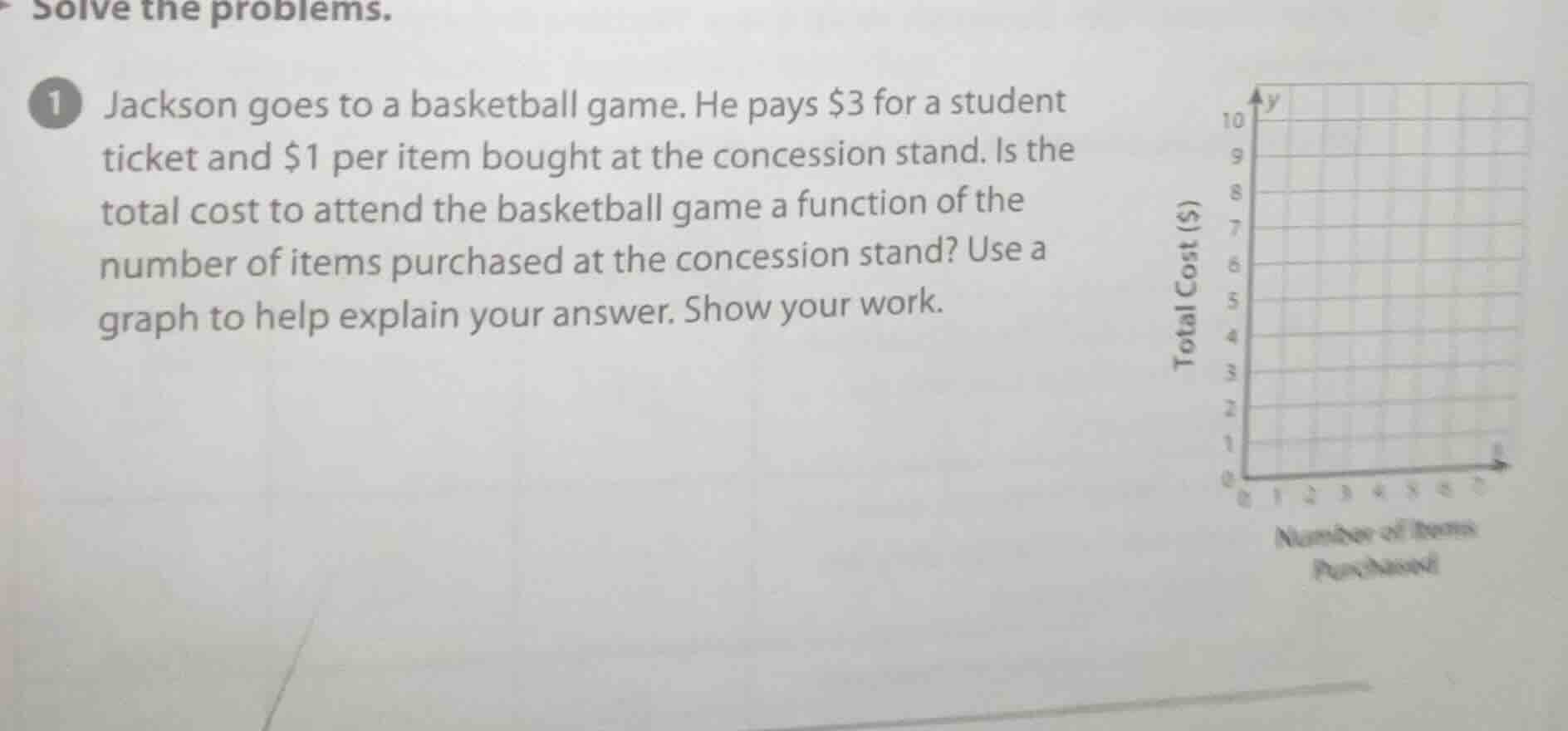
1 jackson goes to a basketball game. he pays $3 for a student ticket and $1 per item bought at the concession stand. is the total cost to attend the basketball game a function of the number of items purchased at the concession stand? use a graph to help explain your answer. show your work.
Step1: Define Variables and Cost Function
Let \( x \) be the number of items purchased at the concession stand, and \( y \) be the total cost (in dollars). The fixed cost for the ticket is $3, and the variable cost is $1 per item. So the total cost function is \( y = 3 + 1 \cdot x \), or \( y = x + 3 \).
Step2: Analyze the Function Definition
A relation is a function if for every input (value of \( x \)), there is exactly one output (value of \( y \)). For the function \( y = x + 3 \), when we choose any non - negative integer (since we can't buy a negative number of items) for \( x \) (e.g., if \( x = 0 \), \( y=3\); if \( x = 1 \), \( y = 4 \); if \( x = 2 \), \( y=5 \), etc.), there is exactly one corresponding \( y \)-value.
Step3: Graphical Interpretation
To graph \( y=x + 3 \) (for non - negative integer values of \( x \), since \( x \) represents the number of items), we can plot points:
- When \( x = 0 \), \( y=3+0 = 3 \), so the point is \((0,3)\).
- When \( x = 1 \), \( y=3 + 1=4 \), so the point is \((1,4)\).
- When \( x = 2 \), \( y=3+2 = 5 \), so the point is \((2,5)\).
- And so on.
If we were to draw a vertical line (the vertical line test) at any \( x \)-value (for \( x\geq0 \)), the vertical line would intersect the graph at only one point. This confirms that for each input \( x \) (number of items), there is exactly one output \( y \) (total cost).

Snap & solve any problem in the app
Get step-by-step solutions on Sovi AI
Photo-based solutions with guided steps
Explore more problems and detailed explanations
Yes, the total cost to attend the basketball game is a function of the number of items purchased at the concession stand. The cost function is \( y=x + 3 \) (where \( x \) is the number of items and \( y \) is the total cost), and by the vertical line test (or the definition of a function), for each number of items \( x \), there is exactly one total cost \( y \).