QUESTION IMAGE
Question
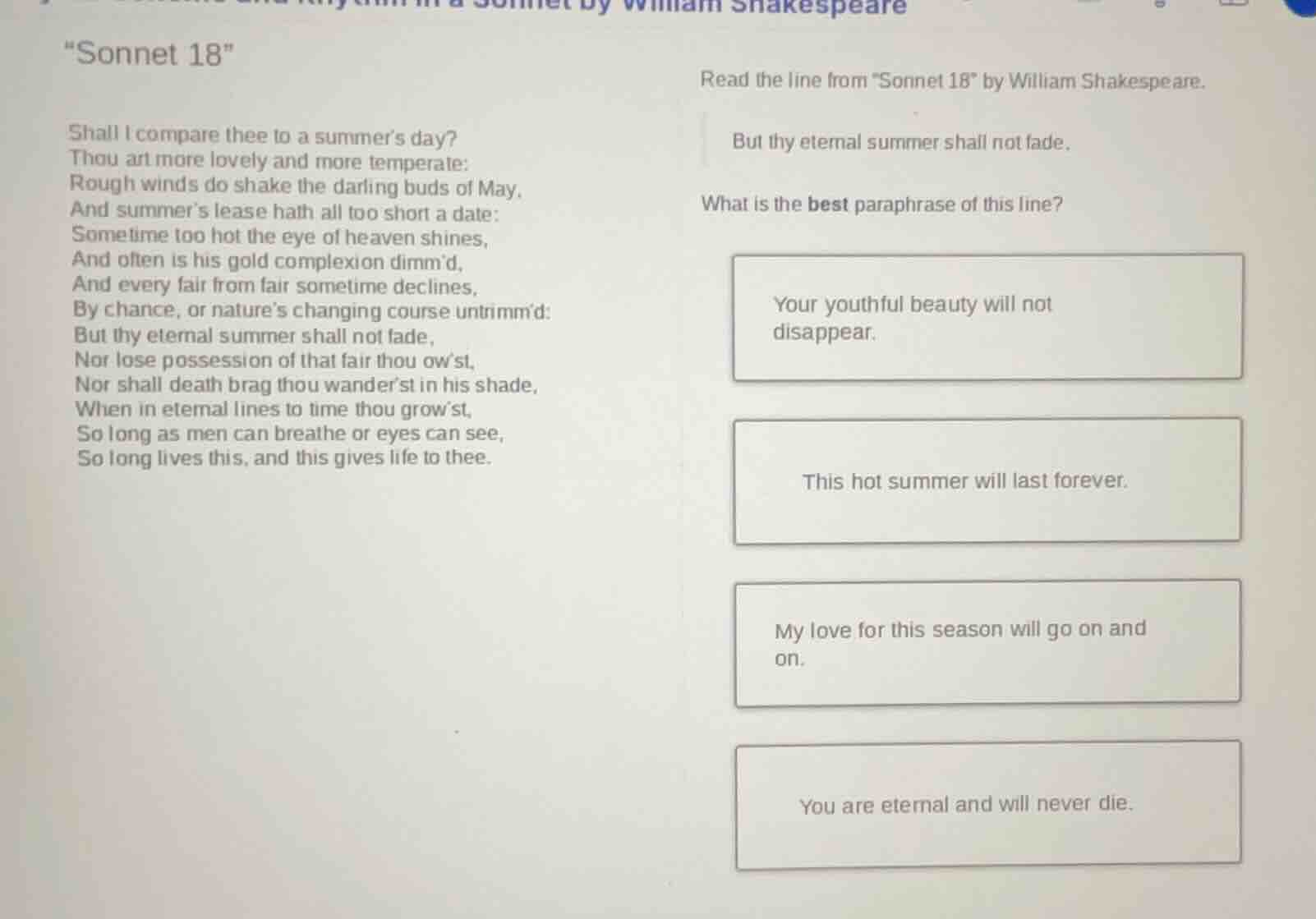
“sonnet 18”
shall i compare thee to a summer’s day?
thou art more lovely and more temperate:
rough winds do shake the darling buds of may,
and summer’s lease hath all too short a date:
sometime too hot the eye of heaven shines,
and often is his gold complexion dimm’d,
and every fair from fair sometime declines,
by chance, or nature’s changing course untrimm’d:
but thy eternal summer shall not fade,
nor lose possession of that fair thou ow’st,
nor shall death brag thou wander’st in his shade,
when in eternal lines to time thou grow’st,
so long as men can breathe or eyes can see,
so long lives this, and this gives life to thee.
read the line from “sonnet 18” by william shakespeare.
but thy eternal summer shall not fade.
what is the best paraphrase of this line?
your youthful beauty will not
disappear.
this hot summer will last forever.
my love for this season will go on and
on.
you are eternal and will never die.
To find the best paraphrase, we analyze the line "But thy eternal summer shall not fade". In the context of Sonnet 18, "thy eternal summer" is a metaphor for the beloved's youthful beauty. "Shall not fade" means it won't disappear.
- The second option is incorrect as it takes "summer" literally (the season), not as a metaphor.
- The third option is incorrect as the line is about the beloved's beauty, not the speaker's love for the season.
- The fourth option is incorrect as the line focuses on beauty not fading, not on immortality or never dying.
- The first option correctly interprets "eternal summer" as youthful beauty and "not fade" as not disappearing.

Snap & solve any problem in the app
Get step-by-step solutions on Sovi AI
Photo-based solutions with guided steps
Explore more problems and detailed explanations
Your youthful beauty will not disappear.