QUESTION IMAGE
Question
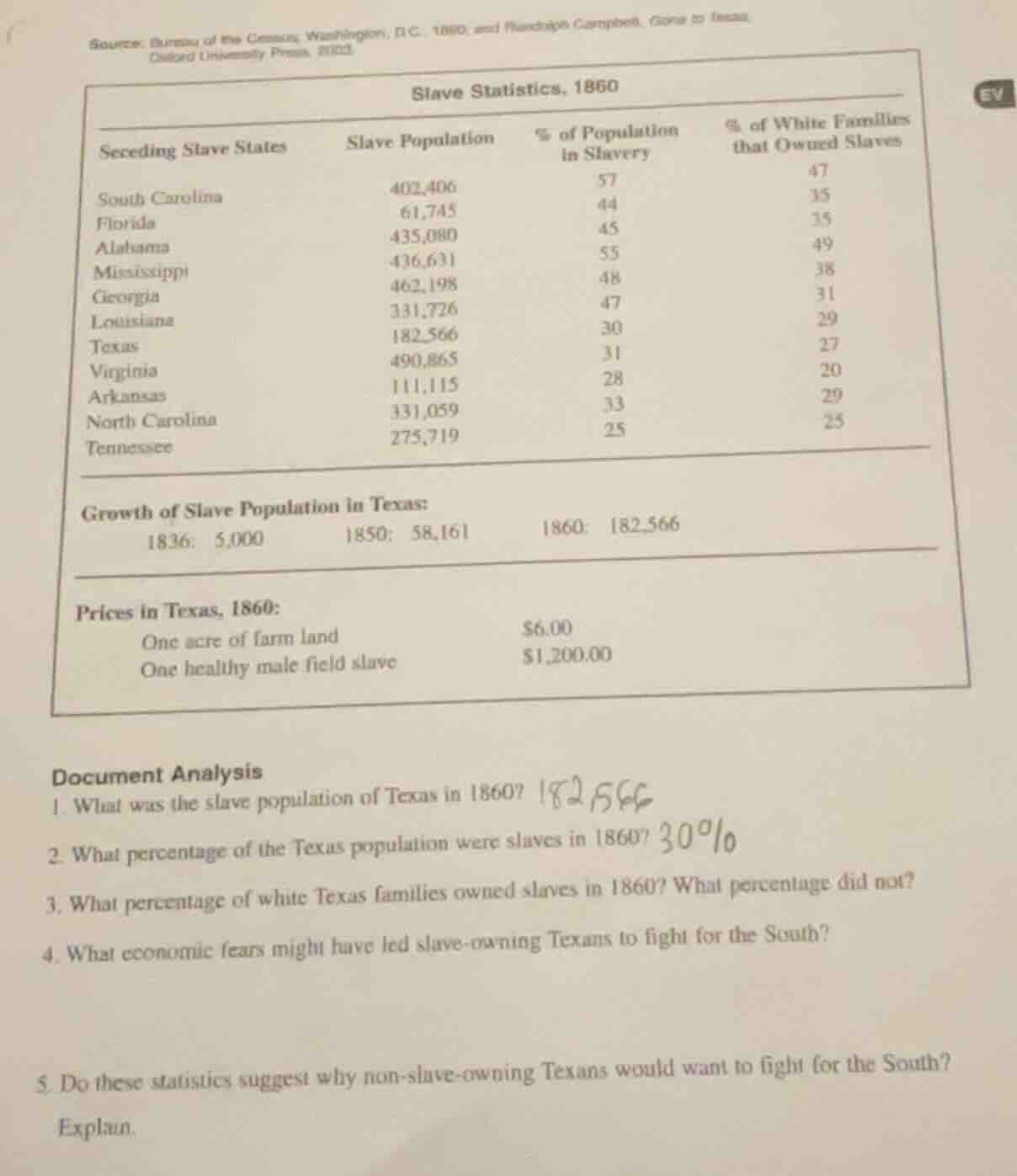
source: bureau of the census, washington, d.c. 1990; and randolph campbell, gone to texas, oxford university press, 2003.
slave statistics, 1860
| seceding slave states | slave population | % of population in slavery | % of white families that owned slaves |
|---|---|---|---|
| florida | 61,745 | 44 | 35 |
| alabama | 435,080 | 45 | 35 |
| mississippi | 436,631 | 55 | 49 |
| georgia | 462,198 | 48 | 38 |
| louisiana | 331,726 | 47 | 31 |
| texas | 182,566 | 30 | 27 |
| virginia | 490,865 | 31 | 20 |
| arkansas | 111,115 | 28 | 29 |
| north carolina | 331,059 | 33 | 25 |
| tennessee | 275,719 | 25 | 25 |
growth of slave population in texas:
1836: 5,000 1850: 58,161 1860: 182,566
prices in texas, 1860:
one acre of farm land $6.00
one healthy male field slave $1,200.00
document analysis
- what was the slave population of texas in 1860?
- what percentage of the texas population were slaves in 1860?
- what percentage of white texas families owned slaves in 1860? what percentage did not?
- what economic fears might have led slave - owning texans to fight for the south?
- do these statistics suggest why non - slave - owning texans would want to fight for the south? explain.
Brief Explanations
- Retrieved directly from the "Slave Statistics, 1860" table for Texas.
- Retrieved directly from the "% of Population in Slavery" column for Texas in the 1860 table.
- The percentage of white Texas families that owned slaves is taken from the table. The non-owning percentage is calculated by subtracting the owning percentage from 100.
- Enslaved people were extremely valuable property (worth 200x an acre of farmland in Texas, 1860). Slave owners feared losing this massive economic asset if slavery was abolished, along with losing the forced labor that powered their agricultural economy.
- The data shows 73% of white Texas families did not own slaves. However, many non-owning white Texans may have aspired to own slaves (a key economic status symbol) or held white supremacist views that aligned them with the pro-slavery South, even without direct slave ownership.

Snap & solve any problem in the app
Get step-by-step solutions on Sovi AI
Photo-based solutions with guided steps
Explore more problems and detailed explanations
- 182,566
- 30%
- 29% of white Texas families owned slaves; 71% did not.
- Slave-owning Texans likely feared losing their extremely valuable enslaved people (who were worth far more than farmland) and the forced labor that sustained their agricultural economic system if slavery was abolished.
- Yes. While 71% of white Texas families did not own slaves, many may have desired to own enslaved people as a path to economic advancement, or held white supremacist beliefs that led them to support the pro-slavery South's cause, even without owning slaves themselves.