QUESTION IMAGE
Question
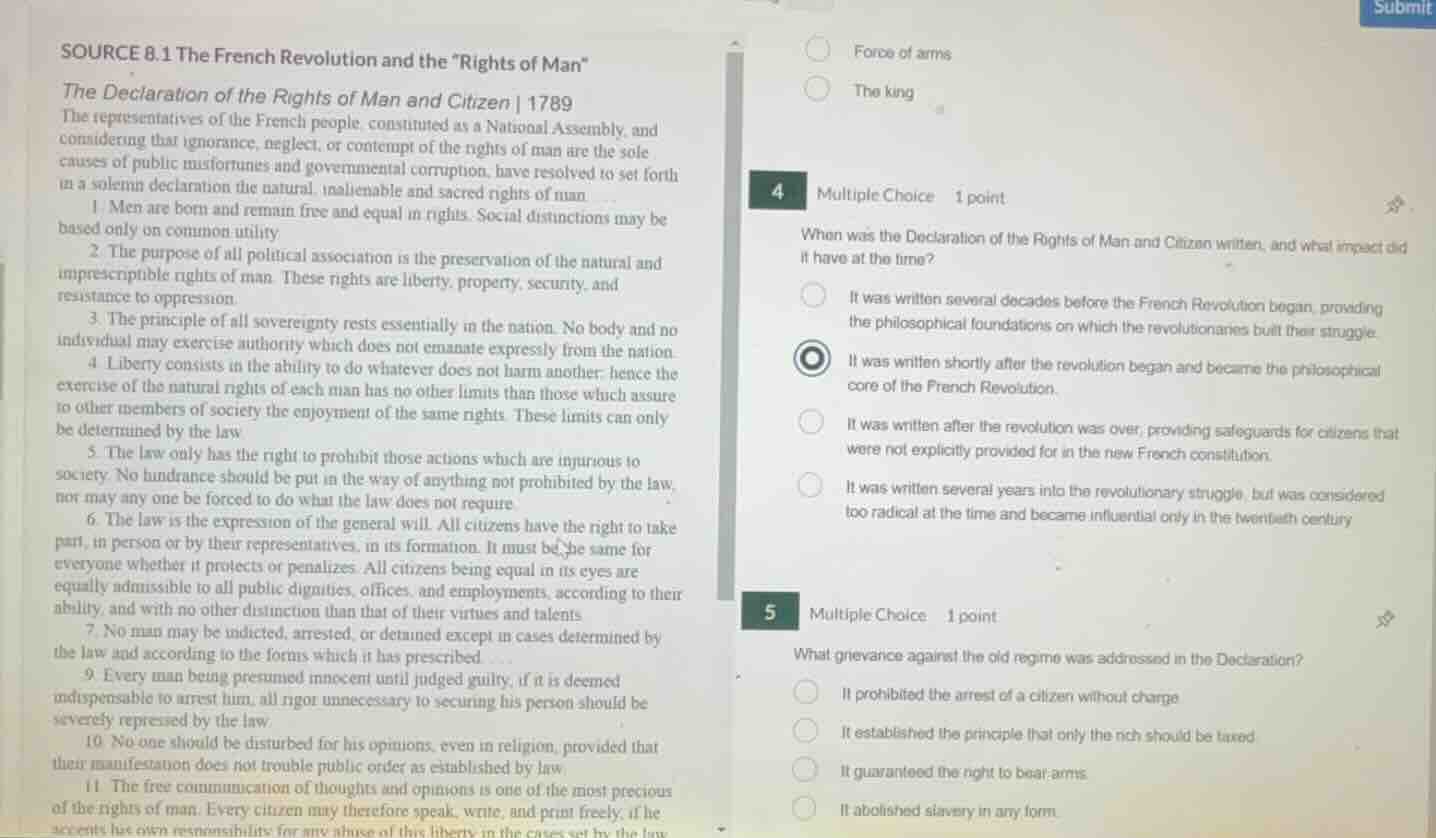
source 8.1 the french revolution and the
ights of man\
the declaration of the rights of man and citizen | 1789
the representatives of the french people, constituted as a national assembly, and considering that ignorance, neglect, or contempt of the rights of man are the sole causes of public misfortunes and governmental corruption, have resolved to set forth in a solemn declaration the natural, inalienable and sacred rights of man
- men are born and remain free and equal in rights. social distinctions may be based only on common utility
- the purpose of all political association is the preservation of the natural and imprescriptible rights of man. these rights are liberty, property, security, and resistance to oppression.
- the principle of all sovereignty rests essentially in the nation. no body and no individual may exercise authority which does not emanate expressly from the nation
- liberty consists in the ability to do whatever does not harm another; hence the exercise of the natural rights of each man has no other limits than those which assure to other members of society the enjoyment of the same rights. these limits can only be determined by the law
- the law only has the right to prohibit those actions which are injurious to society. no hindrance should be put in the way of anything not prohibited by the law, nor may any one be forced to do what the law does not require
- the law is the expression of the general will. all citizens have the right to take part, in person or by their representatives, in its formation. it must be the same for everyone whether it protects or penalizes. all citizens being equal in its eyes are equally admissible to all public dignities, offices, and employments, according to their ability, and with no other distinction than that of their virtues and talents
- no man may be indicted, arrested, or detained except in cases determined by the law and according to the forms which it has prescribed
- every man being presumed innocent until judged guilty, if it is deemed indispensable to arrest him, all rigor unnecessary to securing his person should be severely repressed by the law
- no one should be disturbed for his opinions, even in religion, provided that their manifestation does not trouble public order as established by law
- the free communication of thoughts and opinions is one of the most precious of the rights of man. every citizen may therefore speak, write, and print freely, if he accepts the own responsibility for any abuse of this liberty in the cases set by the law
force of arms
the king
4 multiple choice 1 point
when was the declaration of the rights of man and citizen written, and what impact did it have at the time?
it was written several decades before the french revolution began, providing the philosophical foundations on which the revolutionaries built their struggle.
it was written shortly after the revolution began and became the philosophical core of the french revolution.
it was written after the revolution was over, providing safeguards for citizens that were not explicitly provided for in the new french constitution.
it was written several years into the revolutionary struggle, but was considered too radical at the time and became influential only in the twentieth century
5 multiple choice 1 point
what grievance against the old regime was addressed in the declaration?
it prohibited the arrest of a citizen without charge
it established the principle that only the rich should be taxed
it guaranteed the right to bear arms
it abolished slavery in any form
For question 4: The Declaration of the Rights of Man and Citizen was adopted in August 1789, shortly after the start of the French Revolution in July 1789, and it served as the key philosophical framework for the revolution's ideals.
For question 5: Article 7 of the Declaration states that no one may be arrested or detained except per lawful, prescribed cases, addressing the arbitrary arrests common under the old regime. The other options are incorrect: the declaration did not target only the rich for taxation, did not guarantee arms rights, and did not abolish slavery.

Snap & solve any problem in the app
Get step-by-step solutions on Sovi AI
Photo-based solutions with guided steps
Explore more problems and detailed explanations
- It was written shortly after the revolution began and became the philosophical core of the French Revolution.
- It prohibited the arrest of a citizen without charge