QUESTION IMAGE
Question
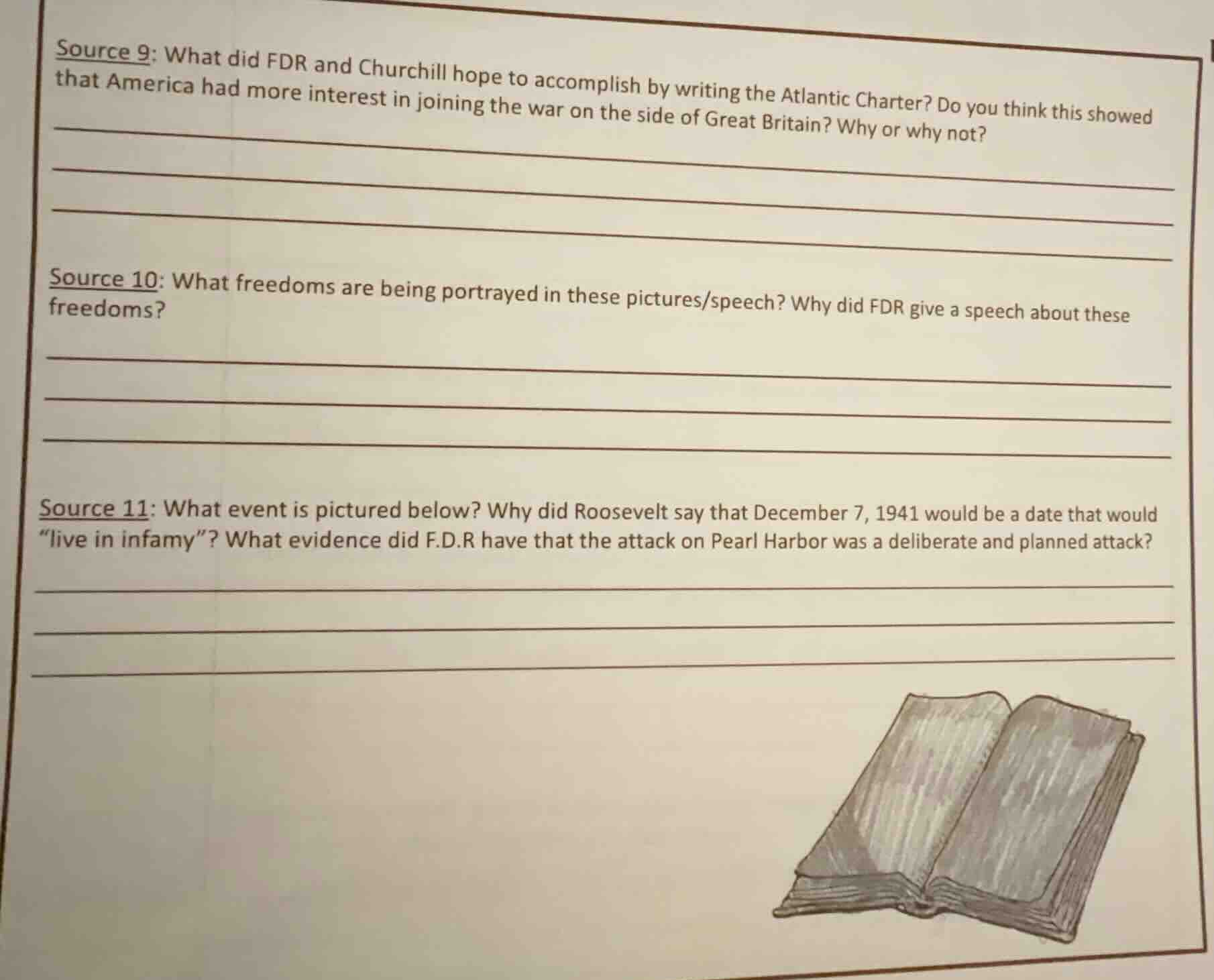
source 9: what did fdr and churchill hope to accomplish by writing the atlantic charter? do you think this showed that america had more interest in joining the war on the side of great britain? why or why not?
source 10: what freedoms are being portrayed in these pictures/speech? why did fdr give a speech about these freedoms?
source 11: what event is pictured below? why did roosevelt say that december 7, 1941 would be a date that would \live in infamy\? what evidence did f.d.r have that the attack on pearl harbor was a deliberate and planned attack?
Response
Source 9
Brief Explanations
- Accomplishment of the Atlantic Charter: FDR and Churchill aimed to outline post - war goals (like self - determination, free trade) and gain U.S. support for the Allied cause without direct U.S. entry yet.
- U.S. War Interest: It showed growing U.S. alignment with Britain. The charter’s principles (opposing Axis aggression) aligned with Britain’s war aims, suggesting U.S. sympathy, though U.S. was still officially neutral. Reasons: Shared democratic values, economic ties, and the charter’s anti - Axis stance hinted at U.S. leaning toward Britain’s side.
Brief Explanations
- Freedoms Portrayed: Likely the Four Freedoms (speech, worship, from want, from fear) from FDR’s speech.
- Reason for the Speech: FDR gave the speech to rally domestic and international support for the Allied cause, frame the war as a fight for universal freedoms, and justify U.S. aid to democracies (like Britain) against Axis tyranny.
Brief Explanations
- Event Pictured: The attack on Pearl Harbor (Japanese surprise attack on U.S. naval base in Hawaii).
- “Date which will live in infamy”: The attack was a surprise, unprovoked act of war against a neutral (at the time) U.S., killing thousands and destroying the Pacific Fleet, so it was a dishonorable, devastating act.
- Evidence of Deliberate Attack: The attack was a coordinated, surprise strike (no declaration of war, simultaneous attacks on multiple targets), showing pre - meditated planning. Japanese military had been planning the attack, and the surprise nature (U.S. was neutral) proved it was deliberate.

Snap & solve any problem in the app
Get step-by-step solutions on Sovi AI
Photo-based solutions with guided steps
Explore more problems and detailed explanations
- By writing the Atlantic Charter, FDR and Churchill hoped to set out post - war ideals (e.g., self - determination, free trade) and build international support against Axis powers, while also gaining U.S. backing for the Allied cause short of direct U.S. war entry.
- This showed America had more interest in joining Britain’s side. The charter’s principles (opposing Axis aggression, promoting democratic ideals) aligned with Britain’s war goals, indicating U.S. sympathy. Also, U.S. economic ties to Britain and concern over Axis expansion made alignment likely, even if U.S. was neutral.