QUESTION IMAGE
Question
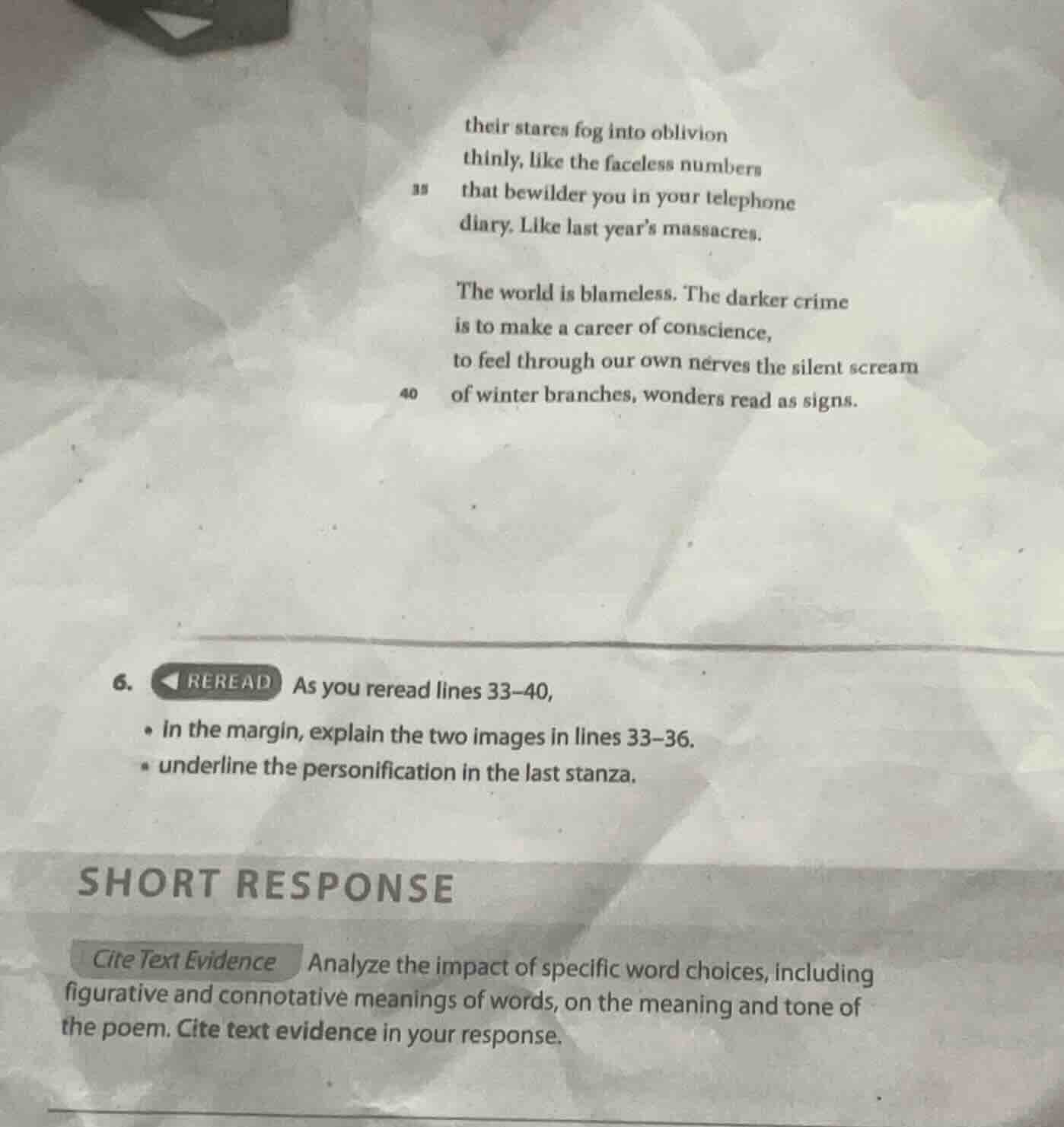
their stares fog into oblivion
thinly, like the faceless numbers
15 that bewilder you in your telephone
diary. like last year’s massacres.
the world is blameless. the darker crime
is to make a career of conscience,
to feel through our own nerves the silent scream
40 of winter branches, wonders read as signs.
- reread as you reread lines 33–40,
- in the margin, explain the two images in lines 33–36.
- underline the personification in the last stanza.
short response
cite text evidence analyze the impact of specific word choices, including
figurative and connotative meanings of words, on the meaning and tone of
the poem. cite text evidence in your response.
For lines 33-36 images:
- The first image is "their stares fog into oblivion thinly, like the faceless numbers that bewilder you in your telephone diary": It compares fading, unrecognizable stares to unknown, confusing phone numbers, conveying the anonymity and forgetfulness of those who suffered.
- The second image is "Like last year's massacres": It links the anonymous stares to past massacres, equating the overlooked people to forgotten victims of violence, emphasizing neglect.
For personification in lines 37-40:
The personification is "the silent scream of winter branches": Winter branches are given the human action of screaming, framing nature as bearing silent, unheard suffering that mirrors human trauma.
For short response on word choice impact:
- Figurative language: The simile of stares to "faceless numbers" (lines 34-35) creates a detached, cold tone, showing how marginalized people are reduced to unimportant, forgotten details. The personification of winter branches' "silent scream" (line 39) extends this tone of suppressed pain, connecting human suffering to a quiet, ignored natural grief.
- Connotative words: "Oblivion" (line 33) has a connotation of total erasure, reinforcing that the people's existence is being wiped away. "Blameless" (line 37) is ironic; it frames the world as avoiding accountability, while "darker crime" (line 38) reverses moral expectations, criticizing those who prioritize conscience as if it were a transgression, shifting the poem's tone to one of bitter social critique.

Snap & solve any problem in the app
Get step-by-step solutions on Sovi AI
Photo-based solutions with guided steps
Explore more problems and detailed explanations
- Explanation of lines 33-36 images:
- Image 1: Fading stares are compared to unrecognizable telephone numbers, symbolizing the anonymity and erasure of marginalized people.
- Image 2: The comparison to "last year's massacres" links these overlooked people to forgotten victims of violence, highlighting societal neglect.
- Personification in last stanza:
"the silent scream of winter branches"
- Short response analysis:
The poem's word choices shape a tone of bitter, quiet despair and critique. The simile of stares to "faceless numbers" (lines 34-35) uses the cold anonymity of unknown contacts to mirror how vulnerable people are reduced to unremembered, irrelevant figures, creating a detached, hopeless tone. The personification of winter branches' "silent scream" (line 39) extends this suffering to the natural world, framing unheard human pain as a universal, suppressed grief. Connotative language like "oblivion" (line 33) emphasizes total erasure of the people's identities, while the ironic phrase "darker crime is to make a career of conscience" (lines 38) reverses moral norms, criticizing a society that punishes empathy. Together, these choices build a meaning centered on societal indifference to suffering and the cost of speaking against it.