QUESTION IMAGE
Question
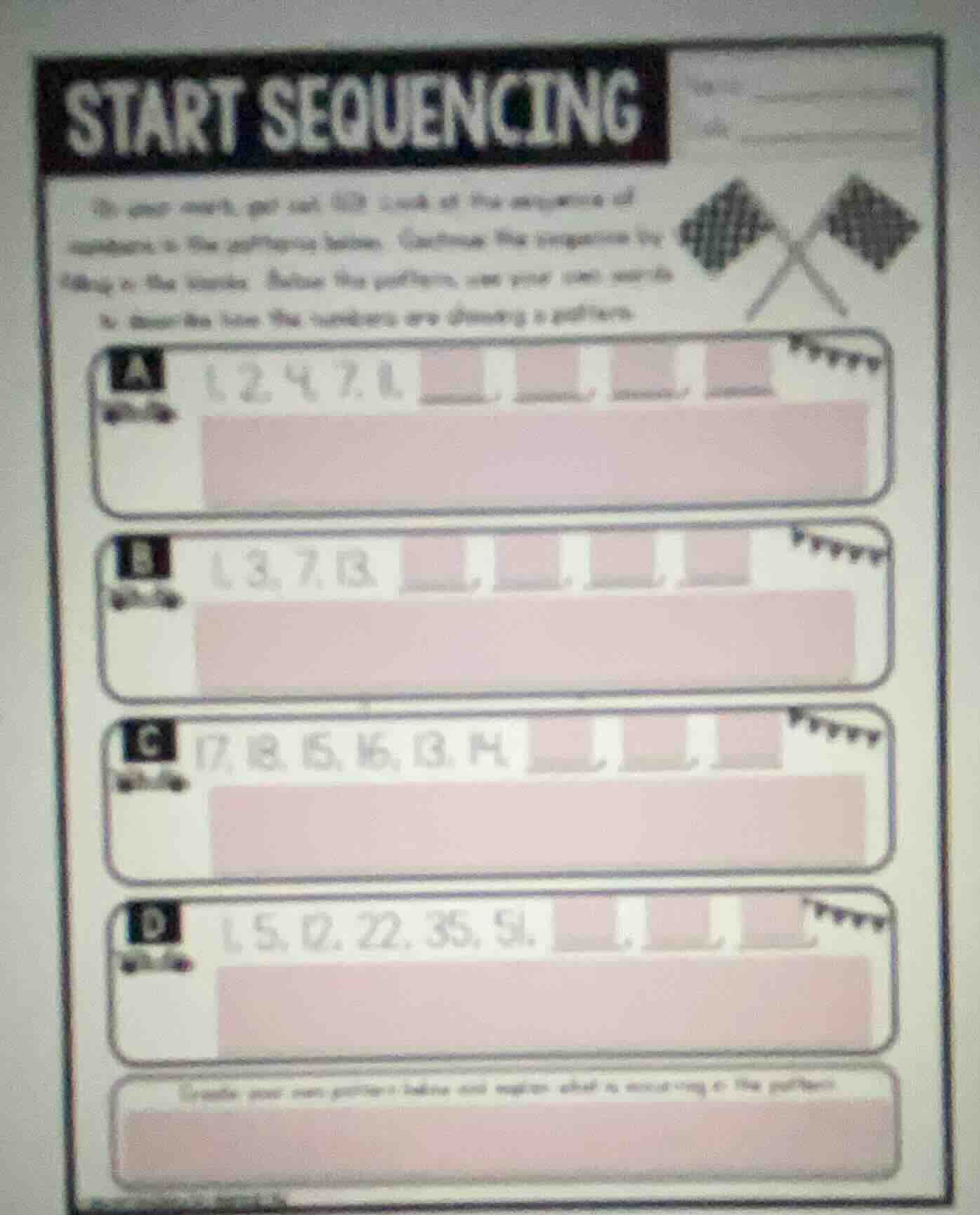
start sequencing
to start, get set! look at the sequence of numbers in the patterns below. continue the sequence by filling in the blanks. below the pattern, use your own words to describe how the numbers are forming a pattern.
a: 1, 2, 4, 7, 11, __, , , __
b: 1, 3, 7, 13, __, , , __
c: 17, 18, 15, 16, 13, 14, __, , __
d: 1, 5, 12, 22, 35, 51, __, , __
create your own pattern below and explain what is occurring in the pattern?
Sequence A: 1, 2, 4, 7, 11,...
Step1: Find the pattern of differences
The differences between consecutive terms: \(2 - 1 = 1\), \(4 - 2 = 2\), \(7 - 4 = 3\), \(11 - 7 = 4\). So the difference increases by 1 each time.
Step2: Calculate the next terms
Next difference after 4 is \(5\), so next term: \(11 + 5 = 16\)
Next difference: \(6\), term: \(16 + 6 = 22\)
Next difference: \(7\), term: \(22 + 7 = 29\)
Next difference: \(8\), term: \(29 + 8 = 37\)
Step1: Find the pattern of differences
Differences: \(3 - 1 = 2\), \(7 - 3 = 4\), \(13 - 7 = 6\). The difference increases by 2 each time.
Step2: Calculate the next terms
Next difference: \(8\), term: \(13 + 8 = 21\)
Next difference: \(10\), term: \(21 + 10 = 31\)
Next difference: \(12\), term: \(31 + 12 = 43\)
Next difference: \(14\), term: \(43 + 14 = 57\)
Step1: Identify the alternating pattern
Odd - numbered terms (1st, 3rd, 5th...): \(17, 15, 13\) (decrease by 2). Even - numbered terms (2nd, 4th, 6th...): \(18, 16, 14\) (decrease by 2).
Step2: Calculate the next terms
7th term (odd - numbered): \(13 - 2 = 11\)
8th term (even - numbered): \(14 - 2 = 12\)
9th term (odd - numbered): \(11 - 2 = 9\)

Snap & solve any problem in the app
Get step-by-step solutions on Sovi AI
Photo-based solutions with guided steps
Explore more problems and detailed explanations
16, 22, 29, 37