QUESTION IMAGE
Question
stickleba final quiz
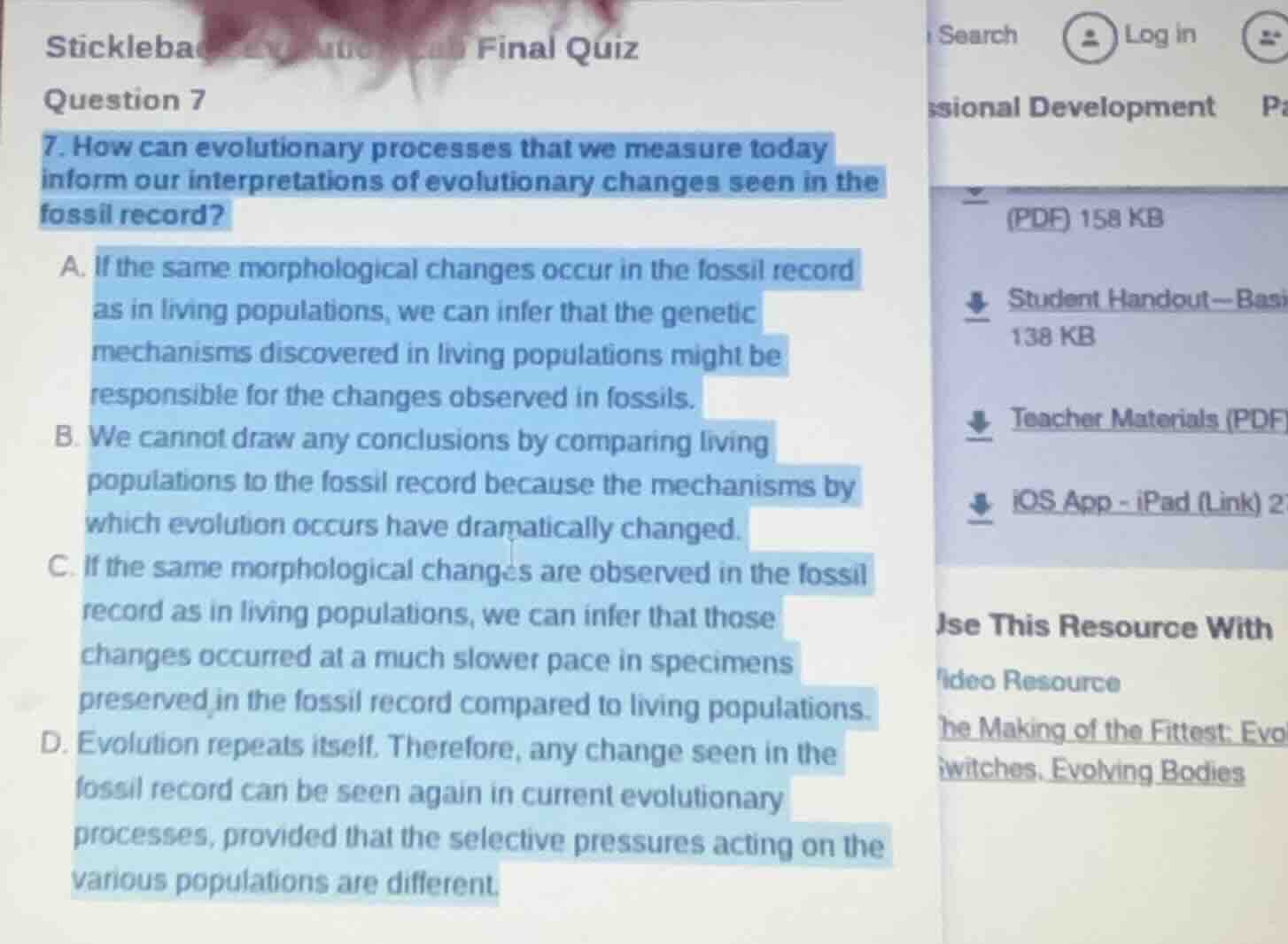
question 7
- how can evolutionary processes that we measure today inform our interpretations of evolutionary changes seen in the fossil record?
a. if the same morphological changes occur in the fossil record as in living populations, we can infer that the genetic mechanisms discovered in living populations might be responsible for the changes observed in fossils.
b. we cannot draw any conclusions by comparing living populations to the fossil record because the mechanisms by which evolution occurs have dramatically changed.
c. if the same morphological changes are observed in the fossil record as in living populations, we can infer that those changes occurred at a much slower pace in specimens preserved in the fossil record compared to living populations.
d. evolution repeats itself. therefore, any change seen in the fossil record can be seen again in current evolutionary processes, provided that the selective pressures acting on the various populations are different.
To solve this, we analyze each option:
- Option A: When similar morphological changes are seen in fossils and living populations, it's reasonable to infer that the genetic mechanisms (identified in living populations) could be responsible for fossil changes. This aligns with how we use modern evolutionary data to interpret fossils.
- Option B: Stating we can't draw conclusions is incorrect, as evolutionary mechanisms are consistent over time (e.g., natural selection, genetic drift).
- Option C: There's no basis to assume fossil changes are slower; the rate can vary, and this isn't a valid inference from morphological similarity.
- Option D: Evolution doesn't "repeat" in a deterministic way, and the claim about selective pressures being different for repetition is illogical (similar pressures would be more likely for similar changes).

Snap & solve any problem in the app
Get step-by-step solutions on Sovi AI
Photo-based solutions with guided steps
Explore more problems and detailed explanations
A. If the same morphological changes occur in the fossil record as in living populations, we can infer that the genetic mechanisms discovered in living populations might be responsible for the changes observed in fossils.