QUESTION IMAGE
Question
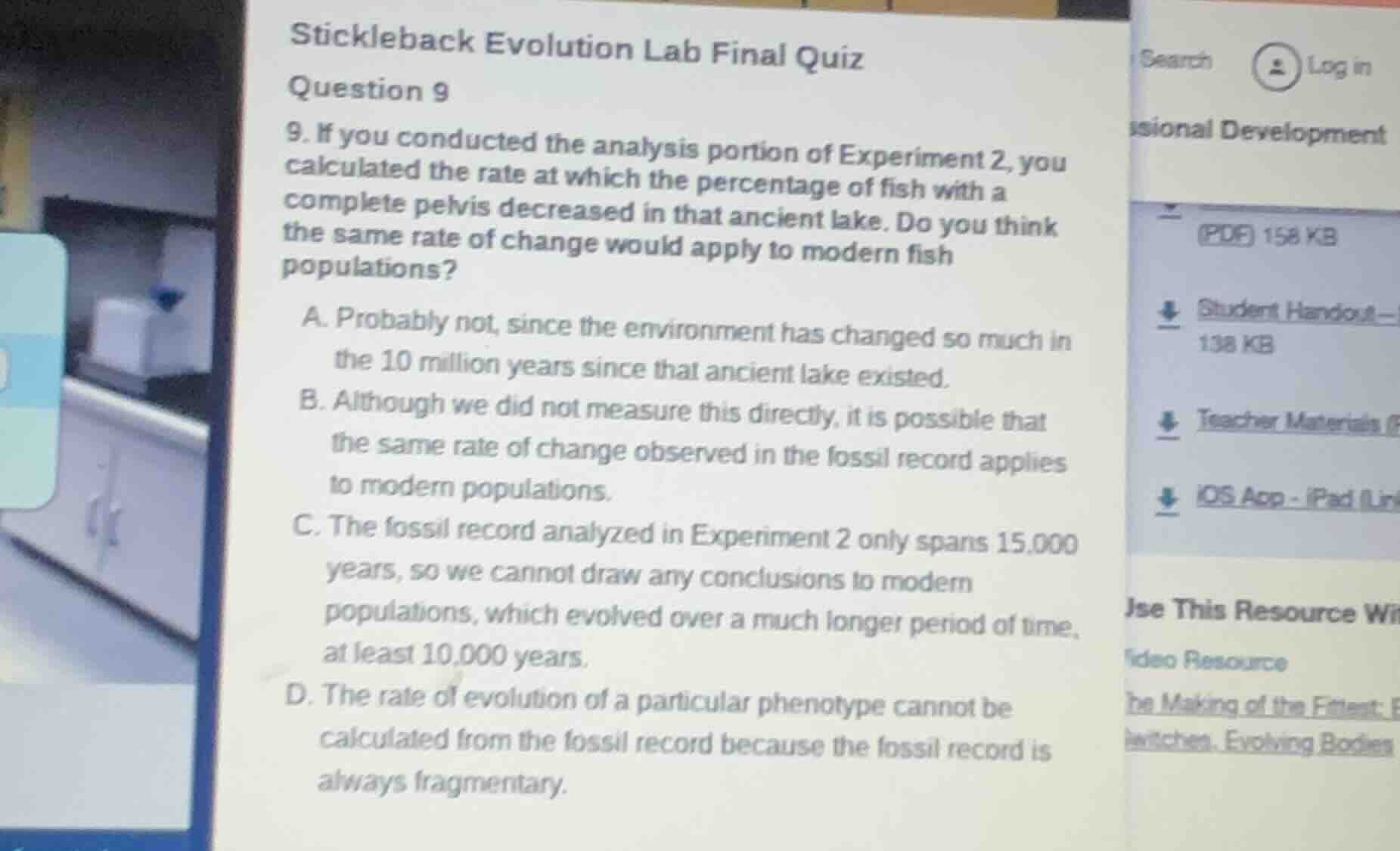
stickleback evolution lab final quiz
question 9
- if you conducted the analysis portion of experiment 2, you calculated the rate at which the percentage of fish with a complete pelvis decreased in that ancient lake. do you think the same rate of change would apply to modern fish populations?
a. probably not, since the environment has changed so much in the 10 million years since that ancient lake existed.
b. although we did not measure this directly, it is possible that the same rate of change observed in the fossil record applies to modern populations.
c. the fossil record analyzed in experiment 2 only spans 15,000 years, so we cannot draw any conclusions to modern populations, which evolved over a much longer period of time, at least 10,000 years.
d. the rate of evolution of a particular phenotype cannot be calculated from the fossil record because the fossil record is always fragmentary.
To determine the answer, we analyze each option:
- Option A: Evolutionary rates depend on environmental factors. Over 10 million years, the environment has likely changed significantly, so the rate of change in the ancient lake may not apply to modern fish. This is a valid point about environmental influence on evolution.
- Option B: Stating it's possible the rate applies is less likely because environmental changes over such a long time would likely alter selective pressures, so this option is not as strong.
- Option C: The fossil record in Experiment 2 (15,000 years) and modern populations' evolution time (at least 10,000 years) – the time span logic here is flawed as 15,000 years is comparable to 10,000 years, and the main issue is environmental change, not just time span.
- Option D: The fossil record can be used to calculate evolutionary rates (e.g., in stickleback studies, fossil records help track pelvic structure evolution), so this statement is incorrect.

Snap & solve any problem in the app
Get step-by-step solutions on Sovi AI
Photo-based solutions with guided steps
Explore more problems and detailed explanations
A. Probably not, since the environment has changed so much in the 10 million years since that ancient lake existed.