QUESTION IMAGE
Question
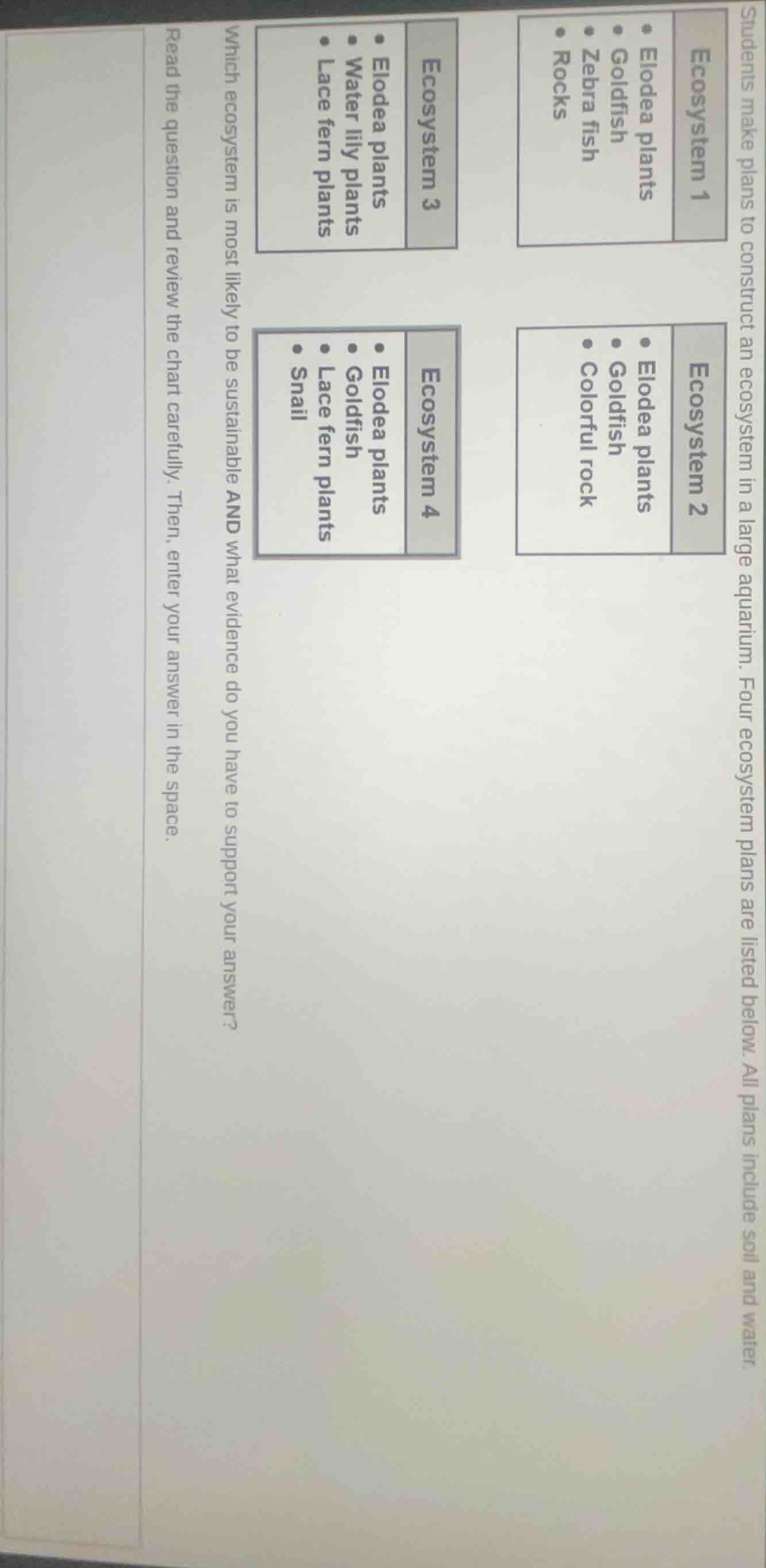
students make plans to construct an ecosystem in a large aquarium. four ecosystem plans are listed below. all plans include soil and water.
ecosystem 1
- elodea plants
- goldfish
- zebra fish
- rocks
ecosystem 2
- elodea plants
- goldfish
- colorful rock
ecosystem 3
- elodea plants
- water lily plants
- lace fern plants
ecosystem 4
- elodea plants
- goldfish
- lace fern plants
- snail
read the question and review the chart carefully. then, enter your answer in the space.
which ecosystem is most likely to be sustainable and what evidence do you have to support your answer?
A sustainable ecosystem needs a balanced food web (producers, consumers, decomposers or detritivores) and diverse species for stability. Ecosystem 4 has Elodea (producer), Lace fern (producer), Goldfish (consumer), and Snail (detritivore/consumer). It has multiple producers (supporting energy flow) and a detritivore (recycles nutrients), while others lack detritivores or have fewer producers. Ecosystem 1: 2 consumers (Goldfish, Zebra fish) but only 1 producer (Elodea) – may lack enough energy. Ecosystem 2: 1 consumer (Goldfish), 1 producer, and non - living (colorful rock) – limited diversity. Ecosystem 3: 3 producers (Elodea, Water lily, Lace fern) but no consumers or detritivores – energy not transferred. Ecosystem 4 has producers (Elodea, Lace fern) for energy, Goldfish (consumer) to eat plants, and Snail (detritivore) to break down organic matter, recycling nutrients, creating a more balanced flow of energy and nutrients, so it’s more sustainable.

Snap & solve any problem in the app
Get step-by-step solutions on Sovi AI
Photo-based solutions with guided steps
Explore more problems and detailed explanations
Ecosystem 4 is most likely to be sustainable. Evidence: It has multiple producers (Elodea plants, Lace fern plants) for energy, a consumer (Goldfish) to utilize plant energy, and a snail (detritivore) to recycle nutrients from organic matter, creating a balanced flow of energy and nutrients. Other ecosystems lack this balance: Ecosystem 1 has too many consumers for one producer; Ecosystem 2 has limited diversity; Ecosystem 3 has no consumers/detritivores to transfer energy.