QUESTION IMAGE
Question
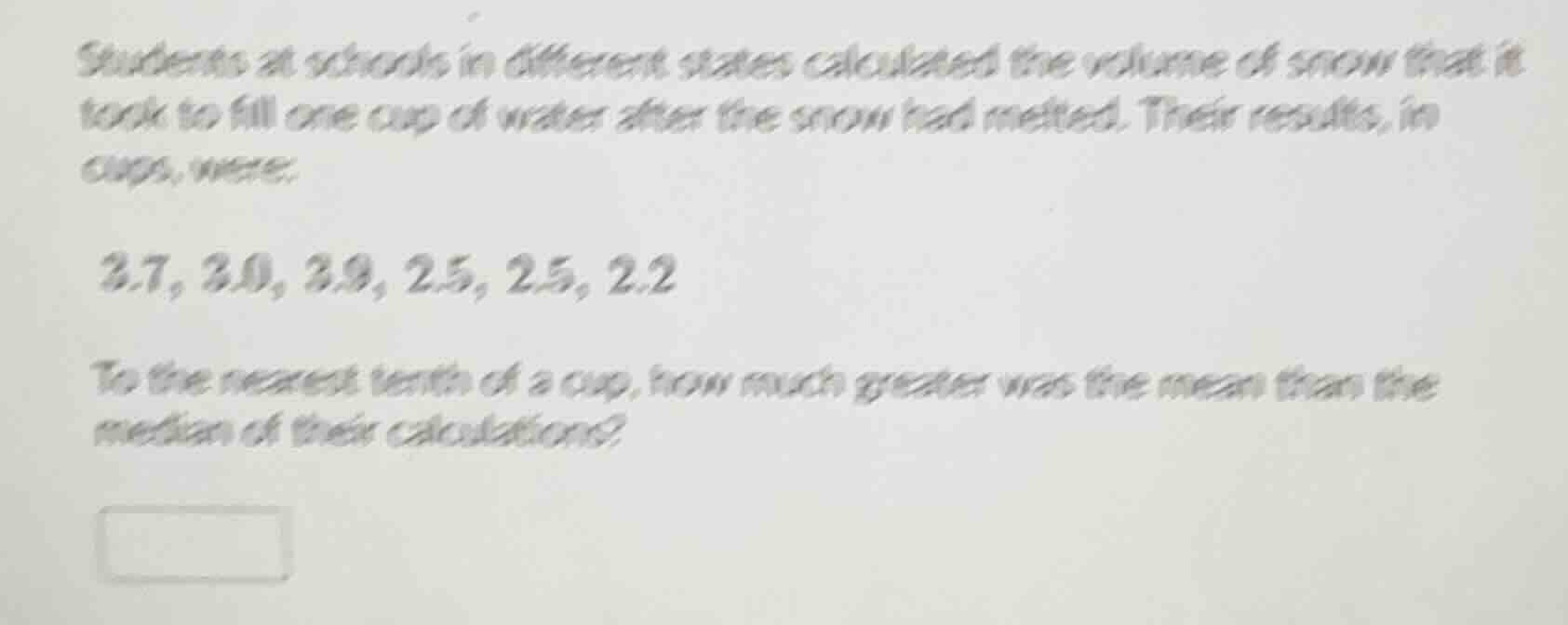
students at schools in different states calculated the volume of snow that it took to fill one cup of water after the snow had melted. their results, in cups, were: 3.7, 3.0, 3.9, 2.5, 2.5, 2.2 to the nearest tenth of a cup, how much greater was the mean than the median of their calculations?
Step1: Calculate the mean
First, find the sum of the data set: \(3.7 + 3.0 + 3.9 + 2.5 + 2.5 + 2.2\). Let's compute that: \(3.7+3.0 = 6.7\), \(6.7+3.9 = 10.6\), \(10.6+2.5 = 13.1\), \(13.1+2.5 = 15.6\), \(15.6+2.2 = 17.8\). Then, the mean is the sum divided by the number of data points (which is 6). So, mean \(=\frac{17.8}{6}\approx 2.9667\).
Step2: Calculate the median
First, order the data set: \(2.2, 2.5, 2.5, 3.0, 3.7, 3.9\). Since there are 6 (an even number) data points, the median is the average of the 3rd and 4th values. The 3rd value is \(2.5\) and the 4th value is \(3.0\). So, median \(=\frac{2.5 + 3.0}{2}=\frac{5.5}{2}=2.75\).
Step3: Find the difference
Subtract the median from the mean: \(2.9667 - 2.75 = 0.2167\). Round to the nearest tenth: \(0.2\) (wait, no, wait, let's check the calculations again. Wait, mean calculation: sum is \(3.7+3.0=6.7\), \(6.7+3.9=10.6\), \(10.6+2.5=13.1\), \(13.1+2.5=15.6\), \(15.6+2.2=17.8\). Mean: \(17.8\div6\approx2.9667\approx3.0\) (wait, no, 17.8 divided by 6: 6*2=12, 17.8-12=5.8, 5.8/6≈0.9667, so total mean≈2.9667, which is approximately 3.0 when rounded to the nearest tenth? Wait, no, the question says "to the nearest tenth of a cup, how much greater was the mean than the median". Wait, let's recalculate mean:
Sum: \(3.7 + 3.0 = 6.7\); \(6.7 + 3.9 = 10.6\); \(10.6 + 2.5 = 13.1\); \(13.1 + 2.5 = 15.6\); \(15.6 + 2.2 = 17.8\). Mean: \(17.8 / 6 ≈ 2.9667\) (which is approximately 3.0 when rounded to the nearest tenth? Wait, no, 2.9667 to the nearest tenth is 3.0? Wait, 2.9667: the tenths place is 9, the hundredths is 6, so we round up the tenths place: 2.9 + 0.1 = 3.0? Wait, no, 2.9667 is 2.9 (tenths place) with 6 in hundredths, so round up: 3.0? Wait, no, 2.9667 is approximately 3.0 when rounded to the nearest tenth? Wait, no, 2.9667: the first decimal is 9, second is 6, so 2.9667 ≈ 3.0? Wait, no, 2.9667 is 2.97 when rounded to two decimals, to the nearest tenth: look at the hundredths digit (6), which is more than 5, so we round the tenths digit (9) up, which makes it 3.0? Wait, 2.9 + 0.1 = 3.0. Then median: 2.75, which to the nearest tenth is 2.8? Wait, no, the question says "to the nearest tenth of a cup, how much greater was the mean than the median". Wait, maybe I made a mistake in rounding. Wait, mean is approximately 2.9667, median is 2.75. The difference is 2.9667 - 2.75 = 0.2167. Rounded to the nearest tenth: 0.2? Wait, no, 0.2167 is closer to 0.2 or 0.3? The hundredths digit is 1, which is less than 5, so we round down to 0.2? Wait, no, 0.2167: the tenths place is 2, hundredths is 1, so to the nearest tenth, it's 0.2. Wait, but let's check the mean again. Wait, sum is 3.7 + 3.0 + 3.9 + 2.5 + 2.5 + 2.2. Let's add again: 3.7 + 3.0 = 6.7; 6.7 + 3.9 = 10.6; 10.6 + 2.5 = 13.1; 13.1 + 2.5 = 15.6; 15.6 + 2.2 = 17.8. 17.8 divided by 6: 6*2=12, 17.8-12=5.8, 5.8/6=0.966..., so 2.966..., which is 3.0 when rounded to the nearest tenth? Wait, 2.966... is 3.0 when rounded to the nearest tenth? Because the hundredths digit is 6, which is more than 5, so we round the tenths digit (9) up, which makes it 3.0. Then median: 2.75, which is 2.8 when rounded to the nearest tenth? Wait, no, 2.75 to the nearest tenth: the hundredths digit is 5, so we round the tenths digit (7) up to 8, so 2.8. Then the difference is 3.0 - 2.8 = 0.2? Wait, no, that's conflicting with the previous calculation. Wait, maybe the question is asking for the difference before rounding? Wait, no, the question says "to the nearest tenth of a cup, how much greater was the mean than the median". So we need to calculate t…

Snap & solve any problem in the app
Get step-by-step solutions on Sovi AI
Photo-based solutions with guided steps
Explore more problems and detailed explanations
\(0.2\)