QUESTION IMAGE
Question
studysync
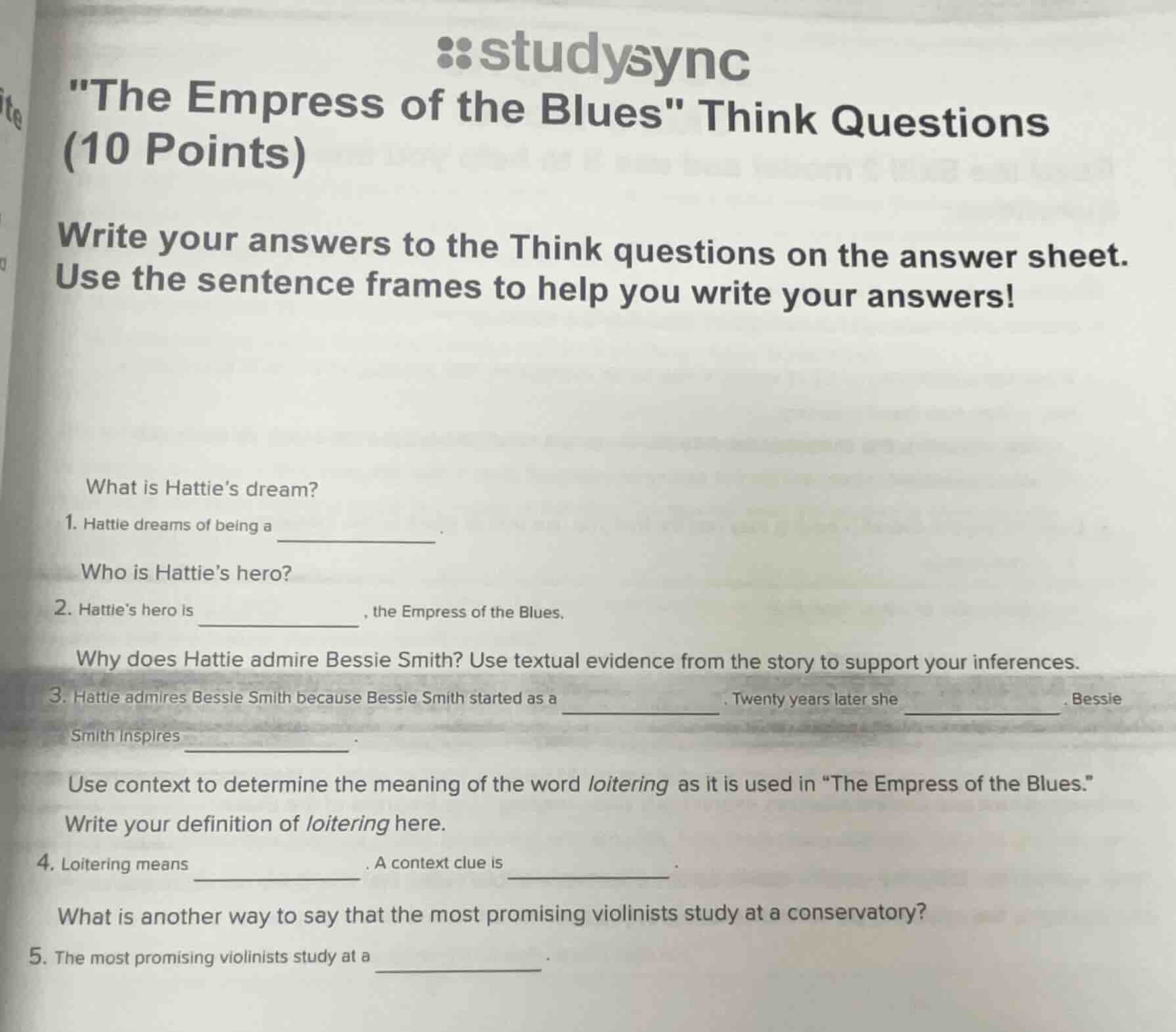
\the empress of the blues\ think questions
(10 points)
write your answers to the think questions on the answer sheet.
use the sentence frames to help you write your answers!
what is hattie’s dream?
- hattie dreams of being a __________.
who is hattie’s hero?
- hattie’s hero is __________, the empress of the blues.
why does hattie admire bessie smith? use textual evidence from the story to support your inferences.
- hattie admires bessie smith because bessie smith started as a ________. twenty years later she ________. bessie
smith inspires __________.
use context to determine the meaning of the word loitering as it is used in \the empress of the blues.\
write your definition of loitering here.
- loitering means ________. a context clue is ________.
what is another way to say that the most promising violinists study at a conservatory?
- the most promising violinists study at a __________.
To answer these questions, we need to refer to the text "The Empress of the Blues" (since the specific text isn't provided here, we'll give general guidance based on typical content for such a story):
Question 1: What is Hattie’s dream?
In stories like this, Hattie often dreams of being a musician (or singer, specifically a blues singer) (matching the “Empress of the Blues” theme).
Question 2: Who is Hattie’s hero?
The “Empress of the Blues” is a title for Bessie Smith, so Hattie’s hero is Bessie Smith.
Question 3: Why does Hattie admire Bessie Smith?
Bessie Smith likely started as a street performer (or poor/unknown artist) and later became successful (e.g., “Twenty years later she became famous/the Empress of the Blues”). She inspires Hattie to pursue her own musical dreams (or shows that hard work leads to success).
Question 4: Meaning of “loitering”
“Loitering” means lingering/standing around without purpose. A context clue might be a sentence like “Don’t loiter on the street” (implying idleness) or a description of people hanging around.
Question 5: Rewording the sentence
The most promising violinists study at a conservatory (so rephrased: “A conservatory is where the most promising violinists study”).
If you have the actual text, you can fill in the blanks with evidence from it (e.g., for Q3, find lines about Bessie’s journey; for Q4, find the sentence with “loitering” to identify context clues).
For example, with typical story details:
- Hattie dreams of being a singer (or blues singer).
- Hattie’s hero is Bessie Smith, the Empress of the Blues.
- Hattie admires Bessie Smith because Bessie Smith started as a street performer. Twenty years later she became the Empress of the Blues (or a famous blues singer). Bessie Smith inspires Hattie to follow her musical dreams (or shows that hard work pays off).
- Loitering means standing around without a clear purpose (or idling). A context clue is “Hattie was told not to loiter near the theater” (or similar from the text).
- The most promising violinists study at a conservatory (so the rephrased sentence is: “A conservatory is where the most promising violinists study”).
To complete the blanks, use the text’s specific details!

Snap & solve any problem in the app
Get step-by-step solutions on Sovi AI
Photo-based solutions with guided steps
Explore more problems and detailed explanations
To answer these questions, we need to refer to the text "The Empress of the Blues" (since the specific text isn't provided here, we'll give general guidance based on typical content for such a story):
Question 1: What is Hattie’s dream?
In stories like this, Hattie often dreams of being a musician (or singer, specifically a blues singer) (matching the “Empress of the Blues” theme).
Question 2: Who is Hattie’s hero?
The “Empress of the Blues” is a title for Bessie Smith, so Hattie’s hero is Bessie Smith.
Question 3: Why does Hattie admire Bessie Smith?
Bessie Smith likely started as a street performer (or poor/unknown artist) and later became successful (e.g., “Twenty years later she became famous/the Empress of the Blues”). She inspires Hattie to pursue her own musical dreams (or shows that hard work leads to success).
Question 4: Meaning of “loitering”
“Loitering” means lingering/standing around without purpose. A context clue might be a sentence like “Don’t loiter on the street” (implying idleness) or a description of people hanging around.
Question 5: Rewording the sentence
The most promising violinists study at a conservatory (so rephrased: “A conservatory is where the most promising violinists study”).
If you have the actual text, you can fill in the blanks with evidence from it (e.g., for Q3, find lines about Bessie’s journey; for Q4, find the sentence with “loitering” to identify context clues).
For example, with typical story details:
- Hattie dreams of being a singer (or blues singer).
- Hattie’s hero is Bessie Smith, the Empress of the Blues.
- Hattie admires Bessie Smith because Bessie Smith started as a street performer. Twenty years later she became the Empress of the Blues (or a famous blues singer). Bessie Smith inspires Hattie to follow her musical dreams (or shows that hard work pays off).
- Loitering means standing around without a clear purpose (or idling). A context clue is “Hattie was told not to loiter near the theater” (or similar from the text).
- The most promising violinists study at a conservatory (so the rephrased sentence is: “A conservatory is where the most promising violinists study”).
To complete the blanks, use the text’s specific details!