QUESTION IMAGE
Question
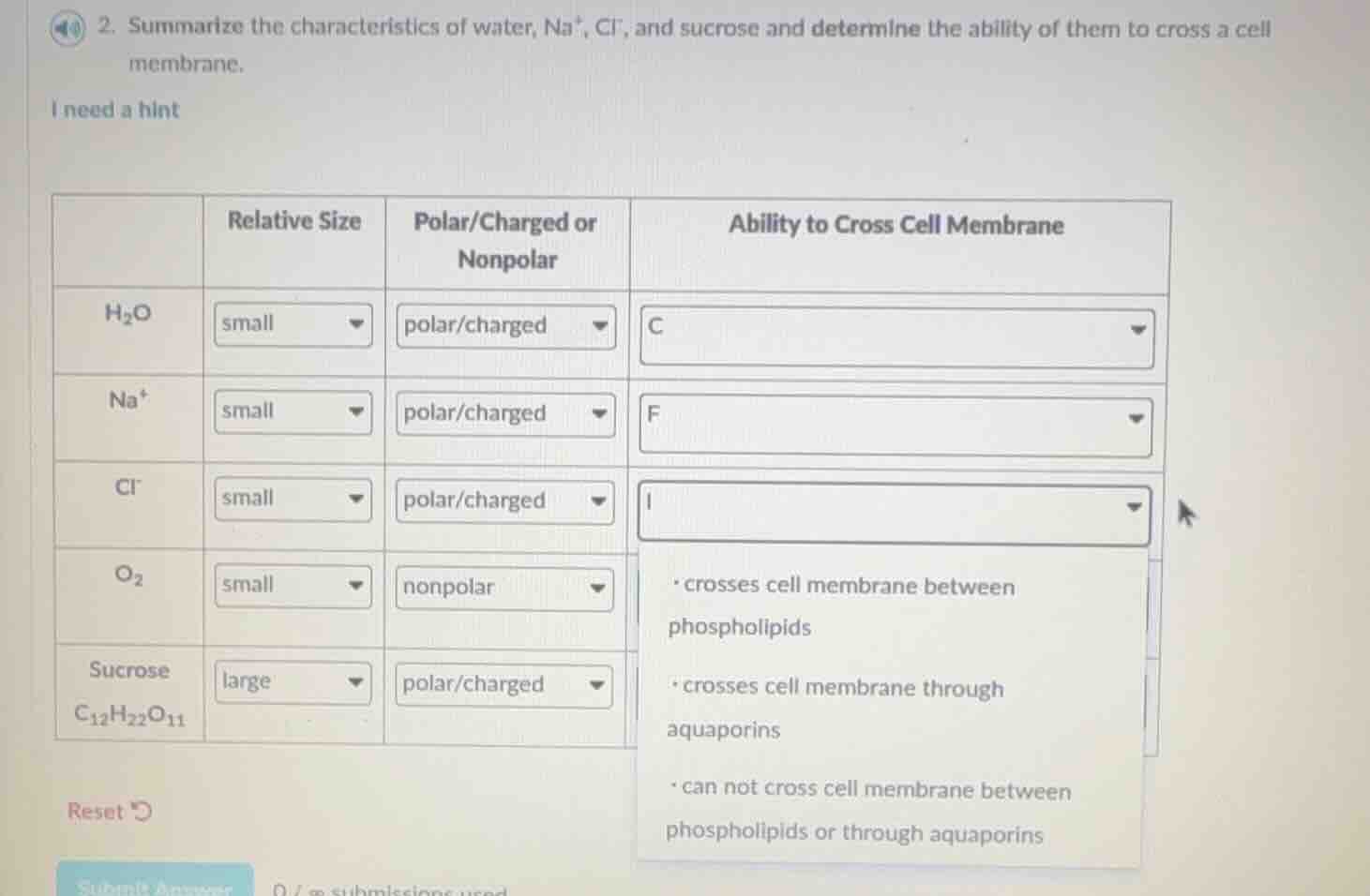
- summarize the characteristics of water, na⁺, cl⁻, and sucrose and determine the ability of them to cross a cell membrane.
i need a hint
relative size | polar/charged or nonpolar | ability to cross cell membrane
--- | --- | ---
h₂o | small | polar/charged | c
na⁺ | small | polar/charged | f
cl⁻ | small | polar/charged | i
o₂ | small | nonpolar |
sucrose c₁₂h₂₂o₁₁ | large | polar/charged |
· crosses cell membrane between phospholipids
· crosses cell membrane through aquaporins
· can not cross cell membrane between phospholipids or through aquaporins
reset
submit answer 0 / 8 submissions used
Brief Explanations
- Water (H₂O): Small polar molecules cross cell membranes through specialized channel proteins called aquaporins, as they cannot easily pass through the nonpolar phospholipid bilayer directly.
- Sodium ion (Na⁺): Charged ions cannot diffuse through the phospholipid bilayer or aquaporins; they require specific ion channels (not listed in the options, but the only remaining valid choice for charged small particles is the option indicating they cannot cross via the two listed pathways).
- Chloride ion (Cl⁻): Like other charged ions, it cannot cross the cell membrane through the phospholipid bilayer or aquaporins, as charged particles are repelled by the nonpolar bilayer and aquaporins only transport water.
- Oxygen (O₂): Small nonpolar molecules can freely diffuse directly between the phospholipids of the cell membrane, as they are compatible with the nonpolar interior of the bilayer.
- Sucrose (C₁₂H₂₂O₁₁): Large polar molecules are too big for aquaporins and cannot pass through the nonpolar phospholipid bilayer, so they cannot cross via either of the listed pathways.

Snap & solve any problem in the app
Get step-by-step solutions on Sovi AI
Photo-based solutions with guided steps
Explore more problems and detailed explanations
| Substance | Ability to Cross Cell Membrane |
|---|---|
| Na⁺ | can not cross cell membrane between phospholipids or through aquaporins |
| Cl⁻ | can not cross cell membrane between phospholipids or through aquaporins |
| O₂ | crosses cell membrane between phospholipids |
| Sucrose (C₁₂H₂₂O₁₁) | can not cross cell membrane between phospholipids or through aquaporins |