QUESTION IMAGE
Question
summary:
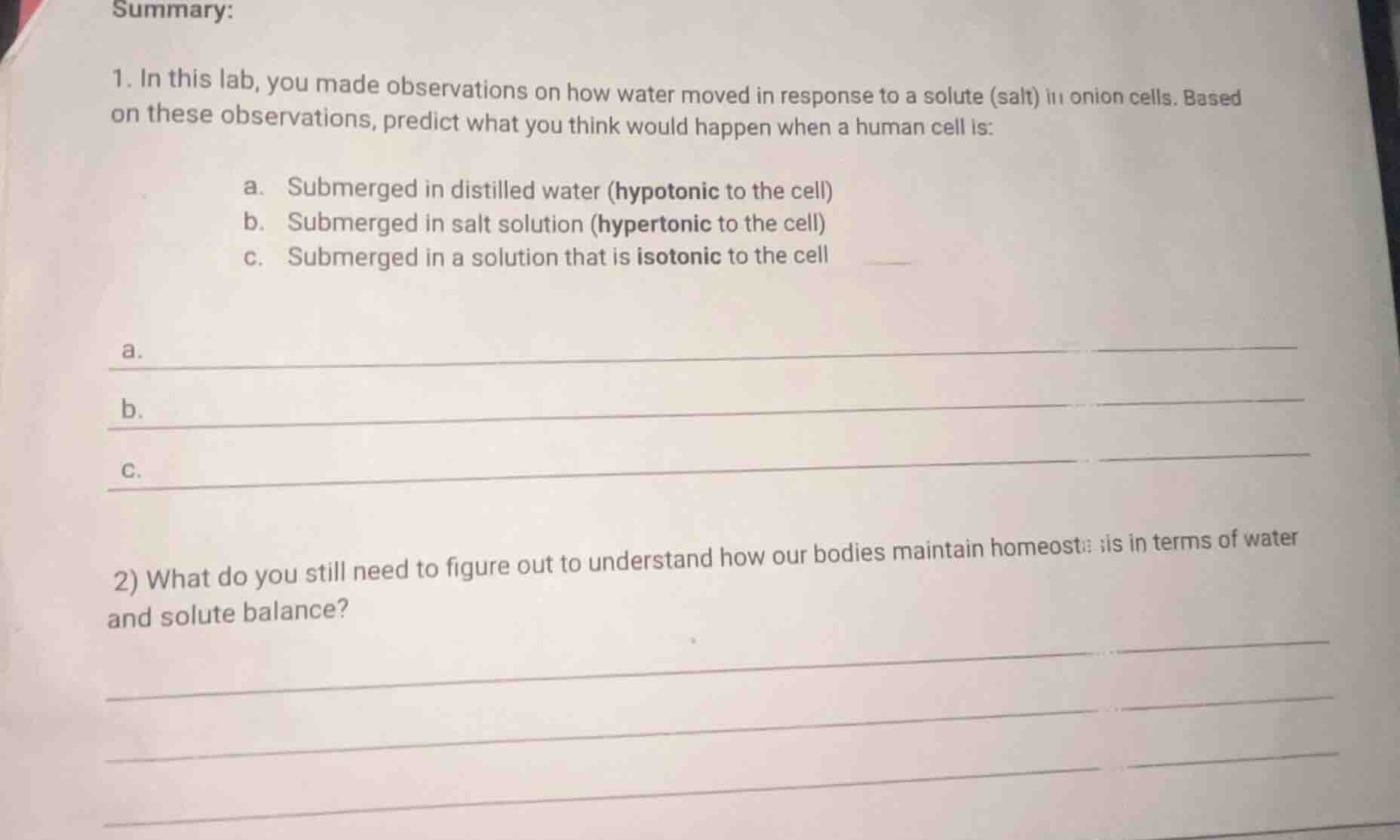
- in this lab, you made observations on how water moved in response to a solute (salt) in onion cells. based on these observations, predict what you think would happen when a human cell is:
a. submerged in distilled water (hypotonic to the cell)
b. submerged in salt solution (hypertonic to the cell)
c. submerged in a solution that is isotonic to the cell
a.
b.
c.
- what do you still need to figure out to understand how our bodies maintain homeostasis in terms of water and solute balance?
- For the human cell scenarios:
a. Distilled water has a lower solute concentration than the human cell (hypotonic). Water moves into the cell via osmosis. Unlike plant cells with cell walls, human cells lack this rigid structure, so they swell and will eventually burst.
b. A salt solution has a higher solute concentration than the human cell (hypertonic). Water moves out of the cell via osmosis, causing the cell to shrink and shrivel.
c. An isotonic solution has the same solute concentration as the human cell. There is no net movement of water, so the cell maintains its normal shape and size.
- To understand bodily water and solute homeostasis, key unknowns include how specific organs (like kidneys, skin, and intestines) coordinate their water/solute transport actions, how hormonal signals (such as ADH and aldosterone) are precisely regulated in response to changing internal/external conditions, and how individual cell membrane transport proteins are controlled to support whole-body balance.

Snap & solve any problem in the app
Get step-by-step solutions on Sovi AI
Photo-based solutions with guided steps
Explore more problems and detailed explanations
1.
a. The cell will swell and eventually burst as water moves into it via osmosis.
b. The cell will shrink and shrivel as water moves out of it via osmosis.
c. The cell will maintain its normal shape and size with no net water movement.
- Examples include: How do organs like the kidneys, skin, and intestines coordinate to adjust water and solute levels? How do hormonal signals (e.g., ADH, aldosterone) respond to changes in the body's water/solute balance to trigger corrective actions? How are cell membrane transport proteins regulated to support overall bodily homeostasis?