QUESTION IMAGE
Question
summary
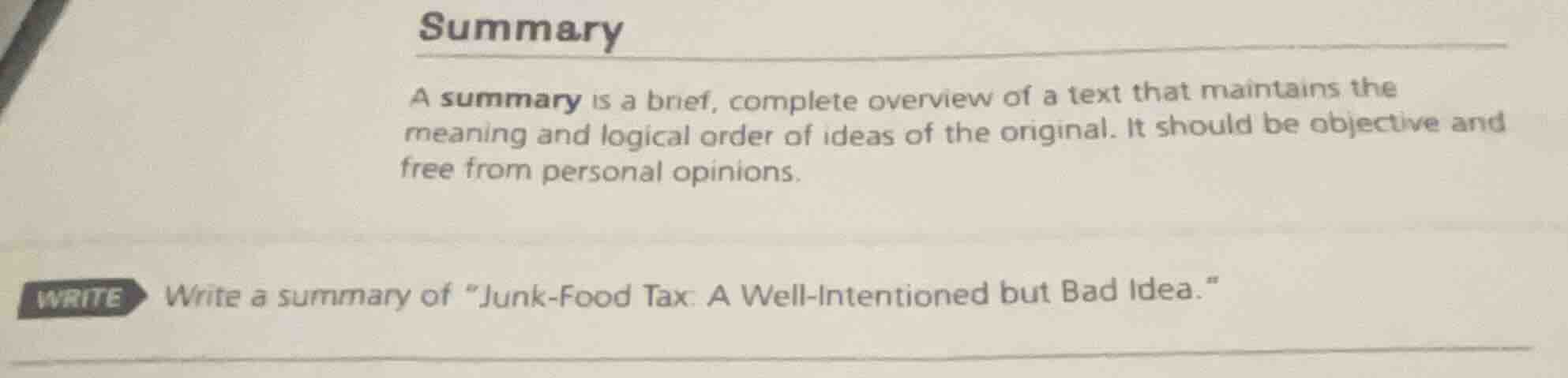
a summary is a brief, complete overview of a text that maintains the meaning and logical order of ideas of the original. it should be objective and free from personal opinions.
write write a summary of \junk - food tax: a well - intentioned but bad idea.\
To write a summary of "Junk - Food Tax: A Well - Intentioned but Bad Idea", we need to follow the definition of a summary. Since the original text (which we don't have the full content of) is titled "Junk - Food Tax: A Well - Intentioned but Bad Idea", we can assume that it likely presents the argument that while the idea of a junk - food tax has good intentions (maybe to improve public health by reducing junk - food consumption), it is a bad idea. The reasons could include that it disproportionately affects lower - income groups (as junk food is often more affordable and a staple for those with less money), it doesn't address the root causes of junk - food consumption (like lack of access to healthy food options, marketing of junk food to children), or it creates a black market for junk food. A summary would briefly state the main argument (junk - food tax is well - intentioned but bad) and the key supporting points from the text, while being objective and concise.
However, since we don't have the full text of "Junk - Food Tax: A Well - Intentioned but Bad Idea", here is a general framework for the summary:
- Identify the main claim: The author argues that a junk - food tax, though well - intentioned (probably to improve health), is a bad idea.
- Extract key reasons: For example, if the text says it burdens low - income people, or doesn't solve the underlying issues of unhealthy eating, include those points.
- Combine into a brief overview: A summary of "Junk - Food Tax: A Well - Intentioned but Bad Idea" would state that the proposal of a junk - food tax, aimed at improving public health by reducing junk - food intake, is well - meaning but ultimately a poor idea. The text likely explains this by highlighting drawbacks such as its unfair impact on lower - income individuals, its failure to tackle the core reasons for junk - food consumption (e.g., limited healthy food access, aggressive junk - food marketing), and potential negative economic or social consequences.
If we had the full text, we would extract the main ideas, organize them in the original logical order, and present them concisely and objectively.
For example, if the text was: "A junk - food tax is proposed to cut down on unhealthy eating. While this idea aims to improve public health, it's a bad plan. Low - income families spend a larger share of their income on junk food, so the tax would hurt them more. Also, it doesn't fix why people eat junk food, like not having enough healthy food in their neighborhoods or being bombarded with junk - food ads. So, the tax is well - intentioned but bad."
The summary would be: "The text 'Junk - Food Tax: A Well - Intentioned but Bad Idea' argues that a junk - food tax, intended to reduce unhealthy eating and improve public health, is a flawed proposal. It explains the tax unfairly burdens low - income families (who spend a greater portion of their income on junk food) and fails to address the root causes of junk - food consumption, such as limited healthy food access and extensive junk - food marketing."
Since the actual text isn't provided, the above is a guide on how to write the summary based on the title and common arguments against such a tax.

Snap & solve any problem in the app
Get step-by-step solutions on Sovi AI
Photo-based solutions with guided steps
Explore more problems and detailed explanations
To write a summary of "Junk - Food Tax: A Well - Intentioned but Bad Idea", we need to follow the definition of a summary. Since the original text (which we don't have the full content of) is titled "Junk - Food Tax: A Well - Intentioned but Bad Idea", we can assume that it likely presents the argument that while the idea of a junk - food tax has good intentions (maybe to improve public health by reducing junk - food consumption), it is a bad idea. The reasons could include that it disproportionately affects lower - income groups (as junk food is often more affordable and a staple for those with less money), it doesn't address the root causes of junk - food consumption (like lack of access to healthy food options, marketing of junk food to children), or it creates a black market for junk food. A summary would briefly state the main argument (junk - food tax is well - intentioned but bad) and the key supporting points from the text, while being objective and concise.
However, since we don't have the full text of "Junk - Food Tax: A Well - Intentioned but Bad Idea", here is a general framework for the summary:
- Identify the main claim: The author argues that a junk - food tax, though well - intentioned (probably to improve health), is a bad idea.
- Extract key reasons: For example, if the text says it burdens low - income people, or doesn't solve the underlying issues of unhealthy eating, include those points.
- Combine into a brief overview: A summary of "Junk - Food Tax: A Well - Intentioned but Bad Idea" would state that the proposal of a junk - food tax, aimed at improving public health by reducing junk - food intake, is well - meaning but ultimately a poor idea. The text likely explains this by highlighting drawbacks such as its unfair impact on lower - income individuals, its failure to tackle the core reasons for junk - food consumption (e.g., limited healthy food access, aggressive junk - food marketing), and potential negative economic or social consequences.
If we had the full text, we would extract the main ideas, organize them in the original logical order, and present them concisely and objectively.
For example, if the text was: "A junk - food tax is proposed to cut down on unhealthy eating. While this idea aims to improve public health, it's a bad plan. Low - income families spend a larger share of their income on junk food, so the tax would hurt them more. Also, it doesn't fix why people eat junk food, like not having enough healthy food in their neighborhoods or being bombarded with junk - food ads. So, the tax is well - intentioned but bad."
The summary would be: "The text 'Junk - Food Tax: A Well - Intentioned but Bad Idea' argues that a junk - food tax, intended to reduce unhealthy eating and improve public health, is a flawed proposal. It explains the tax unfairly burdens low - income families (who spend a greater portion of their income on junk food) and fails to address the root causes of junk - food consumption, such as limited healthy food access and extensive junk - food marketing."
Since the actual text isn't provided, the above is a guide on how to write the summary based on the title and common arguments against such a tax.