QUESTION IMAGE
Question
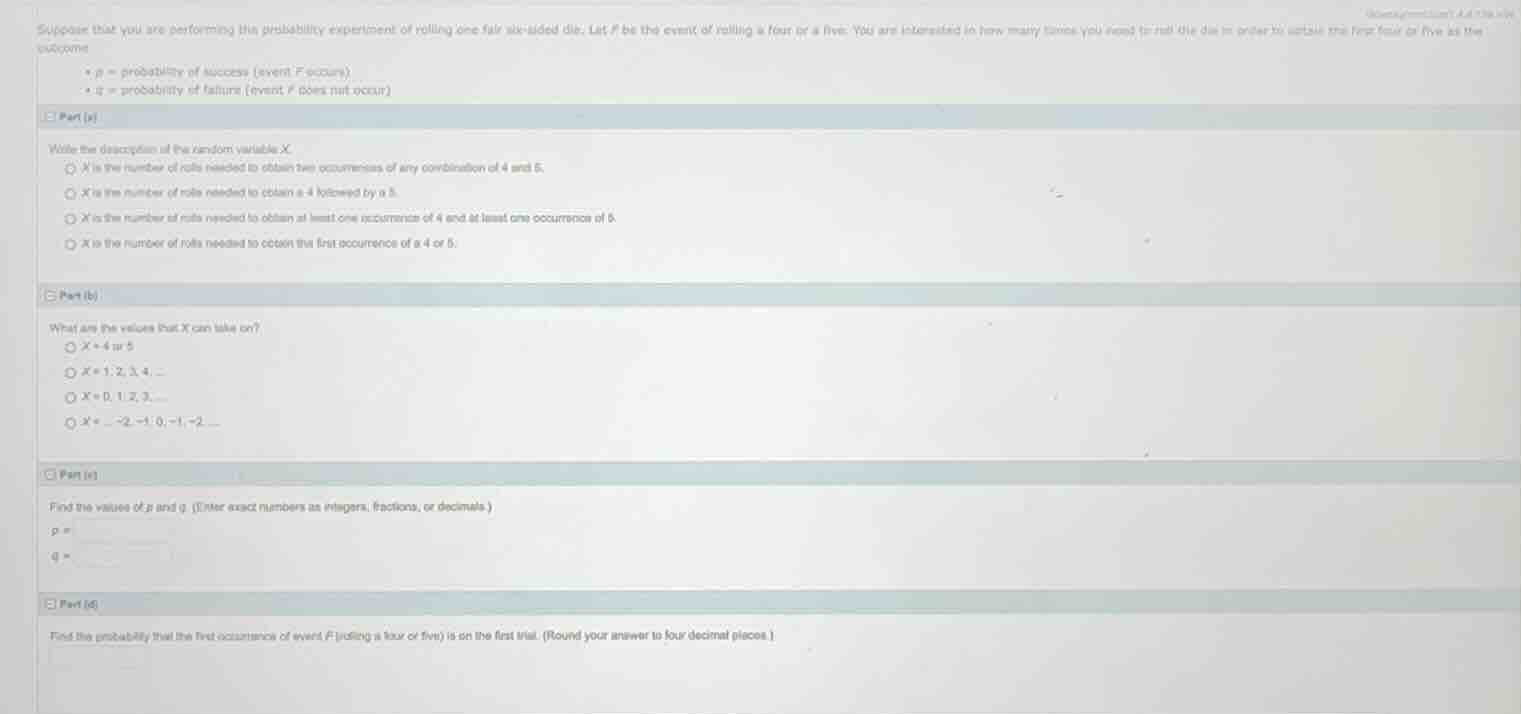
suppose that you are performing the probability experiment of rolling one fair six-sided die. let f be the event of rolling a four or a five. you are interested in how many times you need to roll the die in order to obtain the first four or five as the outcome• p = probability of success (event f occurs)• q = probability of failure (event f does not occur)part (a)write the description of the random variable x.○ x is the number of rolls needed to obtain two occurrences of any combination of 4 and 5.○ x is the number of rolls needed to obtain a 4 followed by a 5.○ x is the number of rolls needed to obtain at least one occurrence of 4 and at least one occurrence of 5.○ x is the number of rolls needed to obtain the first occurrence of a 4 or 5.part (b)what are the values that x can take on?○ x = 4 or 5○ x = 1, 2, 3, 4, ...○ x = 0, 1, 2, 3,...○ x = ...-2, -1, 0, 1, 2,...part (c)find the values of p and q. (enter exact numbers as integers, fractions, or decimals.)p =q =part (d)find the probability that the first occurrence of event f (rolling a four or five) is on the first trial. (round your answer to four decimal places.)
Part (a)
Step1: Identify random variable X
The problem states we are interested in the number of rolls needed to get the first 4 or 5.
Step2: Match correct description
The option "X is the number of rolls needed to obtain the first occurrence of a 4 or 5" matches the definition.
Part (b)
Step1: Define possible roll counts
To get the first success, you could roll once, twice, three times, etc. There is no upper limit, and you can't roll 0 or negative times.
Step2: Select valid values
The set $X=1,2,3,4,...$ is the only valid option.
Part (c)
Step1: Calculate success probability p
A fair die has 6 outcomes. Event F (4 or 5) has 2 favorable outcomes.
$p = \frac{\text{Number of favorable outcomes}}{\text{Total outcomes}} = \frac{2}{6} = \frac{1}{3}$
Step2: Calculate failure probability q
Since $q = 1 - p$, substitute $p=\frac{1}{3}$.
$q = 1 - \frac{1}{3} = \frac{2}{3}$
Part (d)
Step1: Recall geometric probability formula
For the first success on trial 1, the probability is $P(X=1) = p$.
Step2: Substitute p and round
Use $p=\frac{1}{3} \approx 0.3333$ (rounded to 4 decimal places).

Snap & solve any problem in the app
Get step-by-step solutions on Sovi AI
Photo-based solutions with guided steps
Explore more problems and detailed explanations
Part (a): X is the number of rolls needed to obtain the first occurrence of a 4 or 5.
Part (b): $X=1,2,3,4,...$
Part (c): $p=\frac{1}{3}$, $q=\frac{2}{3}$
Part (d): 0.3333