QUESTION IMAGE
Question
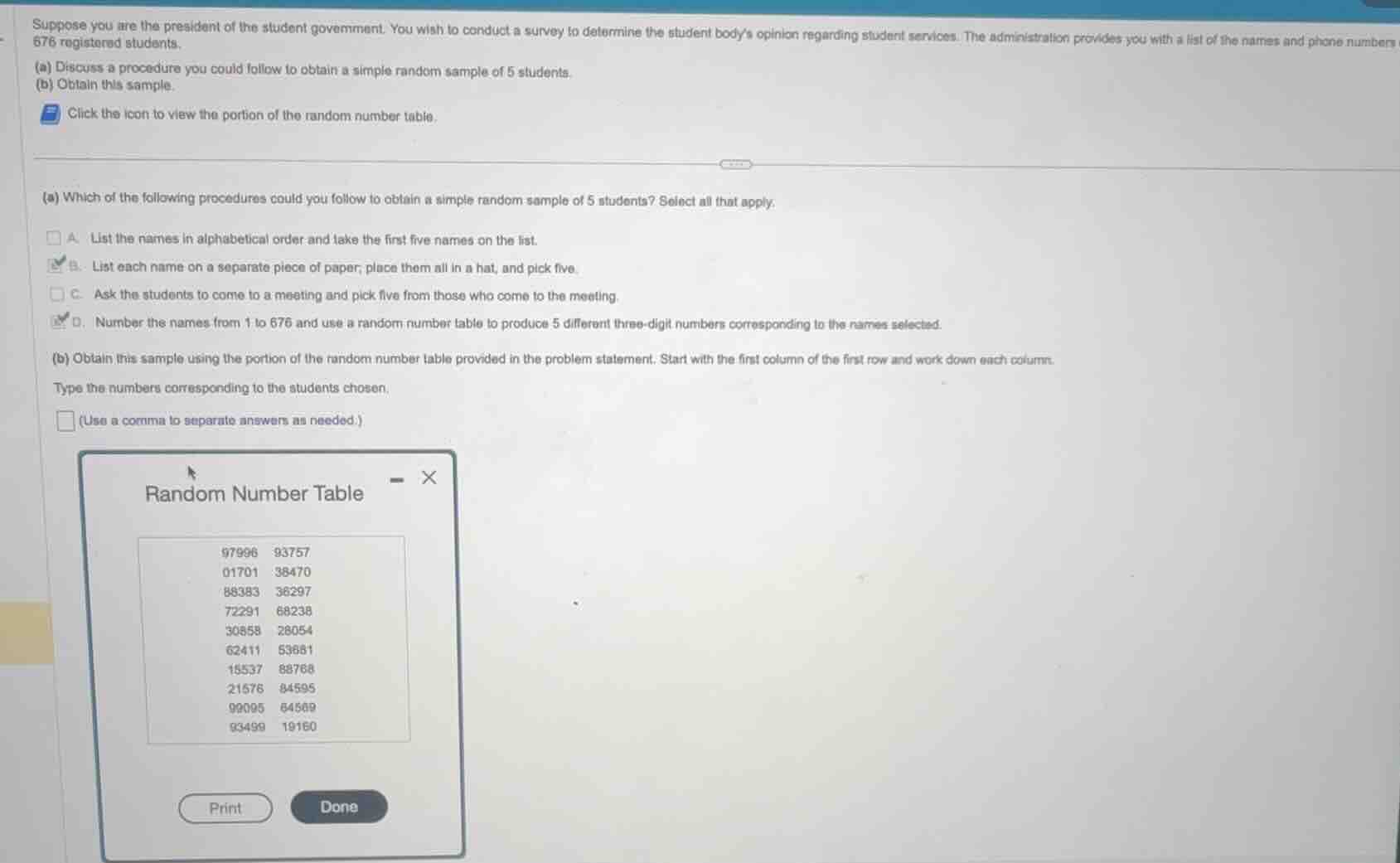
suppose you are the president of the student government. you wish to conduct a survey to determine the student bodys opinion regarding student services. the administration provides you with a list of the names and phone numbers of 676 registered students.
(a) discuss a procedure you could follow to obtain a simple random sample of 5 students.
(b) obtain this sample.
click the icon to view the portion of the random number table.
(a) which of the following procedures could you follow to obtain a simple random sample of 5 students? select all that apply.
a. list the names in alphabetical order and take the first five names on the list.
b. list each name on a separate piece of paper, place them all in a hat, and pick five.
c. ask the students to come to a meeting and pick five from those who come to the meeting.
d. number the names from 1 to 676 and use a random number table to produce 5 different three - digit numbers corresponding to the names selected.
(b) obtain this sample using the portion of the random number table provided in the problem statement. start with the first column of the first row and work down each column.
type the numbers corresponding to the students chosen.
(use a comma to separate answers as needed.)
random number table
97996 93757
01701 38470
88383 36297
72291 68238
30858 28054
62411 53881
15537 88768
21576 84595
99095 84599
93499 19160
print done
Part (a)
- Option A: Taking first five alphabetical names is not random (systematic bias), so incorrect.
- Option B: Drawing names from a hat is a classic simple random sampling method (each has equal chance), so correct.
- Option C: Picking from meeting attendees is a convenience sample (biased, not all have equal chance), so incorrect.
- Option D: Numbering and using random numbers ensures equal chance and random selection, so correct.
Step 1: Understand the range
We need numbers between 1 and 676 (since there are 676 students). We will take three - digit numbers from the random number table, starting from the first column of the first row and moving down each column.
Step 2: Extract numbers from the table
- First column (first row down):
- 979 (too big, >676, skip)
- 017 (valid, 17 ≤ 676)
- 883 (too big, skip)
- 722 (too big, skip)
- 308 (valid, 308 ≤ 676)
- 624 (valid, 624 ≤ 676)
- 155 (valid, 155 ≤ 676)
- 215 (valid, 215 ≤ 676)
- 990 (too big, skip)
- 934 (too big, skip)
- We need 5 valid numbers. Let's list the valid ones in order: 017, 308, 624, 155, 215. Wait, wait, let's check again. Wait, maybe I misread the columns. Wait, the random number table has two columns? Wait, the table is:
First column entries (row - by - row): 97986 (first five digits? Wait, no, the table is presented as two columns? Wait, looking at the table:
Row 1: 97986, 93757
Row 2: 01701, 38470
Row 3: 88383, 36297
Row 4: 72291, 68238
Row 5: 30858, 28054
Row 6: 62411, 53881
Row 7: 15537, 88768
Row 8: 21576, 84595
Row 9: 99095, 84599
Row 10: 93499, 19160
Wait, maybe we should take three - digit numbers. Let's consider each number as five - digit? No, we need three - digit numbers (since 676 is three - digit). So we can take the first three digits of each five - digit number.
So for the first column (first number in each row, take first three digits):
- Row 1: 979 (first three digits of 97986) → 979 > 676, skip
- Row 2: 017 (first three digits of 01701) → 017 (or 17) is valid
- Row 3: 883 (first three digits of 88383) → 883 > 676, skip
- Row 4: 722 (first three digits of 72291) → 722 > 676, skip
- Row 5: 308 (first three digits of 30858) → 308 is valid
- Row 6: 624 (first three digits of 62411) → 624 is valid
- Row 7: 155 (first three digits of 15537) → 155 is valid
- Row 8: 215 (first three digits of 21576) → 215 is valid
- Row 9: 990 (first three digits of 99095) → 990 > 676, skip
- Row 10: 934 (first three digits of 93499) → 934 > 676, skip
Wait, but we need 5 numbers. Wait, maybe I made a mistake in column selection. Let's try taking three - digit numbers from the first column (treating each row's first three digits as a number):
- Row 2: 017 (valid)
- Row 5: 308 (valid)
- Row 6: 624 (valid)
- Row 7: 155 (valid)
- Row 8: 215 (valid)
Wait, but let's check the second column? No, the problem says "start with the first column of the first row and work down each column". So first column (first set of digits in each row, taking three - digit numbers). Wait, maybe the numbers are five - digit, but we can take the last three? No, the problem says "three - digit numbers". Wait, maybe the table is two columns, each with five - digit numbers, and we take three - digit numbers from each five - digit number, starting from the first column (left - most column) and moving down.
Wait, let's re - examine the random number table:
The table is:
Row 1: 97986 (column 1), 93757 (column 2)
Row 2: 01701 (column 1), 38470 (column 2)
Row 3: 88383 (column 1), 36297 (column 2)
Row 4: 72291 (column 1), 68238 (column 2)
Row 5: 30858 (column 1), 28054 (column 2)
Row 6: 62411 (column 1), 53881 (column 2)
Row 7: 15537 (column 1), 88768 (column 2)
Row 8: 21576 (column 1), 84595 (column 2)
Row 9: 99095 (column 1), 84599 (column 2)
Row 10: 93499 (column 1), 19160 (column 2)
We need to take three - digit numbers. Let's take the first three digits of each number in column 1, moving down:
- Row 1, column 1: 979 (979 > 676, skip)
- Row 2, column 1:…

Snap & solve any problem in the app
Get step-by-step solutions on Sovi AI
Photo-based solutions with guided steps
Explore more problems and detailed explanations
B. List each name on a separate piece of paper; place them all in a hat, and pick five.
D. Number the names from 1 to 676 and use a random number table to produce 5 different three - digit numbers corresponding to the names selected.