QUESTION IMAGE
Question
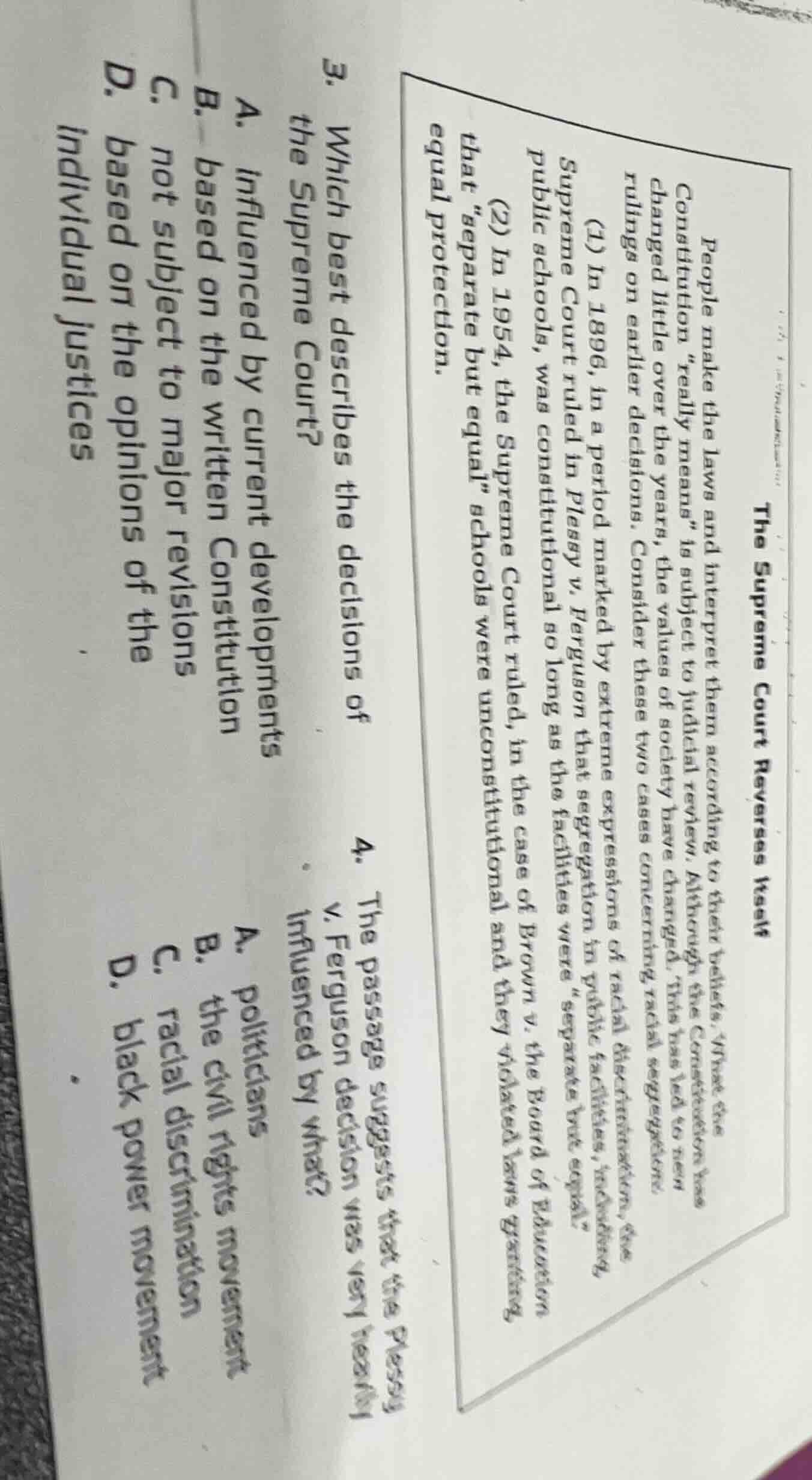
the supreme court reverses itself
people make the laws and interpret them according to their beliefs. what the constitution “really means” is subject to judicial review. although the constitution has changed little over the years, the values of society have changed. this has led to new rulings on earlier decisions. consider these two cases concerning racial segregation.
(1) in 1896, in a period marked by extreme expressions of racial discrimination, the supreme court ruled in plessy v. ferguson that segregation in public facilities, including public schools, was constitutional so long as the facilities were “separate but equal.”
(2) in 1954, the supreme court ruled, in the case of brown v. the board of education, that “separate but equal” schools were unconstitutional and they violated laws granting equal protection.
- which best describes the decisions of the supreme court?
a. influenced by current developments
b. based on the written constitution
c. not subject to major revisions
d. based on the opinions of the individual justices
- the passage suggests that the plessy v. ferguson decision was very influenced by what?
a. politicians
b. the civil rights movement
c. racial discrimination
d. black power movement
Question 3
The passage states that the Constitution's "real meaning" is subject to judicial review and changes with societal values. The Supreme Court's decisions (like Plessy v. Ferguson and Brown v. Board) show they adapt to current developments (changing societal values). Option A fits as the decisions are influenced by current societal developments. Option B is wrong as the Constitution's interpretation changes (not just based on written text). Option C is wrong as there were major revisions (like overturning Plessy with Brown). Option D is wrong as decisions are collective, not individual justices' opinions alone.
The passage discusses racial segregation cases. Plessy v. Ferguson upheld "separate but equal" (allowing racial discrimination in public facilities). The passage suggests the decision was very heavily influenced by racial discrimination (as it upheld segregation). Option A (politicians) is not indicated. Option B (civil rights movement) came after Plessy. Option D (black power movement) also came later. So Option C is correct.

Snap & solve any problem in the app
Get step-by-step solutions on Sovi AI
Photo-based solutions with guided steps
Explore more problems and detailed explanations
A. influenced by current developments