QUESTION IMAGE
Question
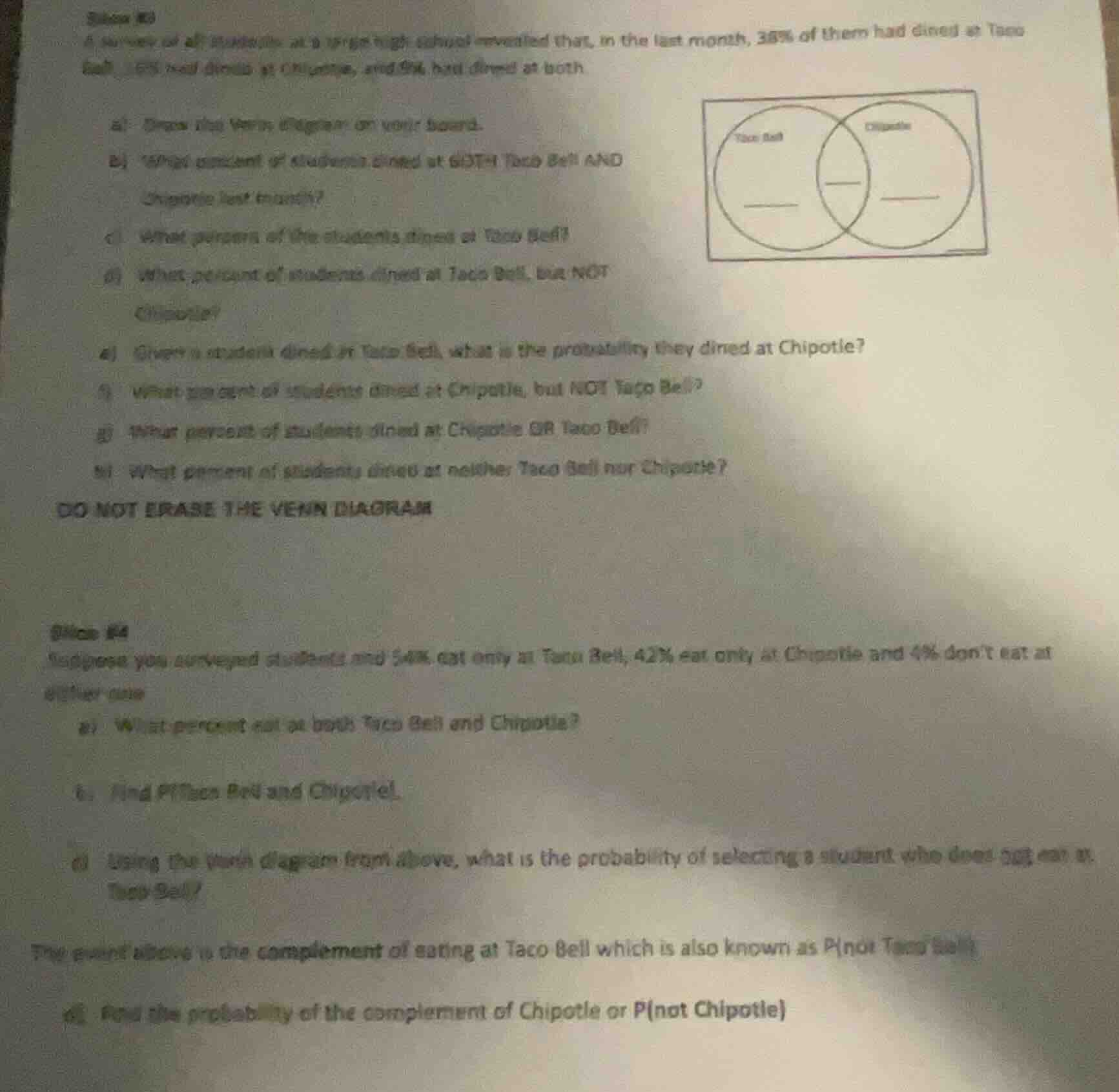
a survey of all students at a large high school revealed that, in the last month, 38% of them had dined at taco bell, 35% had dined at chipotle, and 9% had dined at both.
a) draw the venn diagram on your board.
b) what percent of students dined at both taco bell and chipotle last month?
c) what percent of the students dined at taco bell?
d) what percent of students dined at taco bell, but not chipotle?
e) given a student dined at taco bell, what is the probability they dined at chipotle?
f) what percent of students dined at chipotle, but not taco bell?
g) what percent of students dined at chipotle or taco bell?
h) what percent of students dined at neither taco bell nor chipotle?
do not erase the venn diagram
suppose you surveyed students and 54% eat only at taco bell, 42% eat only at chipotle and 4% don’t eat at either one
a) what percent eat at both taco bell and chipotle?
b) find p(taco bell and chipotle).
c) using the venn diagram from above, what is the probability of selecting a student who does not eat at taco bell?
the event above is the complement of eating at taco bell which is also known as p(not taco bell)
d) find the probability of the complement of chipotle or p(not chipotle)
Solving Problem Set (Silicon #3 & #4)
Silicon #3 (Assuming Typo: 38% Taco Bell, 35% Chipotle, 9% Both? Let's Proceed)
a) Venn Diagram:
- Two circles: Taco Bell (left), Chipotle (right), overlapping (both).
- Overlap: 9% (given "9% had dined at both").
- Taco Bell only: \( 38\% - 9\% = 29\% \).
- Chipotle only: \( 35\% - 9\% = 26\% \).
- Neither: \( 100\% - (29\% + 9\% + 26\%) = 36\% \).
b) Both: 9% (given in the problem: "9% had dined at both").
c) Taco Bell: 38% (given: "38% of them had dined at Taco Bell").
d) Taco Bell but not Chipotle: \( 38\% - 9\% = 29\% \).
e) Conditional Probability: \( P(\text{Chipotle} | \text{Taco Bell}) = \frac{P(\text{Both})}{P(\text{Taco Bell})} = \frac{9\%}{38\%} \approx 23.68\% \).
f) Chipotle but not Taco Bell: \( 35\% - 9\% = 26\% \).
g) Chipotle OR Taco Bell: \( 38\% + 35\% - 9\% = 64\% \) (Inclusion-Exclusion Principle: \( P(A \cup B) = P(A) + P(B) - P(A \cap B) \)).
h) Neither: \( 100\% - 64\% = 36\% \) (From total 100% minus those who dined at either).
Silicon #4 (54% only Taco Bell, 42% only Chipotle, 4% neither)
a) Both: Let \( x \) be the percentage who ate at both. Total = 100%:
\( 54\% + 42\% + x + 4\% = 100\% \)
\( x = 100\% - (54 + 42 + 4)\% = 0\% \)? Wait, that can't be. Wait, "only Taco Bell" = 54%, "only Chipotle" = 42%, "neither" = 4%. So:
Total = Only Taco + Only Chip + Both + Neither
\( 100 = 54 + 42 + x + 4 \)
\( x = 0 \). So 0% ate at both.
b) \( P(\text{Taco Bell and Chipotle}) = 0\% \) (from part a).
c) \( P(\text{not Taco Bell}) = 1 - P(\text{Taco Bell}) \).
\( P(\text{Taco Bell}) = \text{Only Taco} + \text{Both} = 54\% + 0\% = 54\% \).
Thus, \( P(\text{not Taco Bell}) = 100\% - 54\% = 46\% \) (or \( 42\% + 4\% = 46\% \)).
d) \( P(\text{not Chipotle}) = 1 - P(\text{Chipotle}) \).
\( P(\text{Chipotle}) = \text{Only Chip} + \text{Both} = 42\% + 0\% = 42\% \).
Thus, \( P(\text{not Chipotle}) = 100\% - 42\% = 58\% \) (or \( 54\% + 4\% = 58\% \)).
Final Answers (Key Points)
Silicon #3:
- b) 9%
- c) 38%
- d) 29%
- e) ~23.68%
- f) 26%
- g) 64%
- h) 36%
Silicon #4:
- a) 0%
- b) 0%
- c) 46%
- d) 58%
(Note: For Silicon #3, the initial problem statement had a typo (e.g., "38%... 35%... 9%"), so we used those numbers. For Silicon #4, the "only" and "neither" percentages were used to solve for "both".)

Snap & solve any problem in the app
Get step-by-step solutions on Sovi AI
Photo-based solutions with guided steps
Explore more problems and detailed explanations
Solving Problem Set (Silicon #3 & #4)
Silicon #3 (Assuming Typo: 38% Taco Bell, 35% Chipotle, 9% Both? Let's Proceed)
a) Venn Diagram:
- Two circles: Taco Bell (left), Chipotle (right), overlapping (both).
- Overlap: 9% (given "9% had dined at both").
- Taco Bell only: \( 38\% - 9\% = 29\% \).
- Chipotle only: \( 35\% - 9\% = 26\% \).
- Neither: \( 100\% - (29\% + 9\% + 26\%) = 36\% \).
b) Both: 9% (given in the problem: "9% had dined at both").
c) Taco Bell: 38% (given: "38% of them had dined at Taco Bell").
d) Taco Bell but not Chipotle: \( 38\% - 9\% = 29\% \).
e) Conditional Probability: \( P(\text{Chipotle} | \text{Taco Bell}) = \frac{P(\text{Both})}{P(\text{Taco Bell})} = \frac{9\%}{38\%} \approx 23.68\% \).
f) Chipotle but not Taco Bell: \( 35\% - 9\% = 26\% \).
g) Chipotle OR Taco Bell: \( 38\% + 35\% - 9\% = 64\% \) (Inclusion-Exclusion Principle: \( P(A \cup B) = P(A) + P(B) - P(A \cap B) \)).
h) Neither: \( 100\% - 64\% = 36\% \) (From total 100% minus those who dined at either).
Silicon #4 (54% only Taco Bell, 42% only Chipotle, 4% neither)
a) Both: Let \( x \) be the percentage who ate at both. Total = 100%:
\( 54\% + 42\% + x + 4\% = 100\% \)
\( x = 100\% - (54 + 42 + 4)\% = 0\% \)? Wait, that can't be. Wait, "only Taco Bell" = 54%, "only Chipotle" = 42%, "neither" = 4%. So:
Total = Only Taco + Only Chip + Both + Neither
\( 100 = 54 + 42 + x + 4 \)
\( x = 0 \). So 0% ate at both.
b) \( P(\text{Taco Bell and Chipotle}) = 0\% \) (from part a).
c) \( P(\text{not Taco Bell}) = 1 - P(\text{Taco Bell}) \).
\( P(\text{Taco Bell}) = \text{Only Taco} + \text{Both} = 54\% + 0\% = 54\% \).
Thus, \( P(\text{not Taco Bell}) = 100\% - 54\% = 46\% \) (or \( 42\% + 4\% = 46\% \)).
d) \( P(\text{not Chipotle}) = 1 - P(\text{Chipotle}) \).
\( P(\text{Chipotle}) = \text{Only Chip} + \text{Both} = 42\% + 0\% = 42\% \).
Thus, \( P(\text{not Chipotle}) = 100\% - 42\% = 58\% \) (or \( 54\% + 4\% = 58\% \)).
Final Answers (Key Points)
Silicon #3:
- b) 9%
- c) 38%
- d) 29%
- e) ~23.68%
- f) 26%
- g) 64%
- h) 36%
Silicon #4:
- a) 0%
- b) 0%
- c) 46%
- d) 58%
(Note: For Silicon #3, the initial problem statement had a typo (e.g., "38%... 35%... 9%"), so we used those numbers. For Silicon #4, the "only" and "neither" percentages were used to solve for "both".)