QUESTION IMAGE
Question
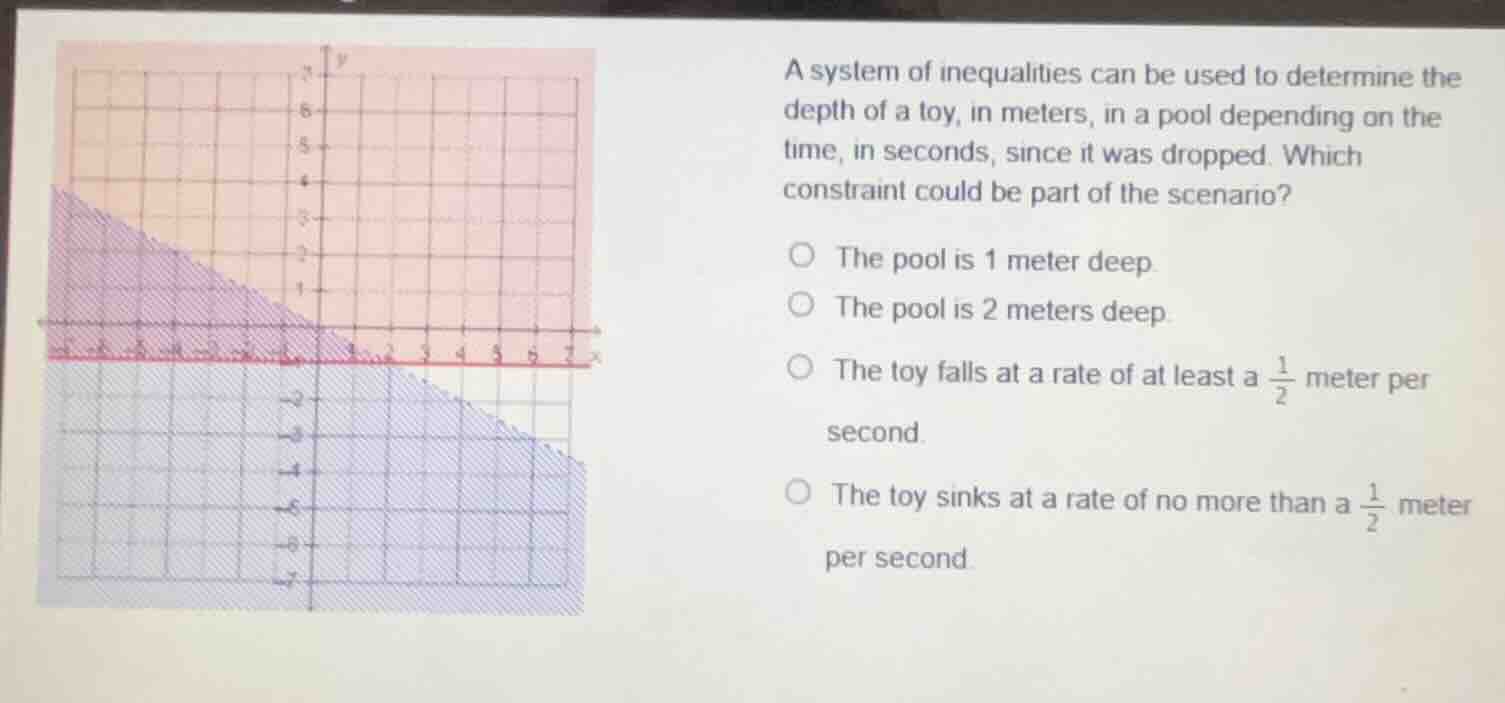
a system of inequalities can be used to determine the depth of a toy, in meters, in a pool depending on the time, in seconds, since it was dropped. which constraint could be part of the scenario?
the pool is 1 meter deep.
the pool is 2 meters deep.
the toy falls at a rate of at least a \\(\frac{1}{2}\\) meter per second.
the toy sinks at a rate of no more than a \\(\frac{1}{2}\\) meter per second.
Step1: Identify boundary line slope
First, find two points on the slanted boundary line: $(-8, 4)$ and $(0, 0)$. Calculate slope:
$$m=\frac{0-4}{0-(-8)}=\frac{-4}{8}=-\frac{1}{2}$$
Step2: Interpret inequality meaning
The shaded region is below this line, so the inequality is $y\leq -\frac{1}{2}x$. Here, $y$ is depth (negative value, downward), $x$ is time. The absolute value of the slope $\frac{1}{2}$ means the toy's sinking rate is at most $\frac{1}{2}$ m/s.
Step3: Evaluate pool depth
The horizontal boundary is $y=-1$, so pool depth is 1 meter, but this does not match the valid rate-based option. The slope interpretation confirms the rate constraint.

Snap & solve any problem in the app
Get step-by-step solutions on Sovi AI
Photo-based solutions with guided steps
Explore more problems and detailed explanations
The toy sinks at a rate of no more than a $\frac{1}{2}$ meter per second.