QUESTION IMAGE
Question
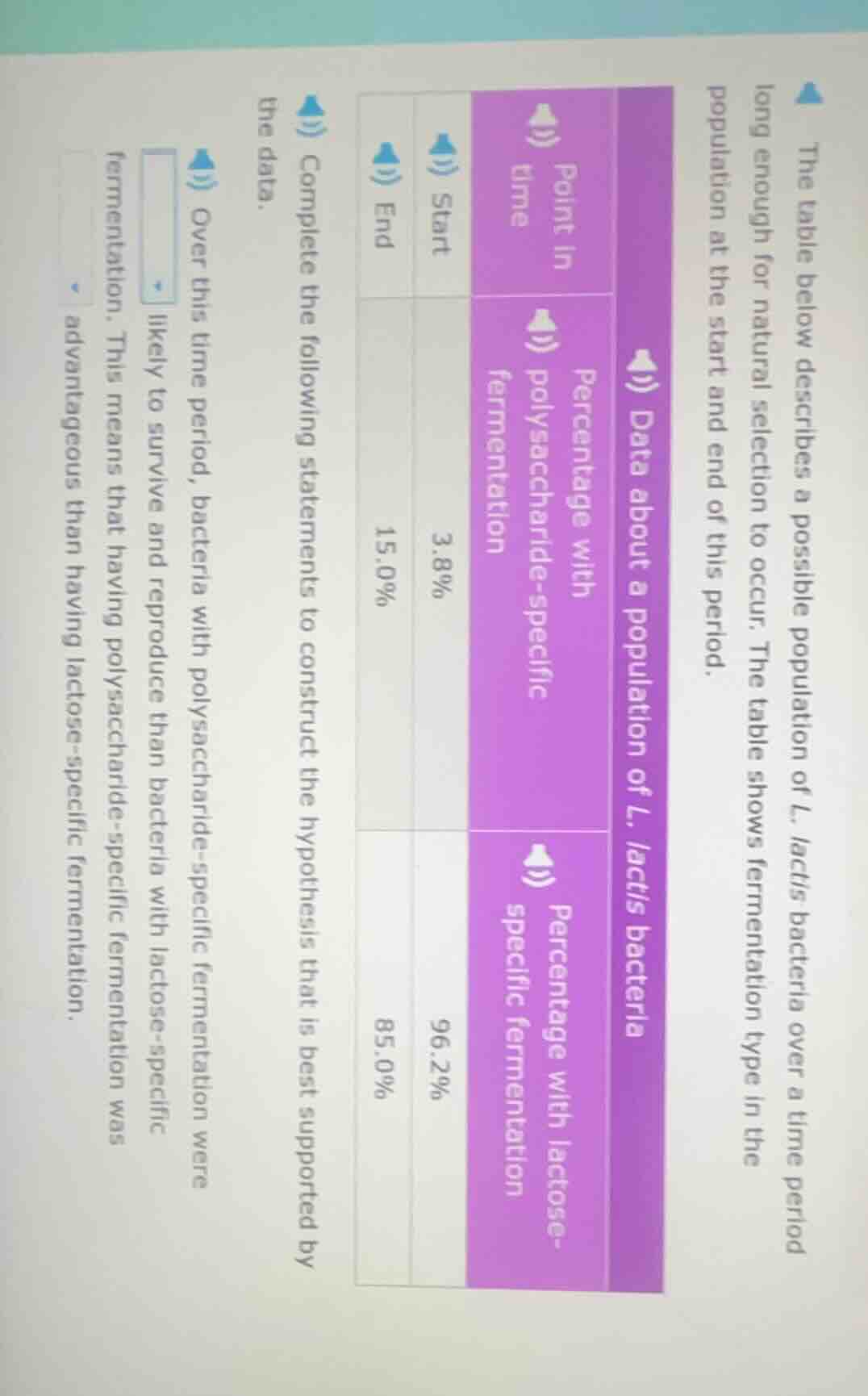
the table below describes a possible population of l. lactis bacteria over a time period long enough for natural selection to occur. the table shows fermentation type in the population at the start and end of this period.
data about a population of l. lactis bacteria
| point in time | percentage with polysaccharide - specific fermentation | percentage with lactose - specific fermentation |
|---|---|---|
| end | 15.0% | 85.0% |
complete the following statements to construct the hypothesis that is best supported by the data.
over this time period, bacteria with polysaccharide - specific fermentation were blank likely to survive and reproduce than bacteria with lactose - specific fermentation. this means that having polysaccharide - specific fermentation was blank advantageous than having lactose - specific fermentation.
- For the first statement: The percentage of bacteria with polysaccharide-specific fermentation increased from 3.8% to 15.0%, while the percentage with lactose-specific fermentation decreased from 96.2% to 85.0%. This means bacteria with polysaccharide-specific fermentation were more likely to survive and reproduce.
- For the second statement: Since the proportion of bacteria with polysaccharide-specific fermentation rose over time, this trait provided a survival/reproductive advantage compared to lactose-specific fermentation.

Snap & solve any problem in the app
Get step-by-step solutions on Sovi AI
Photo-based solutions with guided steps
Explore more problems and detailed explanations
- more likely to survive and reproduce than bacteria with lactose-specific fermentation. This means that having polysaccharide-specific fermentation was
- more advantageous than having lactose-specific fermentation.