QUESTION IMAGE
Question
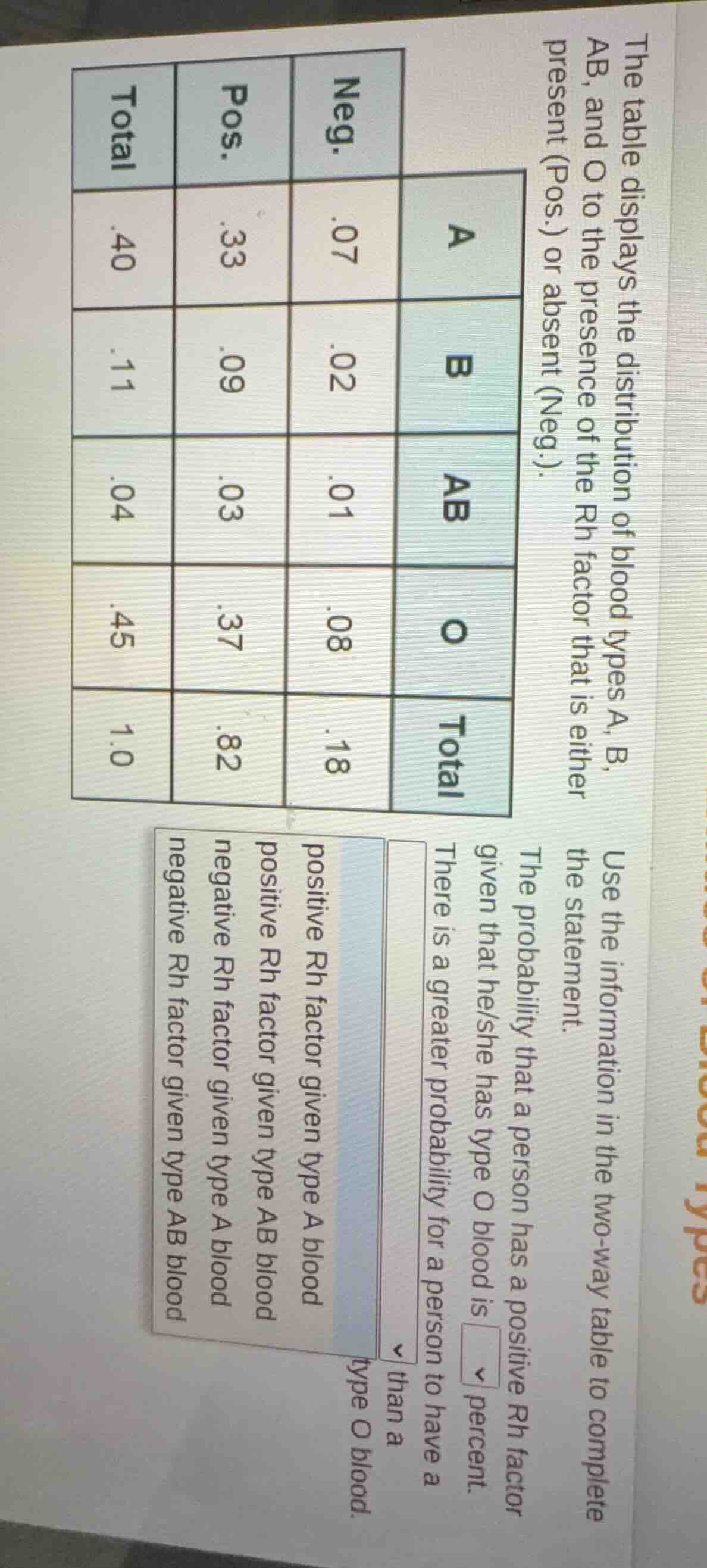
the table displays the distribution of blood types a, b, ab, and o to the presence of the rh factor that is either present (pos.) or absent (neg.).
| neg. | pos. | total | |
|---|---|---|---|
| b | .02 | .09 | .11 |
| ab | .01 | .03 | .04 |
| o | .08 | .37 | .45 |
| total | .18 | .82 | 1.0 |
use the information in the two - way table to complete the statement.
the probability that a person has a positive rh factor given that he/she has type o blood is dropdown percent.
there is a greater probability for a person to have a dropdown than a type o blood.
dropdown options for the second blank: positive rh factor given type a blood, positive rh factor given type ab blood, negative rh factor given type a blood, negative rh factor given type ab blood
Step1: Recall Conditional Probability Formula
The formula for conditional probability is \( P(A|B) = \frac{P(A \cap B)}{P(B)} \). Here, we want to find the probability that a person has a positive Rh factor (Pos.) given that they have type O blood. Let \( A \) be "positive Rh factor" and \( B \) be "type O blood". So we need \( P(\text{Pos.} | \text{O})=\frac{P(\text{Pos.} \cap \text{O})}{P(\text{O})} \).
Step2: Identify Probabilities from Table
From the two - way table, \( P(\text{Pos.} \cap \text{O}) = 0.37 \) (the probability of having both type O blood and positive Rh factor) and \( P(\text{O})=0.45 \) (the total probability of having type O blood).
Step3: Calculate the Conditional Probability
Substitute the values into the formula: \( P(\text{Pos.} | \text{O})=\frac{0.37}{0.45}\approx0.8222 \). To convert this to a percentage, we multiply by 100: \( 0.8222\times100 = 82.22\% \) (approximately). But we can also note that from the table, the probability of positive Rh factor given O blood is \( \frac{0.37}{0.45}\approx0.822 \) or \( 82.2\% \) (if we consider the exact values from the table, the joint probability of O and Pos. is 0.37 and the marginal probability of O is 0.45).
Now we need to compare this with the other probabilities:
- Probability of positive Rh factor given A blood: \( P(\text{Pos.}|A)=\frac{0.33}{0.40} = 0.825 \)
- Probability of positive Rh factor given AB blood: \( P(\text{Pos.}|AB)=\frac{0.03}{0.04}=0.75 \)
- Probability of negative Rh factor given A blood: \( P(\text{Neg.}|A)=\frac{0.07}{0.40} = 0.175 \)
- Probability of negative Rh factor given AB blood: \( P(\text{Neg.}|AB)=\frac{0.01}{0.04}=0.25 \)
We can see that the probability of positive Rh factor given O blood (\( \approx82.2\% \)) is less than the probability of positive Rh factor given A blood (\( \frac{0.33}{0.40} = 0.825 = 82.5\% \)) and greater than the probabilities of positive Rh factor given AB blood, negative Rh factor given A blood, and negative Rh factor given AB blood. But the question is about which probability is greater for a person with type O blood compared to the others. Wait, the original question (from the table and the options) is to find the probability that a person has a positive Rh factor given that he/she has type O blood and then compare. But the main calculation for the probability of positive Rh factor given O blood is \( \frac{0.37}{0.45}\approx82.2\% \) (or \( \frac{37}{45}\approx82.22\% \)).

Snap & solve any problem in the app
Get step-by-step solutions on Sovi AI
Photo-based solutions with guided steps
Explore more problems and detailed explanations
The probability that a person has a positive Rh factor given that he/she has type O blood is approximately \( 82.2\% \) (or \( \frac{37}{45}\approx82.22\% \)). If we consider the comparison, the probability of positive Rh factor given O blood is less than the probability of positive Rh factor given A blood (\( \frac{0.33}{0.40} = 0.825 = 82.5\% \)) and greater than the probability of positive Rh factor given AB blood (\( \frac{0.03}{0.04}=0.75 = 75\% \)), negative Rh factor given A blood (\( \frac{0.07}{0.40}=0.175 = 17.5\% \)) and negative Rh factor given AB blood (\( \frac{0.01}{0.04}=0.25 = 25\% \)). But the main probability of positive Rh factor given O blood is \( \frac{0.37}{0.45}\approx82.2\% \) (or \( 82.22\% \)).