QUESTION IMAGE
Question
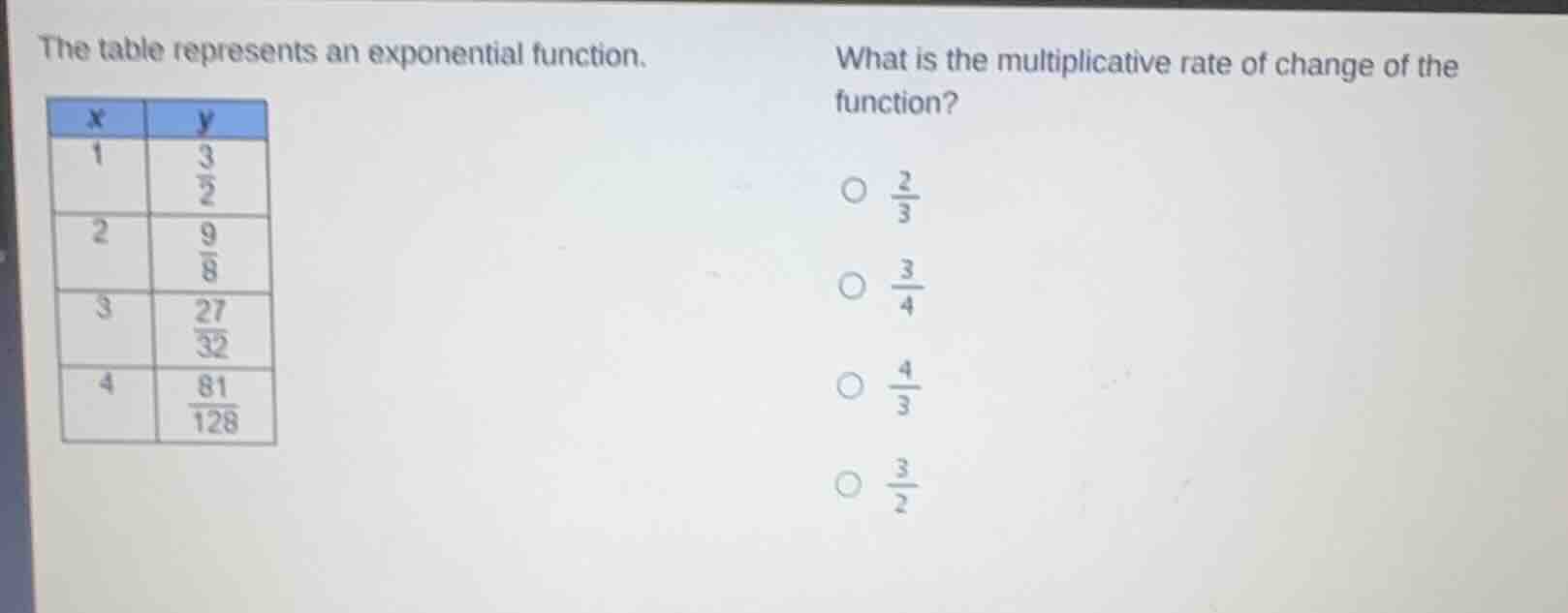
the table represents an exponential function.
| x | y |
|---|---|
| 2 | \\(\frac{9}{8}\\) |
| 3 | \\(\frac{27}{32}\\) |
| 4 | \\(\frac{81}{128}\\) |
what is the multiplicative rate of change of the function?
\\(\circ \frac{2}{3}\\)
\\(\circ \frac{3}{4}\\)
\\(\circ \frac{4}{3}\\)
\\(\circ \frac{3}{2}\\)
Step1: Recall the formula for multiplicative rate of change
The multiplicative rate of change of an exponential function between two points \((x_1,y_1)\) and \((x_2,y_2)\) (where \(x_2=x_1 + 1\)) is given by \(\frac{y_2}{y_1}\).
Step2: Calculate the ratio of \(y\)-values for consecutive \(x\)-values
Take the first two points: when \(x = 1\), \(y=\frac{3}{2}\) and when \(x = 2\), \(y=\frac{9}{8}\).
The multiplicative rate of change is \(\frac{y_2}{y_1}=\frac{\frac{9}{8}}{\frac{3}{2}}\).
We know that dividing by a fraction is the same as multiplying by its reciprocal, so \(\frac{\frac{9}{8}}{\frac{3}{2}}=\frac{9}{8}\times\frac{2}{3}\).
Simplify the numerator and denominator: \(9\times2 = 18\) and \(8\times3=24\), then \(\frac{18}{24}=\frac{3}{4}\)? Wait, no, let's check again. Wait, \(\frac{9}{8}\div\frac{3}{2}=\frac{9}{8}\times\frac{2}{3}=\frac{9\times2}{8\times3}=\frac{18}{24}=\frac{3}{4}\)? Wait, no, wait let's check with the next pair.
Take \(x = 2\), \(y=\frac{9}{8}\) and \(x = 3\), \(y=\frac{27}{32}\).
\(\frac{\frac{27}{32}}{\frac{9}{8}}=\frac{27}{32}\times\frac{8}{9}=\frac{27\times8}{32\times9}=\frac{216}{288}=\frac{3}{4}\).
Take \(x = 3\), \(y=\frac{27}{32}\) and \(x = 4\), \(y=\frac{81}{128}\).
\(\frac{\frac{81}{128}}{\frac{27}{32}}=\frac{81}{128}\times\frac{32}{27}=\frac{81\times32}{128\times27}=\frac{2592}{3456}=\frac{3}{4}\).

Snap & solve any problem in the app
Get step-by-step solutions on Sovi AI
Photo-based solutions with guided steps
Explore more problems and detailed explanations
\(\frac{3}{4}\) (corresponding to the option \(\boldsymbol{\frac{3}{4}}\))