QUESTION IMAGE
Question
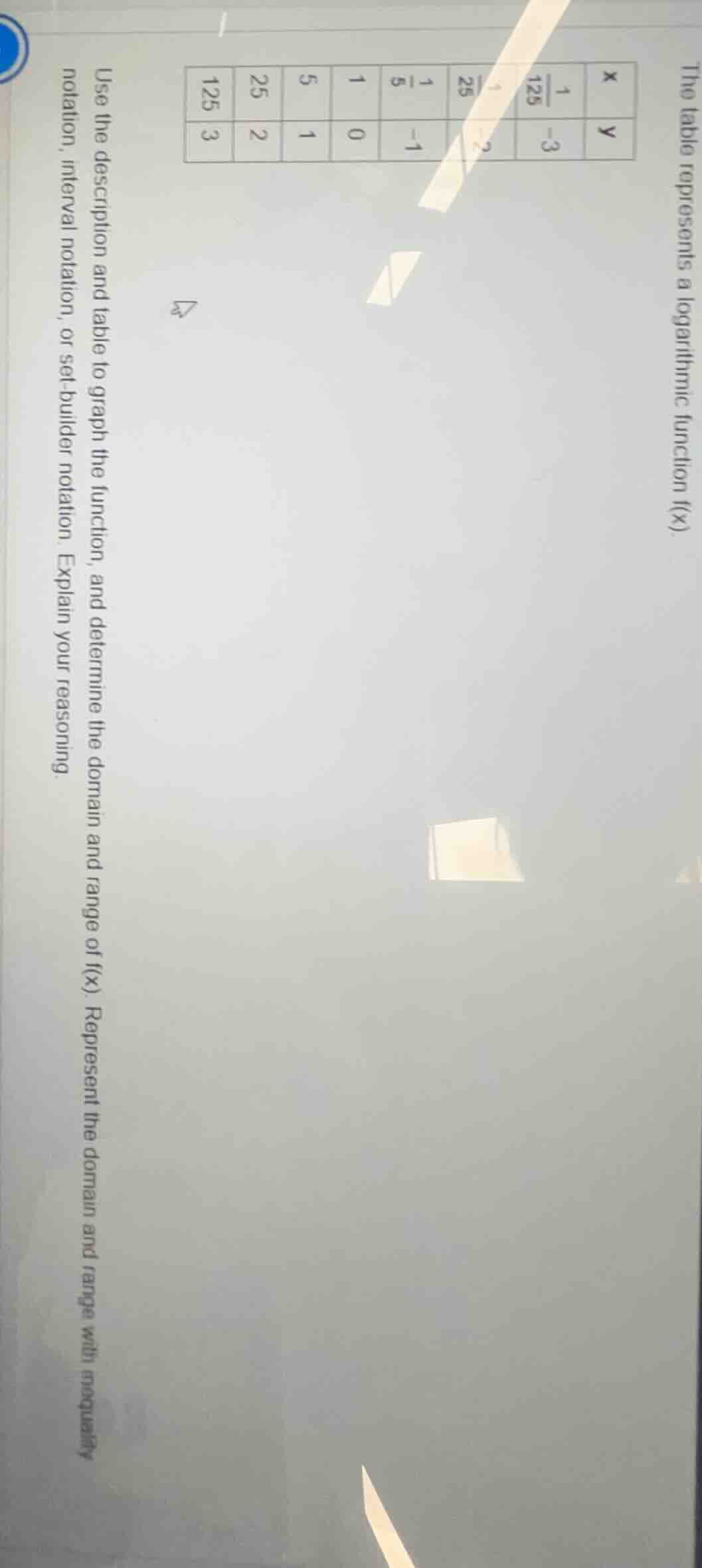
the table represents a logarithmic function f(x).
| x | \\(\frac{1}{125}\\) | \\(\frac{1}{25}\\) | \\(\frac{1}{5}\\) | 1 | 5 | 25 | 125 |
|---|
use the description and table to graph the function, and determine the domain and range of f(x). represent the domain and range with inequality notation, interval notation, or set - builder notation. explain your reasoning.
Step1: Identify the logarithmic function
First, recognize that the table pairs fit the form \(y = \log_{5}x\) (since \(5^y = x\): \(5^{-3}=\frac{1}{125}\), \(5^{-2}=\frac{1}{25}\), \(5^{-1}=\frac{1}{5}\), \(5^{0}=1\), \(5^{1}=5\), \(5^{2}=25\), \(5^{3}=125\)).
Step2: Determine the domain
Logarithmic functions are only defined for positive \(x\)-values.
Inequality: \(x > 0\)
Interval notation: \((0, \infty)\)
Set-builder notation: \(\{x \mid x > 0\}\)
Step3: Determine the range
Logarithmic functions can output all real numbers (the \(y\)-values in the table cover negative, zero, and positive real numbers, and the function extends infinitely in both directions).
Inequality: \(-\infty < y < \infty\)
Interval notation: \((-\infty, \infty)\)
Set-builder notation: \(\{y \mid y \in \mathbb{R}\}\)
Step4: Graphing notes
The graph has a vertical asymptote at \(x=0\), passes through the point \((1,0)\), increases slowly as \(x\) increases, and approaches negative infinity as \(x\) approaches 0 from the right.

Snap & solve any problem in the app
Get step-by-step solutions on Sovi AI
Photo-based solutions with guided steps
Explore more problems and detailed explanations
Domain:
- Inequality: \(x > 0\)
- Interval notation: \((0, \infty)\)
- Set-builder notation: \(\{x \mid x > 0\}\)
Range:
- Inequality: \(-\infty < y < \infty\)
- Interval notation: \((-\infty, \infty)\)
- Set-builder notation: \(\{y \mid y \in \mathbb{R}\}\)
Reasoning:
The function is \(f(x)=\log_{5}x\). Logarithmic functions are undefined for non-positive \(x\)-values, so the domain is all positive real numbers. The function can produce any real number as an output, so the range is all real numbers. The graph has a vertical asymptote at \(x=0\), passes through \((1,0)\), and is increasing for all positive \(x\).