QUESTION IMAGE
Question
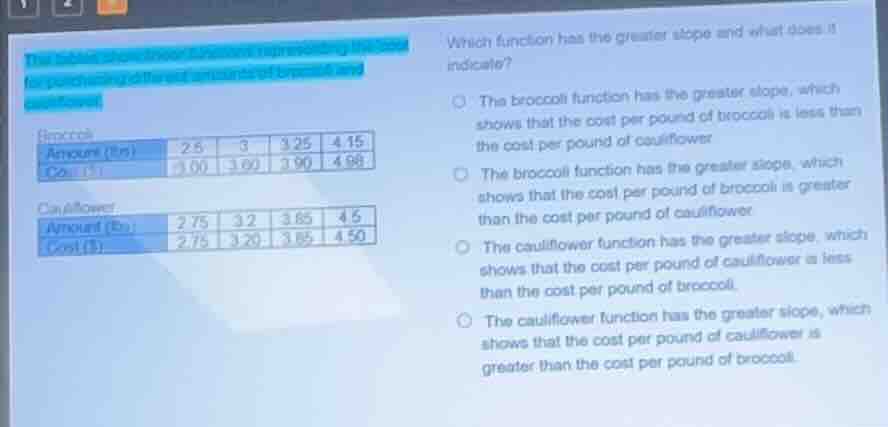
the table shows two functions representing the prices of purchasing different amounts of broccoli and cauliflower. broccoli amount (lbs) 2.5 3 3.25 4.15 cost ($) 3.00 3.60 3.90 4.98 cauliflower amount (lbs) 2.75 3.2 3.85 4.5 cost ($) 2.75 3.20 3.85 4.50 which function has the greater slope and what does it indicate? the broccoli function has the greater slope, which shows that the cost per pound of broccoli is less than the cost per pound of cauliflower. the broccoli function has the greater slope, which shows that the cost per pound of broccoli is greater than the cost per pound of cauliflower. the cauliflower function has the greater slope, which shows that the cost per pound of cauliflower is less than the cost per pound of broccoli. the cauliflower function has the greater slope, which shows that the cost per pound of cauliflower is greater than the cost per pound of broccoli.
Step1: Calculate broccoli's slope
Slope = $\frac{\Delta \text{Cost}}{\Delta \text{Amount}} = \frac{3.00 - 0}{2.5 - 0} = 1.2$
Step2: Calculate cauliflower's slope
Slope = $\frac{\Delta \text{Cost}}{\Delta \text{Amount}} = \frac{2.75 - 0}{2.75 - 0} = 1$
Step3: Compare slopes and interpret
Broccoli slope (1.2) > Cauliflower slope (1). Slope = cost per pound.

Snap & solve any problem in the app
Get step-by-step solutions on Sovi AI
Photo-based solutions with guided steps
Explore more problems and detailed explanations
The broccoli function has the greater slope, which shows that the cost per pound of broccoli is greater than the cost per pound of cauliflower.