QUESTION IMAGE
Question
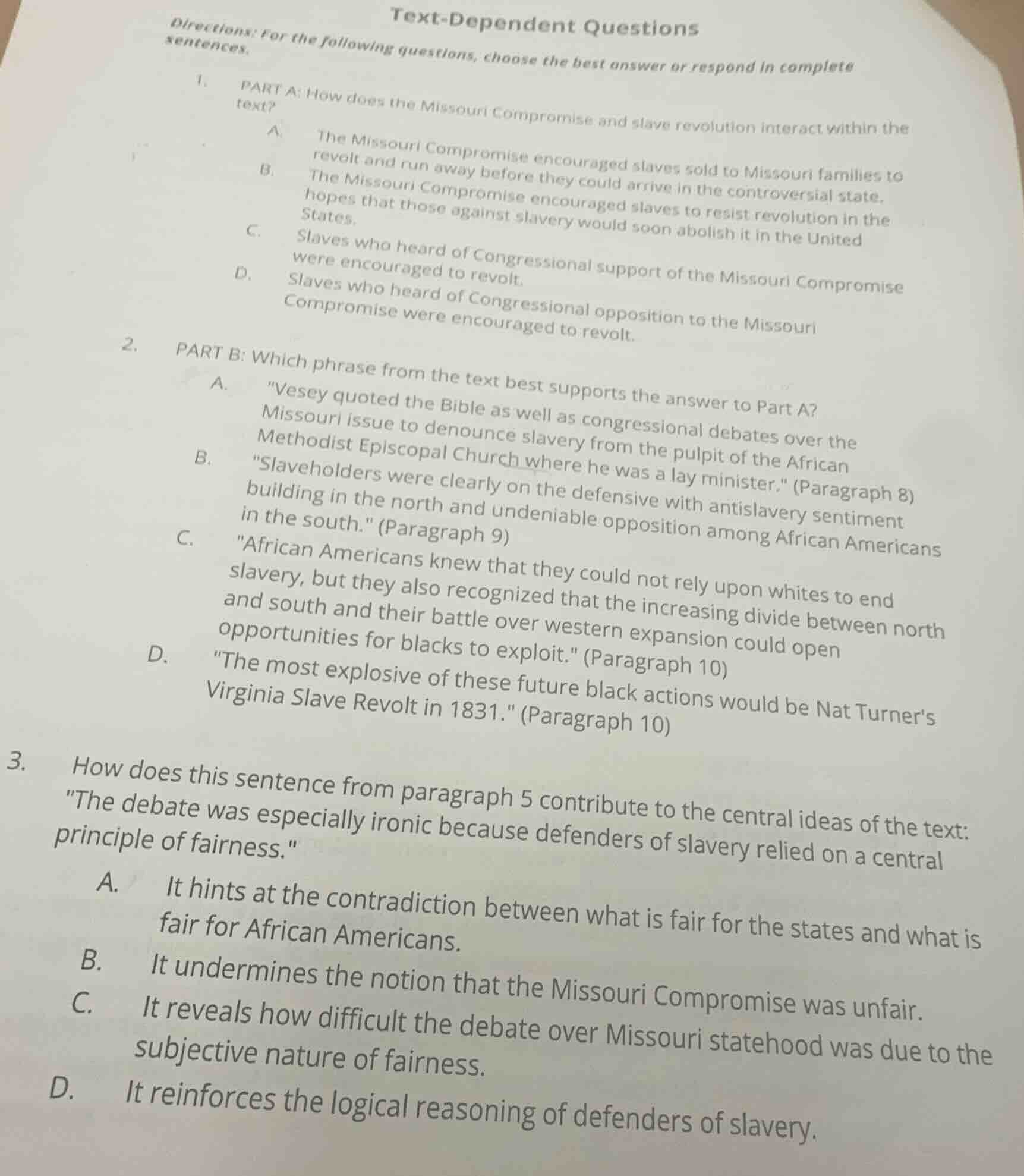
text-dependent questions
directions: for the following questions, choose the best answer or respond in complete sentences.
- part a: how does the missouri compromise and slave revolution interact within the text?
a. the missouri compromise encouraged slaves sold to missouri families to revolt and run away before they could arrive in the controversial state.
b. the missouri compromise encouraged slaves to resist revolution in the hopes that those against slavery would soon abolish it in the united states.
c. slaves who heard of congressional support of the missouri compromise were encouraged to revolt.
d. slaves who heard of congressional opposition to the missouri compromise were encouraged to revolt.
- part b: which phrase from the text best supports the answer to part a?
a. \vesey quoted the bible as well as congressional debates over the missouri issue to denounce slavery from the pulpit of the african methodist episcopal church where he was a lay minister.\ (paragraph 8)
b. \slaveholders were clearly on the defensive with antislavery sentiment building in the north and undeniable opposition among african americans in the south.\ (paragraph 9)
c. \african americans knew that they could not rely upon whites to end slavery, but they also recognized that the increasing divide between north and south and their battle over western expansion could open opportunities for blacks to exploit.\ (paragraph 10)
d. \the most explosive of these future black actions would be nat turners virginia slave revolt in 1831.\ (paragraph 10)
- how does this sentence from paragraph 5 contribute to the central ideas of the text: \the debate was especially ironic because defenders of slavery relied on a central principle of fairness.\
a. it hints at the contradiction between what is fair for the states and what is fair for african americans.
b. it undermines the notion that the missouri compromise was unfair.
c. it reveals how difficult the debate over missouri statehood was due to the subjective nature of fairness.
d. it reinforces the logical reasoning of defenders of slavery.
Question 1 (Part A)
To solve this, we analyze each option:
- Option A: The Missouri Compromise's relation to slaves running away before reaching Missouri isn't a typical interaction with slave revolutions.
- Option B: The Missouri Compromise didn't encourage slaves to resist revolution; it was about statehood and slavery's spread, not suppressing revolts.
- Option C: Congressional support for the Missouri Compromise (which allowed slavery in Missouri) wouldn't encourage slaves to revolt.
- Option D: Congressional opposition to the Missouri Compromise (showing anti - slavery sentiment) could give slaves hope that slavery might be abolished, encouraging revolt. This makes sense as it connects the Compromise's opposition to slave revolution encouragement.
We need a phrase that supports the answer to Part A (slaves were encouraged to revolt by Congressional opposition to the Missouri Compromise).
- Option A: Vesey quoting debates to denounce slavery shows how the Missouri Compromise debate influenced slave revolt encouragement (as it's about using the Compromise - related debates to inspire action against slavery).
- Option B: Talks about slaveholders' defensiveness, not related to slaves being encouraged to revolt by Compromise opposition.
- Option C: Discusses African Americans' recognition of North - South divide, not directly about the Compromise's opposition encouraging revolt.
- Option D: Mentions Nat Turner's revolt, not related to the Missouri Compromise's opposition.
The sentence says defenders of slavery relied on a principle of fairness, which is ironic because slavery is unfair to African Americans.
- Option A: It hints at the contradiction between what is fair for the states (defenders' view) and what is fair for African Americans (slavery is unfair), which matches the irony.
- Option B: It doesn't undermine the idea that the Compromise was unfair; it's about the irony of slavery defenders using fairness.
- Option C: It's not about the debate's difficulty due to fairness' subjectivity, but about the irony of slavery defenders using fairness.
- Option D: It doesn't reinforce the defenders' logical reasoning; it shows the irony in their use of fairness.

Snap & solve any problem in the app
Get step-by-step solutions on Sovi AI
Photo-based solutions with guided steps
Explore more problems and detailed explanations
D. Slaves who heard of Congressional opposition to the Missouri Compromise were encouraged to revolt.