QUESTION IMAGE
Question
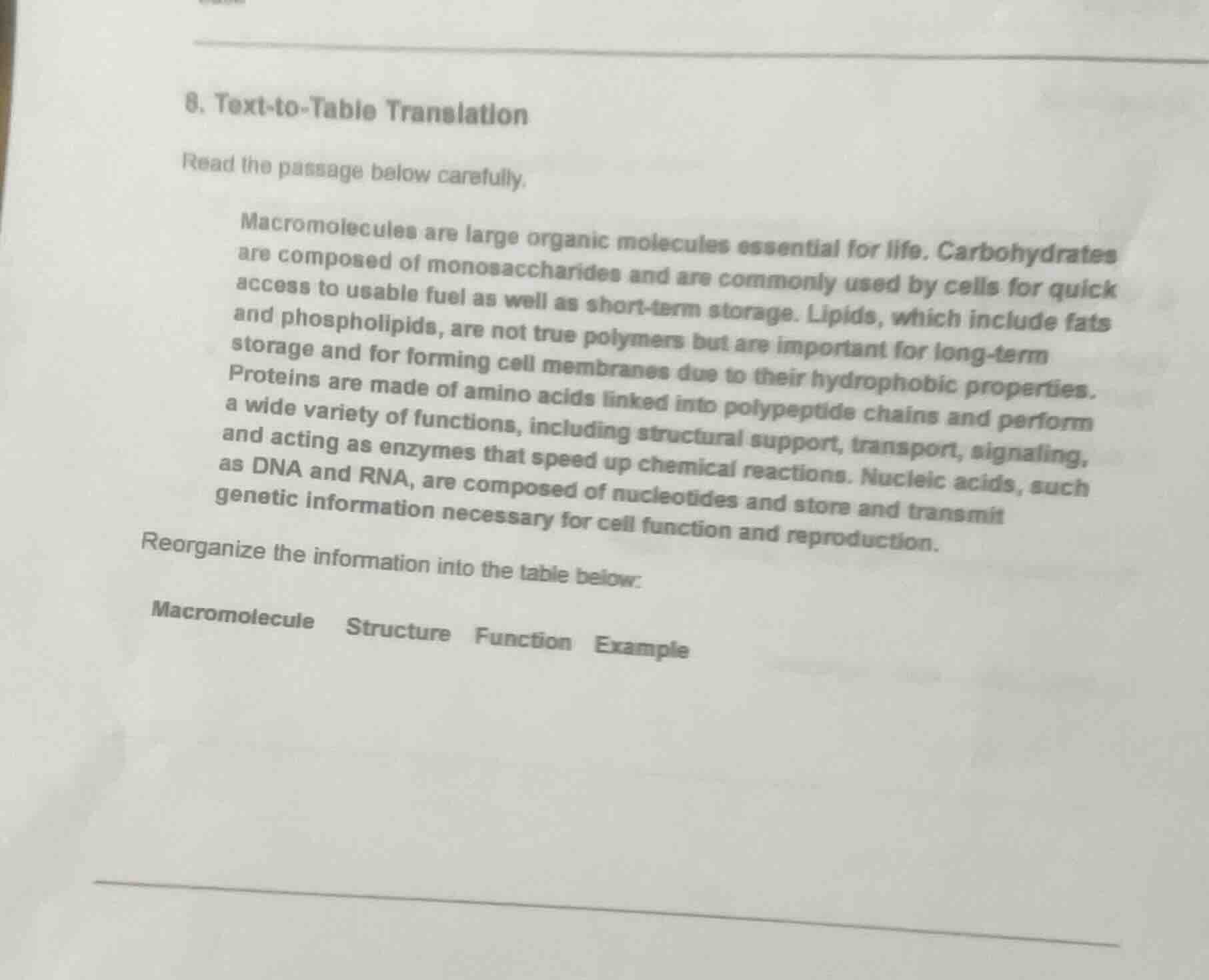
- text - to - table translation
read the passage below carefully.
macromolecules are large organic molecules essential for life. carbohydrates are composed of monosaccharides and are commonly used by cells for quick access to usable fuel as well as short - term storage. lipids, which include fats and phospholipids, are not true polymers but are important for long - term storage and for forming cell membranes due to their hydrophobic properties. proteins are made of amino acids linked into polypeptide chains and perform a wide variety of functions, including structural support, transport, signaling, and acting as enzymes that speed up chemical reactions. nucleic acids, such as dna and rna, are composed of nucleotides and store and transmit genetic information necessary for cell function and reproduction.
reorganize the information into the table below:
macromolecule structure function example
To solve this text - to - table translation problem, we analyze the information about each macromolecule from the passage and fill in the table:
1. Carbohydrates
- Structure: Composed of monosaccharides.
- Function: Quick access to usable fuel, short - term storage.
- Example: Glucose (or other simple sugars, or complex carbs like starch can also be considered. But from the passage, the focus is on the structure and function, and a common example is glucose).
2. Lipids
- Structure: Not true polymers; include fats and phospholipids.
- Function: Long - term storage, forming cell membranes (due to hydrophobic properties).
- Example: Fats (like triglycerides), phospholipids.
3. Proteins
- Structure: Made of amino acids linked into polypeptide chains.
- Function: Structural support, transport, signaling, acting as enzymes (speed up chemical reactions).
- Example: Enzymes (like amylase), hemoglobin (for transport), collagen (for structural support).
4. Nucleic Acids
- Structure: Composed of nucleotides.
- Function: Store and transmit genetic information necessary for cell function and reproduction.
- Example: DNA, RNA.
Now we can fill the table:
| Macromolecule | Structure | Function | Example |
|---|---|---|---|
| Lipids | Not true polymers; include fats and phospholipids | Long - term storage, forming cell membranes | Fats |
| Proteins | Made of amino acids linked into polypeptide chains | Structural support, transport, signaling, enzyme activity | Enzymes (e.g., amylase) |
| Nucleic Acids | Composed of nucleotides | Store and transmit genetic information | DNA |
(Note: For the 'Example' column, there are multiple correct answers. The ones provided are just examples based on the passage and common knowledge about macromolecules.)

Snap & solve any problem in the app
Get step-by-step solutions on Sovi AI
Photo-based solutions with guided steps
Explore more problems and detailed explanations
To solve this text - to - table translation problem, we analyze the information about each macromolecule from the passage and fill in the table:
1. Carbohydrates
- Structure: Composed of monosaccharides.
- Function: Quick access to usable fuel, short - term storage.
- Example: Glucose (or other simple sugars, or complex carbs like starch can also be considered. But from the passage, the focus is on the structure and function, and a common example is glucose).
2. Lipids
- Structure: Not true polymers; include fats and phospholipids.
- Function: Long - term storage, forming cell membranes (due to hydrophobic properties).
- Example: Fats (like triglycerides), phospholipids.
3. Proteins
- Structure: Made of amino acids linked into polypeptide chains.
- Function: Structural support, transport, signaling, acting as enzymes (speed up chemical reactions).
- Example: Enzymes (like amylase), hemoglobin (for transport), collagen (for structural support).
4. Nucleic Acids
- Structure: Composed of nucleotides.
- Function: Store and transmit genetic information necessary for cell function and reproduction.
- Example: DNA, RNA.
Now we can fill the table:
| Macromolecule | Structure | Function | Example |
|---|---|---|---|
| Lipids | Not true polymers; include fats and phospholipids | Long - term storage, forming cell membranes | Fats |
| Proteins | Made of amino acids linked into polypeptide chains | Structural support, transport, signaling, enzyme activity | Enzymes (e.g., amylase) |
| Nucleic Acids | Composed of nucleotides | Store and transmit genetic information | DNA |
(Note: For the 'Example' column, there are multiple correct answers. The ones provided are just examples based on the passage and common knowledge about macromolecules.)