QUESTION IMAGE
Question
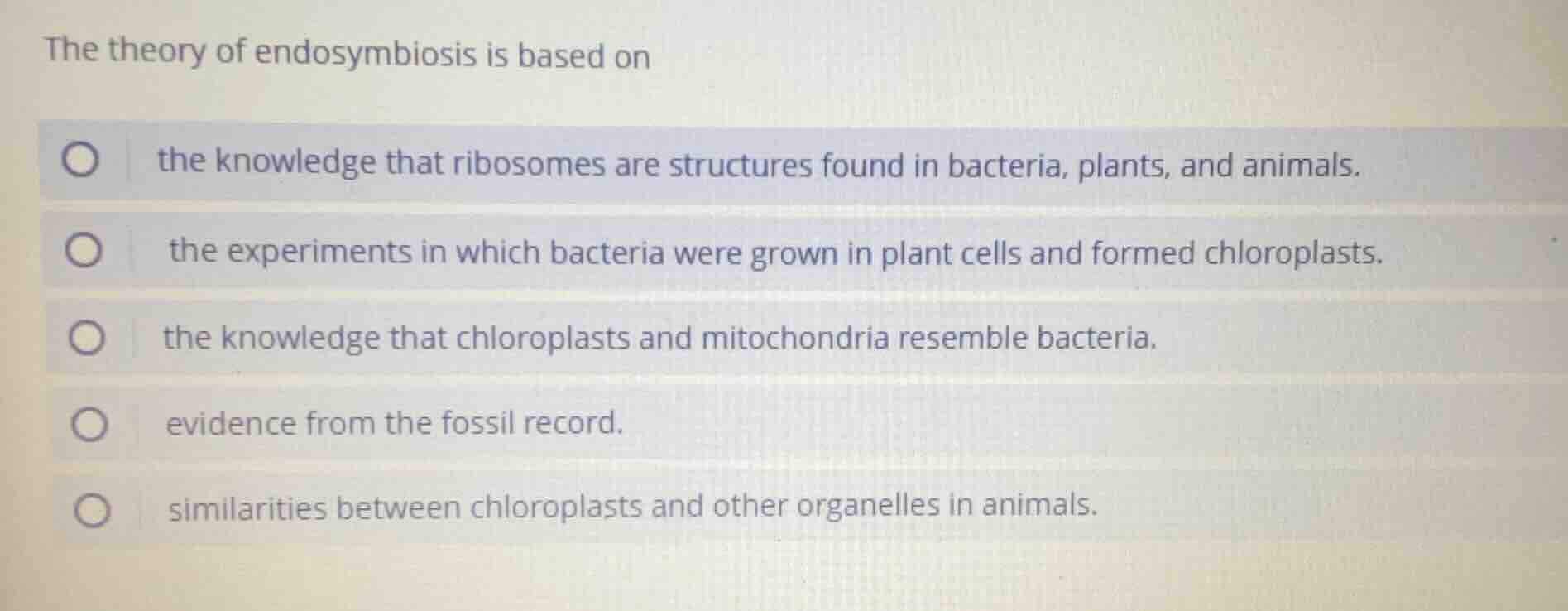
the theory of endosymbiosis is based on
the knowledge that ribosomes are structures found in bacteria, plants, and animals.
the experiments in which bacteria were grown in plant cells and formed chloroplasts.
the knowledge that chloroplasts and mitochondria resemble bacteria.
evidence from the fossil record.
similarities between chloroplasts and other organelles in animals.
The endosymbiotic theory proposes that eukaryotic organelles like mitochondria and chloroplasts originated from free-living bacteria that were engulfed by a host cell. The core evidence for this is that these organelles share key traits with bacteria, such as having their own circular DNA, reproducing via binary fission, and having similar ribosomes and membrane structures. Other options are incorrect: ribosomes are universal in all cells and not unique to the endosymbiont origin; there are no experiments where bacteria formed chloroplasts in plant cells; fossil record evidence is not the primary basis; and chloroplasts are not present in animal cells.

Snap & solve any problem in the app
Get step-by-step solutions on Sovi AI
Photo-based solutions with guided steps
Explore more problems and detailed explanations
the knowledge that chloroplasts and mitochondria resemble bacteria.