QUESTION IMAGE
Question
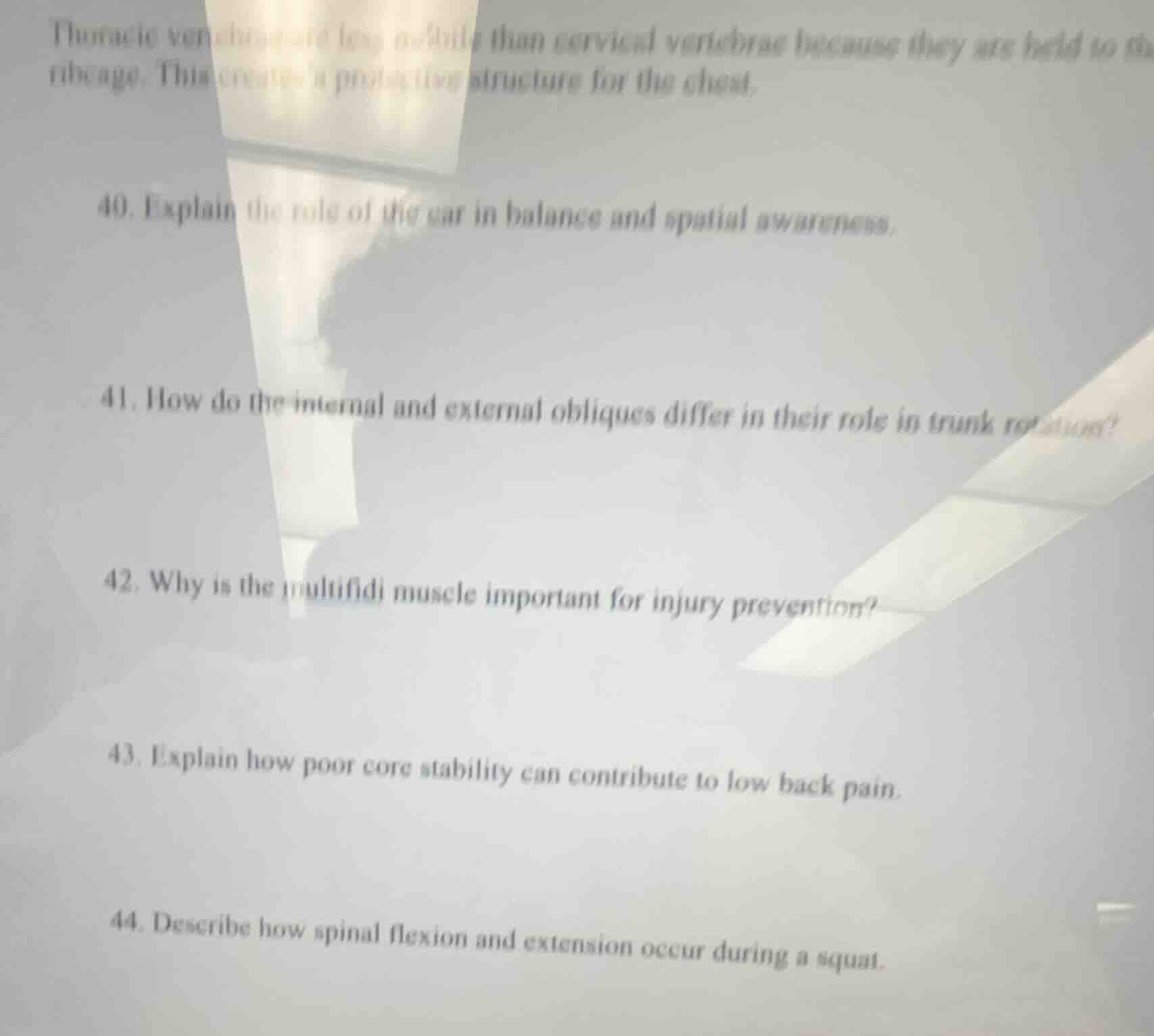
thoracic vertebrae are less mobile than cervical vertebrae because they are held to the ribcage. this creates a protective structure for the chest.
- explain the role of the ear in balance and spatial awareness.
- how do the internal and external obliques differ in their role in trunk rotation?
- why is the multifidi muscle important for injury prevention?
- explain how poor core stability can contribute to low back pain.
- describe how spinal flexion and extension occur during a squat.
For Question 40:
The ear's vestibular system (in the inner ear) manages balance and spatial awareness. It has semicircular canals that detect rotational movements, and otolith organs that sense linear motion and head position relative to gravity. Signals from these structures are sent to the brain, which integrates them with visual and proprioceptive input to maintain equilibrium and spatial orientation.
For Question 41:
The external obliques rotate the trunk to the opposite side (e.g., right external oblique rotates trunk left). The internal obliques rotate the trunk to the same side (e.g., right internal oblique rotates trunk right). Together, they work to control and coordinate trunk twisting movements.
For Question 42:
The multifidi are deep spinal muscles that stabilize individual vertebrae. They maintain proper spinal alignment, reduce excessive stress on spinal joints and discs, and support the spine during movement. By stabilizing the spine segmentally, they prevent abnormal motion that can lead to strains, sprains, or disc injuries.
For Question 43:
Poor core stability means the core muscles (abdominals, obliques, spinal stabilizers) cannot adequately support the spine. This shifts more load to the spinal discs, ligaments, and passive structures. Over time, this increased stress leads to inflammation, muscle imbalances, and degeneration, resulting in low back pain.
For Question 44:
During the eccentric (lowering) phase of a squat, spinal flexion occurs: the trunk leans forward slightly, and the spine flexes at the lumbar and thoracic regions to maintain balance as the hips and knees bend. During the concentric (rising) phase, spinal extension occurs: the core engages to straighten the spine back to a neutral, upright position as the hips and knees extend to return to standing.

Snap & solve any problem in the app
Get step-by-step solutions on Sovi AI
Photo-based solutions with guided steps
Explore more problems and detailed explanations
- The inner ear's vestibular system (semicircular canals for rotational motion, otolith organs for linear motion/head position) sends signals to the brain, which integrates them with visual and proprioceptive input to maintain balance and spatial awareness.
- External obliques rotate the trunk to the opposite side; internal obliques rotate the trunk to the same side.
- The multifidi stabilize individual vertebrae, maintain spinal alignment, reduce stress on spinal structures, and prevent abnormal motion that causes injury.
- Poor core stability shifts excessive load to spinal discs, ligaments, and passive structures, leading to inflammation, muscle imbalances, and degeneration that causes low back pain.
- During the lowering phase of a squat, slight spinal flexion occurs as the trunk leans forward for balance. During the rising phase, spinal extension occurs as the core engages to return the spine to a neutral upright position.