QUESTION IMAGE
Question
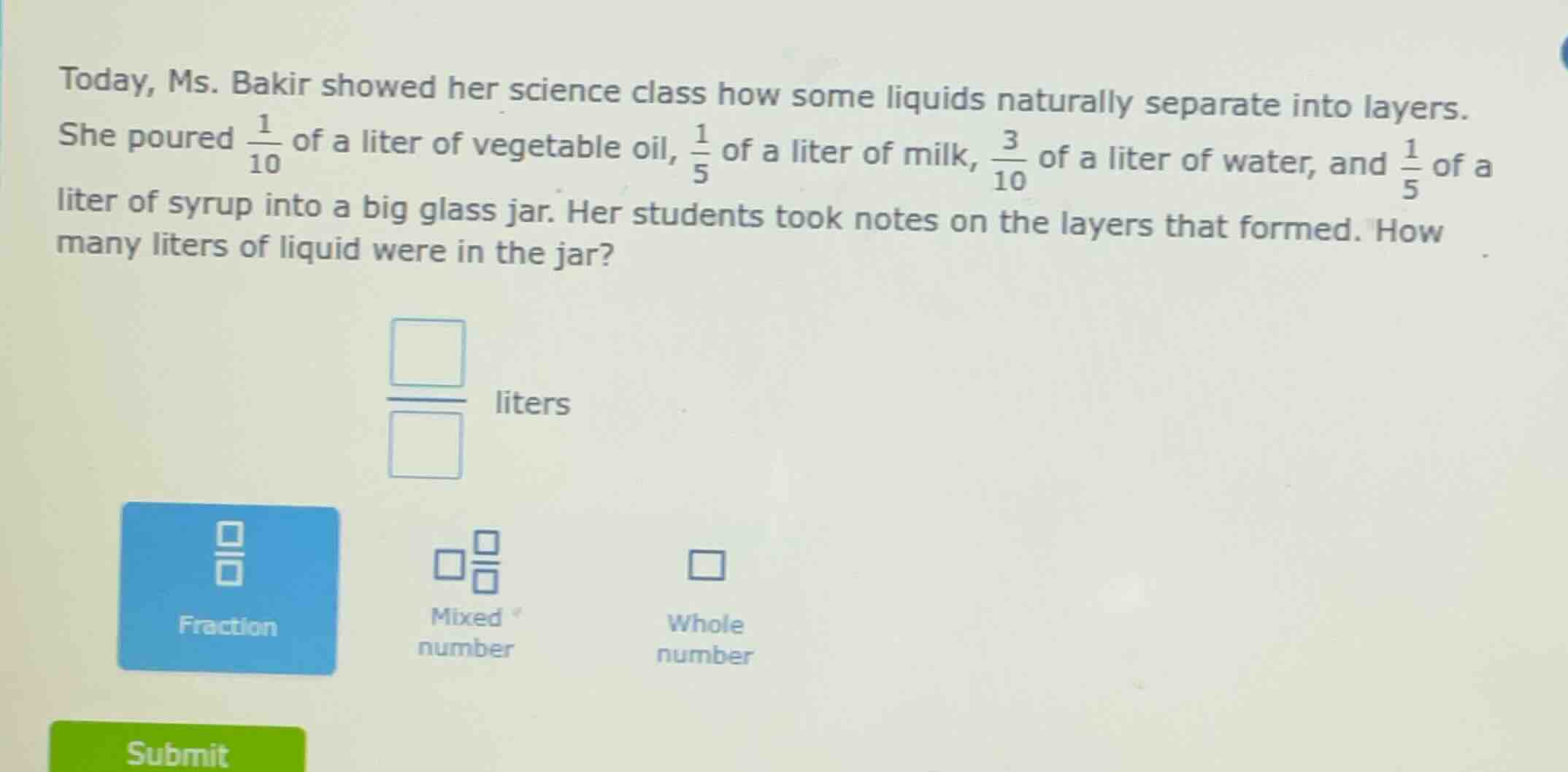
today, ms. bakir showed her science class how some liquids naturally separate into layers. she poured \\(\frac{1}{10}\\) of a liter of vegetable oil, \\(\frac{1}{5}\\) of a liter of milk, \\(\frac{3}{10}\\) of a liter of water, and \\(\frac{1}{5}\\) of a liter of syrup into a big glass jar. her students took notes on the layers that formed. how many liters of liquid were in the jar? \\(\frac{\square}{\square}\\) liters
Step1: Convert fractions to common denominator
To add the fractions \(\frac{1}{10}\), \(\frac{1}{5}\), \(\frac{3}{10}\), and \(\frac{1}{5}\), we first convert \(\frac{1}{5}\) to tenths. Since \(\frac{1}{5} = \frac{2}{10}\), the amounts become \(\frac{1}{10}\), \(\frac{2}{10}\), \(\frac{3}{10}\), and \(\frac{2}{10}\).
Step2: Add the numerators
Now we add the numerators: \(1 + 2 + 3 + 2 = 8\). The denominator remains 10, so the sum is \(\frac{8}{10}\).
Step3: Simplify the fraction
Simplify \(\frac{8}{10}\) by dividing both the numerator and denominator by their greatest common divisor, which is 2. So \(\frac{8 \div 2}{10 \div 2} = \frac{4}{5}\).

Snap & solve any problem in the app
Get step-by-step solutions on Sovi AI
Photo-based solutions with guided steps
Explore more problems and detailed explanations
\(\frac{4}{5}\) liters