QUESTION IMAGE
Question
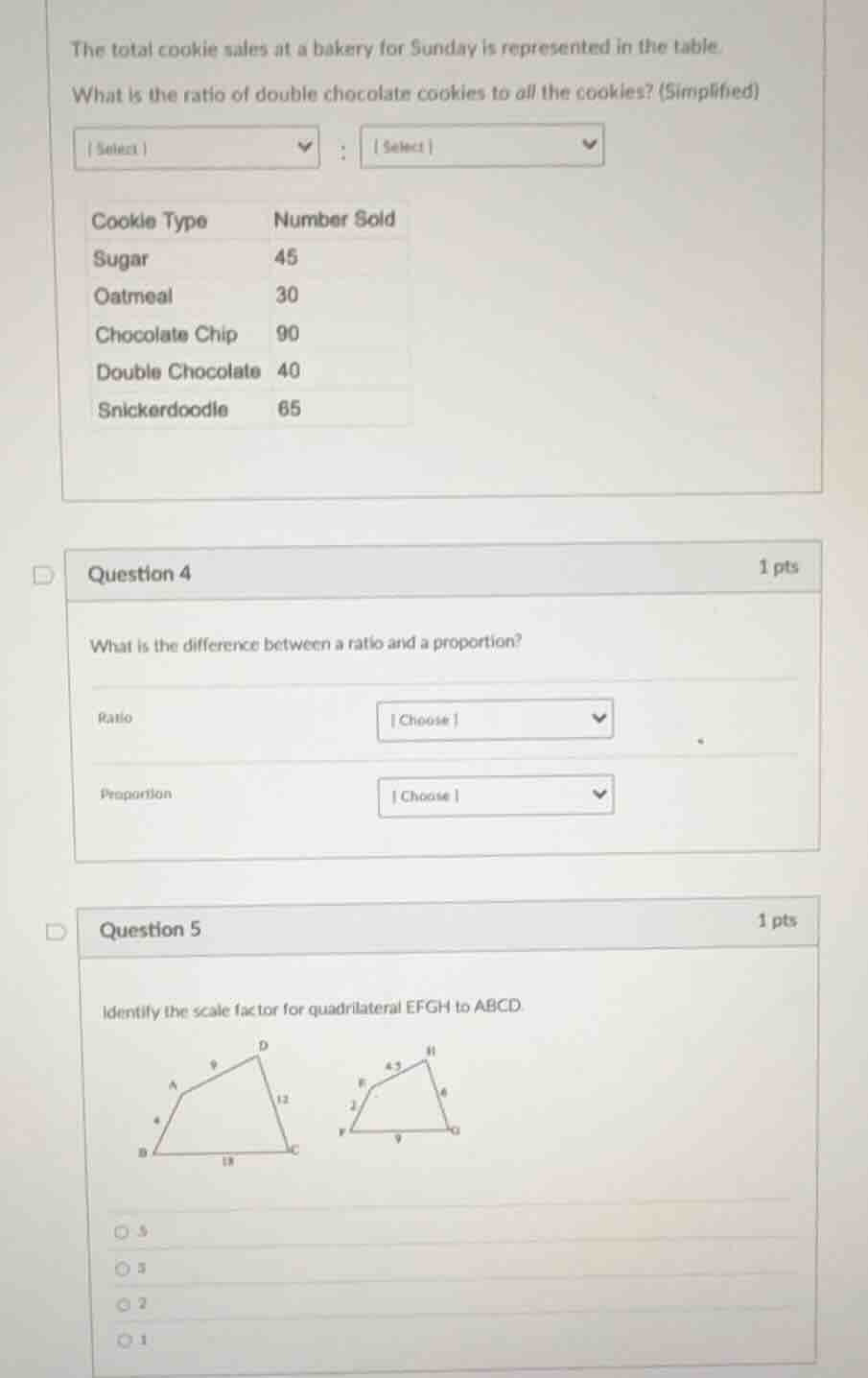
the total cookie sales at a bakery for sunday is represented in the table. what is the ratio of double chocolate cookies to all the cookies? (simplified) select : select cookie type number sold sugar 45 oatmeal 30 chocolate chip 90 double chocolate 40 snickerdoodle 65 question 4 1 pts what is the difference between a ratio and a proportion? ratio choose proportion choose question 5 1 pts identify the scale factor for quadrilateral efgh to abcd (images of quadrilaterals with side lengths: abcd has sides 4, 9, 12, 18; efgh has sides 2, 4.5, 6, 9) options: 5, 3, 2, 1
First Sub - Question (Ratio of double chocolate cookies to all cookies)
Step 1: Calculate total number of cookies
We add up the number of each type of cookie. So, \(45 + 30+90 + 40+65\). Let's calculate that: \(45+30 = 75\), \(75 + 90=165\), \(165+40 = 205\), \(205 + 65=270\).
Step 2: Find the ratio of double chocolate to total
The number of double chocolate cookies is 40, and total is 270. So the ratio is \(\frac{40}{270}\). Simplify this fraction by dividing numerator and denominator by 10: \(\frac{4}{27}\). Wait, no, wait, 40 and 270: GCD of 40 and 270 is 10? Wait 40 ÷ 10 = 4, 270 ÷ 10 = 27? Wait no, 40 and 270: 40 = 2×20, 270 = 27×10. Wait, maybe I miscalculated total. Let's recalculate total: Sugar (45) + Oatmeal (30)=75; 75 + Chocolate Chip (90)=165; 165 + Double Chocolate (40)=205; 205 + Snickerdoodle (65)=270. Yes, total is 270. Double chocolate is 40. So ratio is 40:270, simplify by dividing both by 10: 4:27? Wait no, 40 and 270, GCD is 10? Wait 40 ÷ 10 = 4, 270 ÷ 10 = 27. Wait, but 4 and 27 have no common factors. Wait, but maybe I made a mistake in total. Wait 45+30=75, 75+90=165, 165+40=205, 205+65=270. Yes. So 40:270 simplifies to 4:27? Wait no, 40/270 = 4/27? Wait 40 divided by 10 is 4, 270 divided by 10 is 27. So the ratio is 4:27? Wait, no, wait 40 and 270: GCD is 10? Wait 40 = 2×20, 270 = 27×10. So yes, divide numerator and denominator by 10. So 4:27.
Second Sub - Question (Difference between ratio and proportion)
A ratio is a comparison of two quantities (e.g., \(a:b\) or \(\frac{a}{b}\)), showing the relative size of one to the other. A proportion is an equation stating that two ratios are equal (e.g., \(\frac{a}{b}=\frac{c}{d}\)).
Step 1: Identify corresponding sides
Let's take corresponding sides. For example, side AB in ABCD is 4, and side EF in EFGH is 2. Or side BC in ABCD is 18, side FG in EFGH is 9. Or side CD in ABCD is 12, side GH in EFGH is 6. Or side DA in ABCD is 9, side HE in EFGH is 4.5.
Step 2: Calculate the scale factor
Scale factor from EFGH to ABCD is \(\frac{\text{Length of side in ABCD}}{\text{Length of corresponding side in EFGH}}\). Let's take AB = 4 and EF = 2. So scale factor is \(\frac{4}{2}=2\)? Wait no, wait the question is EFGH to ABCD. So EFGH is the image, ABCD is the original? Wait, no, scale factor from EFGH to ABCD: so if EFGH is the new figure and ABCD is the original, then scale factor \(k=\frac{\text{Length in ABCD}}{\text{Length in EFGH}}\). Let's take BC (18) and FG (9): \(\frac{18}{9}=2\). CD (12) and GH (6): \(\frac{12}{6}=2\). DA (9) and HE (4.5): \(\frac{9}{4.5}=2\). AB (4) and EF (2): \(\frac{4}{2}=2\). So scale factor is 2. Wait, but the options are 5, 3, 2, 1. So the answer is 2.

Snap & solve any problem in the app
Get step-by-step solutions on Sovi AI
Photo-based solutions with guided steps
Explore more problems and detailed explanations
Ratio: A comparison of two quantities (e.g., \(a:b\) or \(\frac{a}{b}\)).
Proportion: An equation stating two ratios are equal (e.g., \(\frac{a}{b}=\frac{c}{d}\)).