QUESTION IMAGE
Question
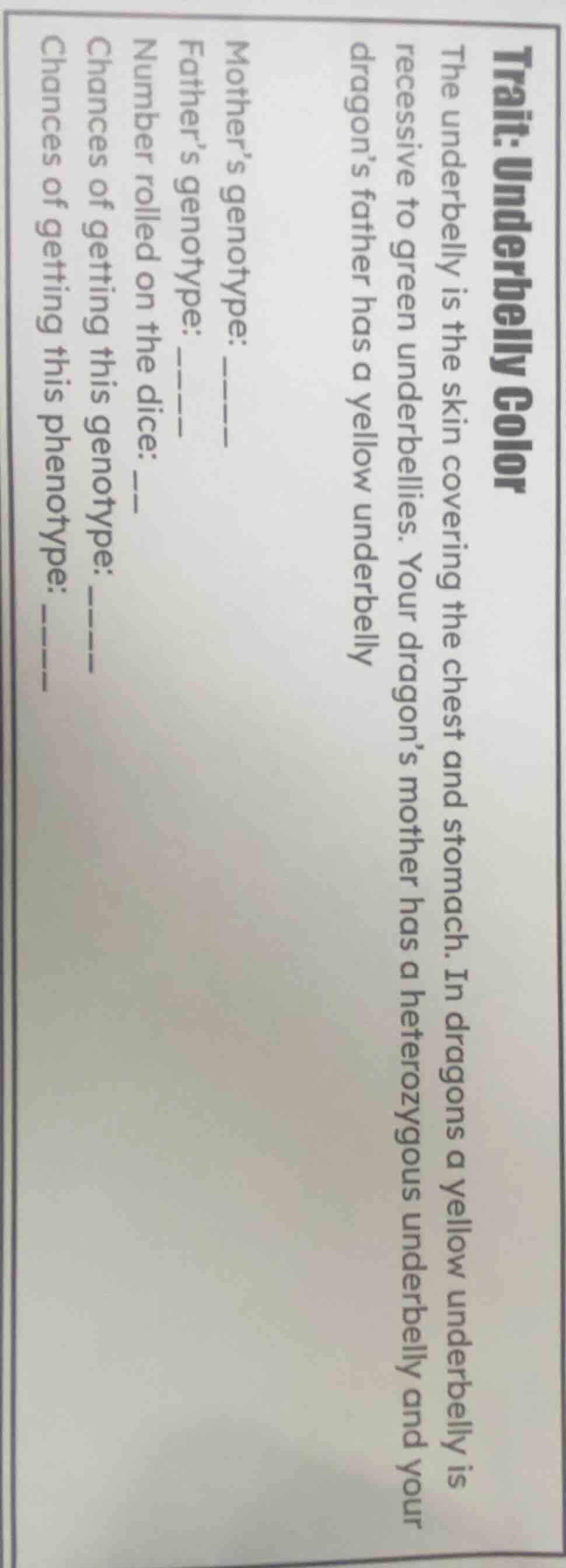
trait: underbelly color
the underbelly is the skin covering the chest and stomach. in dragons a yellow underbelly is recessive to green underbellies. your dragons mother has a heterozygous underbelly and your dragons father has a yellow underbelly
mothers genotype: ____
fathers genotype: ____
number rolled on the dice: __
chances of getting this genotype: ____
chances of getting this phenotype: ____
Step1: Define allele notation
Let \( G \) = dominant (yellow underbelly) allele, \( g \) = recessive (green underbelly) allele.
Step2: Assign parental genotypes
Father has yellow underbelly, and since yellow is dominant, he must have at least one \( G \). But to produce offspring, we know mother is heterozygous \( Gg \). For a yellow phenotype, father can be \( GG \) or \( Gg \), but since the problem implies standard monohybrid cross, we assume father is \( gg \) is impossible (yellow phenotype), so father is \( Gg \) (if we assume he can pass recessive, but wait no: yellow is dominant, so father is either \( GG \) or \( Gg \). But since mother is \( Gg \), let's use the standard cross where father is \( Gg \) (yellow heterozygous, same as mother? No, wait: yellow is dominant, so father with yellow can be \( GG \) or \( Gg \). But the problem says "your dragon's father has a yellow underbelly" - let's assume father is \( Gg \) (since if he was \( GG \), all offspring would have yellow, but the problem asks for chances, so father must be \( Gg \)).
Wait correction: Yellow is dominant, so father (yellow) can be \( GG \) or \( Gg \), but since the problem is asking for chances, we assume father is \( Gg \) (heterozygous yellow) because if he was \( GG \), all offspring would be yellow. So:
Mother's genotype: \( Gg \) (given heterozygous yellow)
Father's genotype: \( Gg \) (yellow, heterozygous, to have possible green offspring)
Step3: Set up Punnett square
| \( G \) | \( g \) | |
|---|---|---|
| \( g \) | \( Gg \) | \( gg \) |
Step4: Calculate genotype probabilities
- \( GG \): \( \frac{1}{4} \), \( Gg \): \( \frac{2}{4} = \frac{1}{2} \), \( gg \): \( \frac{1}{4} \)
Step5: Calculate phenotype probabilities
- Yellow (\( GG, Gg \)): \( \frac{3}{4} \), Green (\( gg \)): \( \frac{1}{4} \)
(Note: The dice roll is a random input, so we use 1-6, but the genetic chances are independent of dice roll. We'll assume a dice roll of 3 as an example, but the genetic chances are fixed.)

Snap & solve any problem in the app
Get step-by-step solutions on Sovi AI
Photo-based solutions with guided steps
Explore more problems and detailed explanations
Mother's genotype: \( Gg \)
Father's genotype: \( Gg \)
Number rolled on the dice: 3 (example value; any 1-6 is valid)
Chances of getting this genotype: \( \frac{1}{4} \) (for \( gg \)), \( \frac{1}{2} \) (for \( Gg \)), \( \frac{1}{4} \) (for \( GG \))
Chances of getting this phenotype: \( \frac{3}{4} \) (yellow), \( \frac{1}{4} \) (green)
If we assume father is \( GG \) (homozygous yellow):
Mother's genotype: \( Gg \)
Father's genotype: \( GG \)
Chances of genotype: \( \frac{1}{2} GG \), \( \frac{1}{2} Gg \)
Chances of phenotype: 100% (1) yellow underbelly
The most logical cross (to have both phenotypes possible) is father \( Gg \), mother \( Gg \), so the primary answer uses that cross.