QUESTION IMAGE
Question
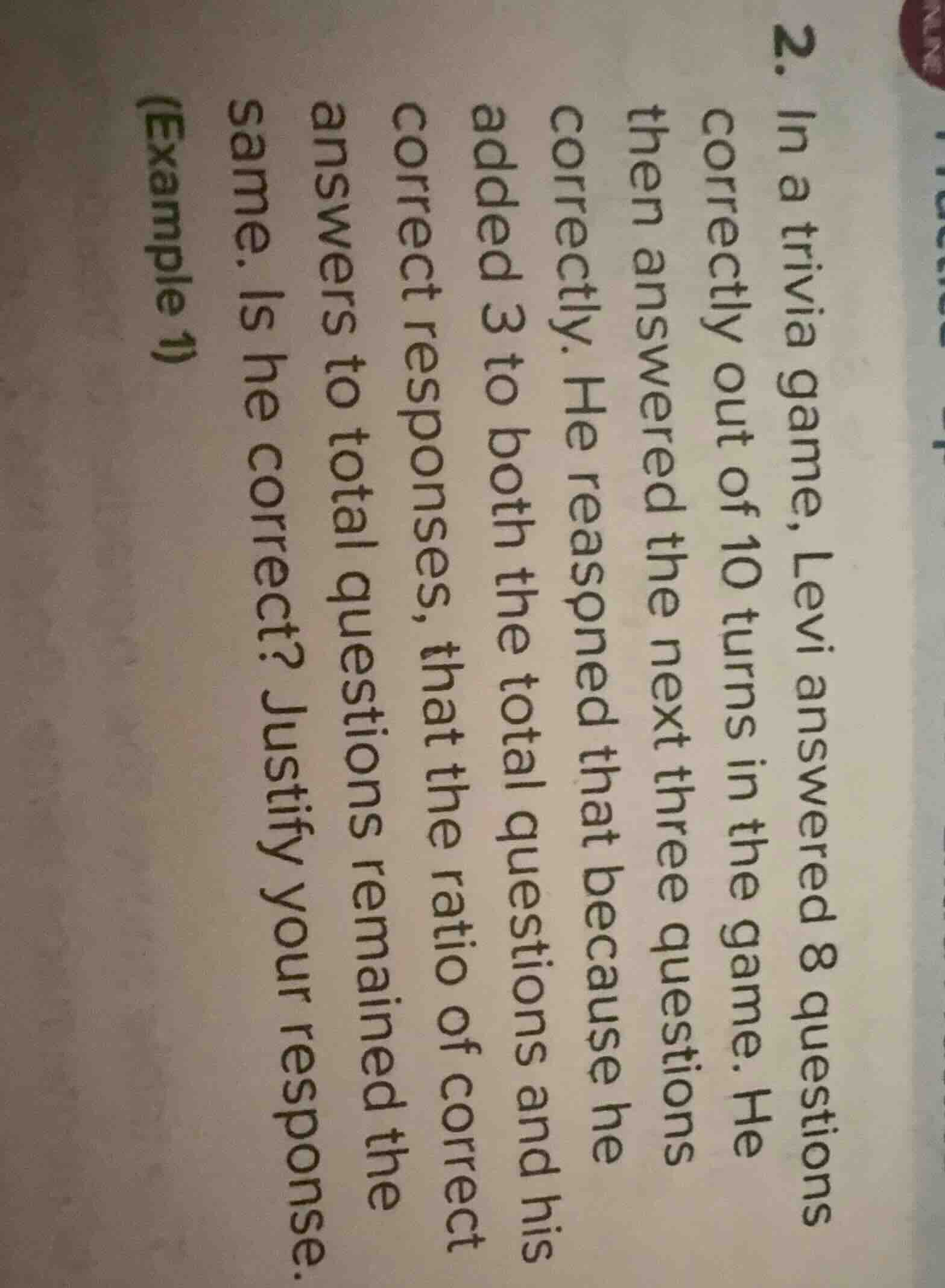
- in a trivia game, levi answered 8 questions correctly out of 10 turns in the game. he then answered the next three questions correctly. he reasoned that because he added 3 to both the total questions and his correct responses, that the ratio of correct answers to total questions remained the same. is he correct? justify your response. (example 1)
Step1: Find initial ratio
Initial correct answers = 8, initial total questions = 10. Initial ratio = $\frac{8}{10}=\frac{4}{5}$.
Step2: Find new ratio
New correct answers = 8 + 3 = 11, new total questions = 10 + 3 = 13. New ratio = $\frac{11}{13}$.
Step3: Compare ratios
$\frac{4}{5} = 0.8$, $\frac{11}{13} \approx 0.846$. Since $0.8
eq 0.846$, the ratios are different.

Snap & solve any problem in the app
Get step-by-step solutions on Sovi AI
Photo-based solutions with guided steps
Explore more problems and detailed explanations
Levi is not correct because the initial ratio of correct to total questions ($\frac{8}{10}=\frac{4}{5}$) is not equal to the new ratio ($\frac{11}{13}$) after adding 3 to both.