QUESTION IMAGE
Question
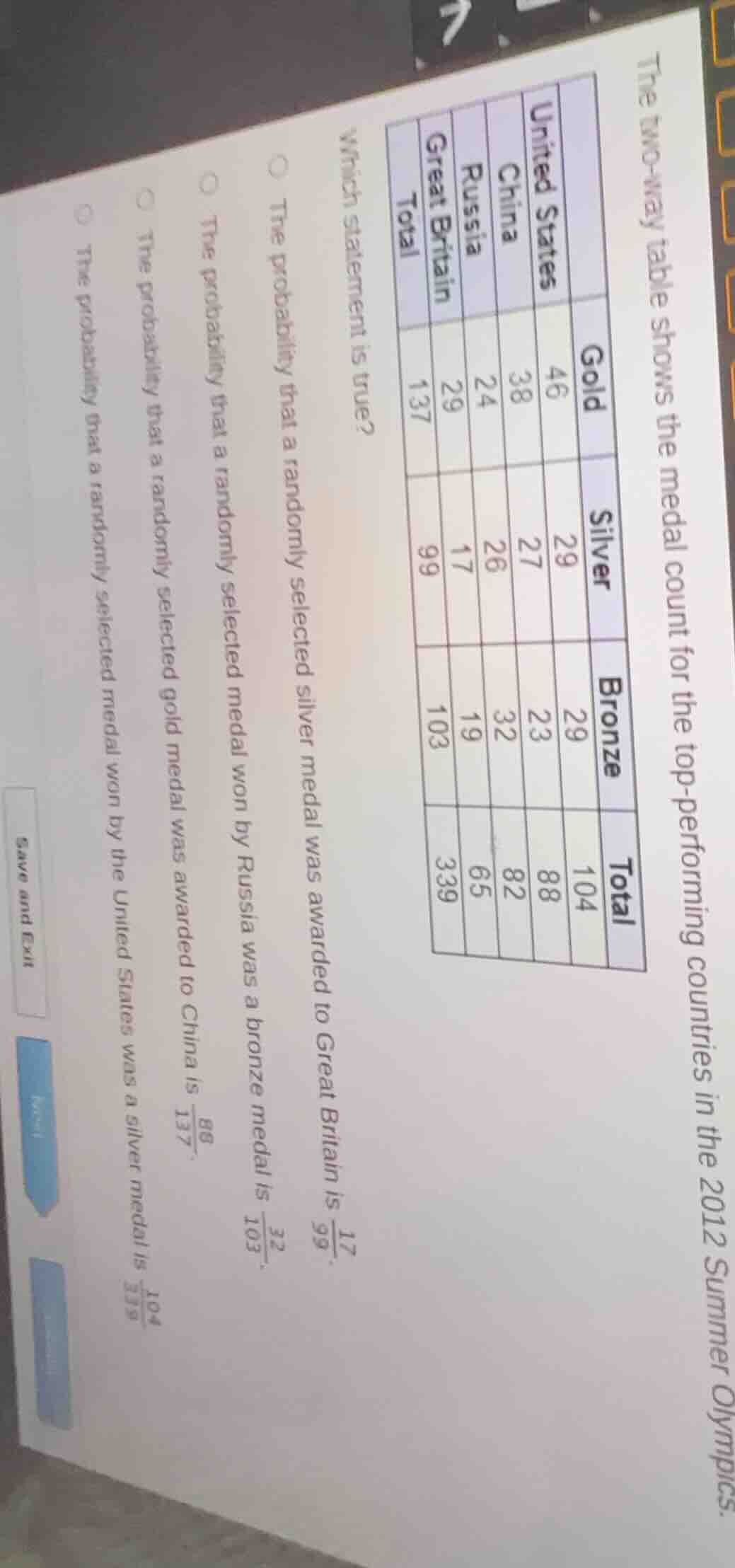
the two - way table shows the medal count for the top - performing countries in the 2012 summer olympics.
| united states | china | russia | great britain | total | |
|---|---|---|---|---|---|
| silver | 29 | 27 | 26 | 17 | 99 |
| bronze | 29 | 23 | 32 | 19 | 103 |
| total | 104 | 88 | 82 | 65 | 339 |
which statement is true?
- the probability that a randomly selected silver medal was awarded to great britain is $\frac{17}{99}$.
- the probability that a randomly selected medal won by russia was a bronze medal is $\frac{32}{103}$.
- the probability that a randomly selected gold medal was awarded to china is $\frac{88}{137}$.
- the probability that a randomly selected medal won by the united states was a silver medal is $\frac{104}{339}$.
Response
To determine the correct statement, we analyze each option using the two - way table:
Option 1: Probability that a randomly selected silver medal was awarded to Great Britain
- The total number of silver medals is \(n(\text{Silver}) = 99\) (from the "Silver" row, "Total" column).
- The number of silver medals awarded to Great Britain is \(n(\text{Silver} \cap \text{Great Britain})=17\).
- The probability \(P=\frac{n(\text{Silver} \cap \text{Great Britain})}{n(\text{Silver})}=\frac{17}{99}\approx0.1717\). Let's check other options to be sure.
Option 2: Probability that a randomly selected medal won by Russia was a bronze medal
- The total number of medals won by Russia is \(n(\text{Russia}) = 82\) (from the "Russia" column, "Total" row).
- The number of bronze medals won by Russia is \(n(\text{Bronze} \cap \text{Russia}) = 32\).
- The probability \(P=\frac{n(\text{Bronze} \cap \text{Russia})}{n(\text{Russia})}=\frac{32}{82}=\frac{16}{41}\approx0.3902\). And \(\frac{32}{103}\) (where 103 is the total number of bronze medals) is incorrect as we are looking at medals won by Russia, so the denominator should be the total number of medals of Russia.
Option 3: Probability that a randomly selected gold medal was awarded to China
- The total number of gold medals is \(n(\text{Gold})=137\) (from the "Gold" row, "Total" column).
- The number of gold medals awarded to China is \(n(\text{Gold} \cap \text{China}) = 38\).
- The probability \(P=\frac{n(\text{Gold} \cap \text{China})}{n(\text{Gold})}=\frac{38}{137}\approx0.2774\), not \(\frac{88}{137}\) (88 is the total number of medals of China).
Option 4: Probability that a randomly selected medal won by the United States was a silver medal
- The total number of medals won by the United States is \(n(\text{United States})=104\) (from the "United States" column, "Total" row).
- The number of silver medals won by the United States is \(n(\text{Silver} \cap \text{United States}) = 29\).
- The probability \(P=\frac{n(\text{Silver} \cap \text{United States})}{n(\text{United States})}=\frac{29}{104}\approx0.2788\), not \(\frac{104}{339}\) (339 is the total number of medals).
So the correct statement is "The probability that a randomly selected silver medal was awarded to Great Britain is \(\frac{17}{99}\)".

Snap & solve any problem in the app
Get step-by-step solutions on Sovi AI
Photo-based solutions with guided steps
Explore more problems and detailed explanations
The probability that a randomly selected silver medal was awarded to Great Britain is \(\frac{17}{99}\) (the first option among the given options about silver medal and Great Britain)