QUESTION IMAGE
Question
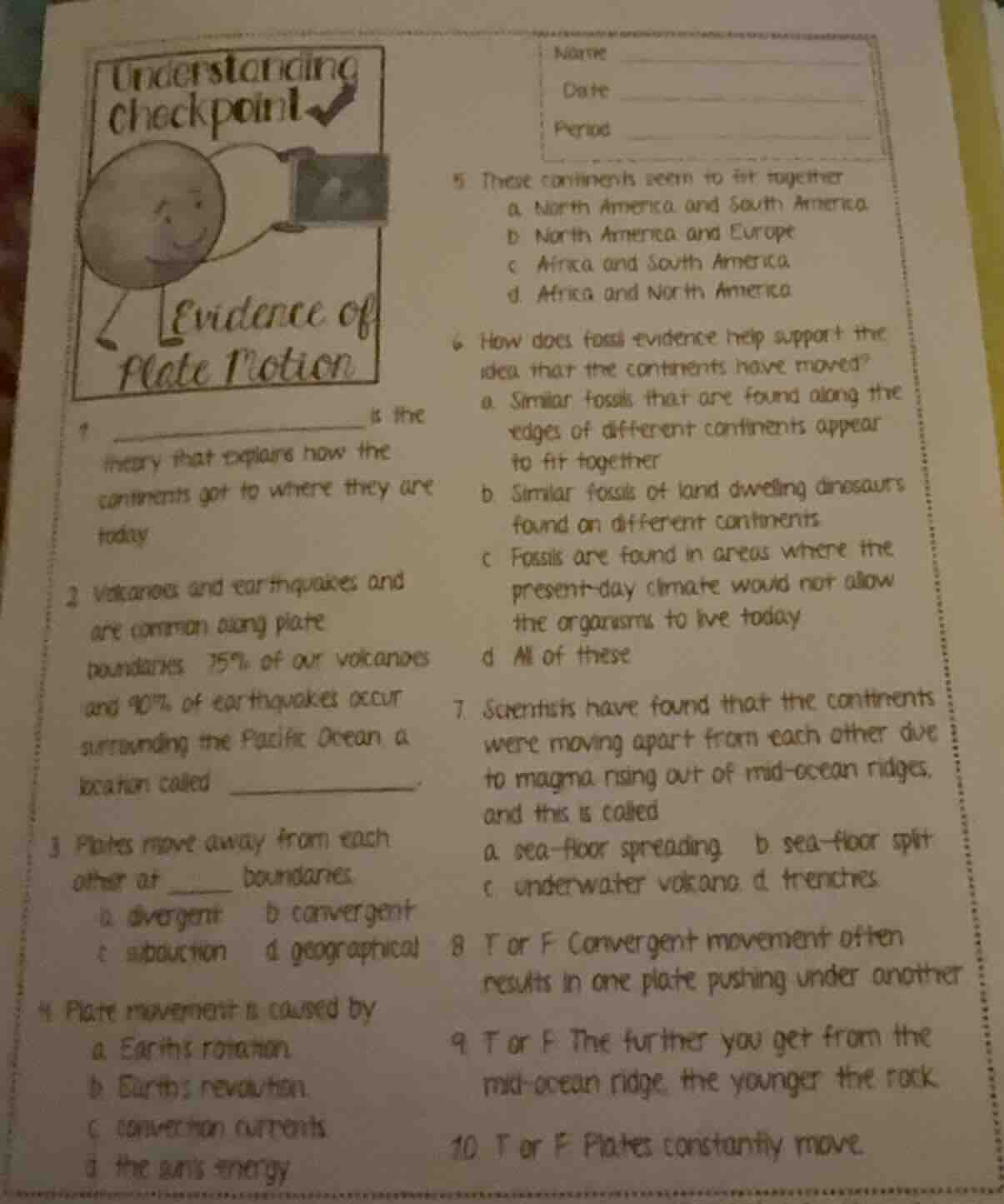
understanding checkpoint evidence of plate motion 1. ________ is the theory that explains how the continents got to where they are today 2. volcanoes and earthquakes and are common along plate boundaries. 75% of our volcanoes and 90% of earthquakes occur surrounding the pacific ocean a location called ______. 3. plates move away from each other at ____ boundaries. a. divergent b. convergent c. subduction d. geographical 4. plate movement is caused by a. earth’s rotation b. earth’s revolution c. convection currents d. the sun’s energy 5. these continents seem to fit together a. north america and south america b. north america and europe c. africa and south america d. africa and north america 6. how does fossil evidence help support the idea that the continents have moved? a. similar fossils that are found along the edges of different continents appear to fit together b. similar fossils of land dwelling dinosaurs found on different continents c. fossils are found in areas where the present - day climate would not allow the organisms to live today d. all of these 7. scientists have found that the continents were moving apart from each other due to magma rising out of mid - ocean ridges, and this is called a. sea - floor spreading b. sea - floor split c. underwater volcano d. trenches 8. t or f convergent movement often results in one plate pushing under another 9. t or f the further you get from the mid - ocean ridge, the younger the rock 10. t or f plates constantly move.
Question 1
The theory explaining continental movement is Continental Drift (or Plate Tectonics, but the primary theory for how continents got to their current positions is Continental Drift initially, now part of Plate Tectonics).
The area around the Pacific Ocean with most volcanoes and earthquakes is the Ring of Fire.
Plates move away at divergent boundaries. Convergent is towards each other, subduction is a type of convergent, geographical is not a plate boundary type.

Snap & solve any problem in the app
Get step-by-step solutions on Sovi AI
Photo-based solutions with guided steps
Explore more problems and detailed explanations
Continental Drift (or Plate Tectonics)