QUESTION IMAGE
Question
understanding macromolecules
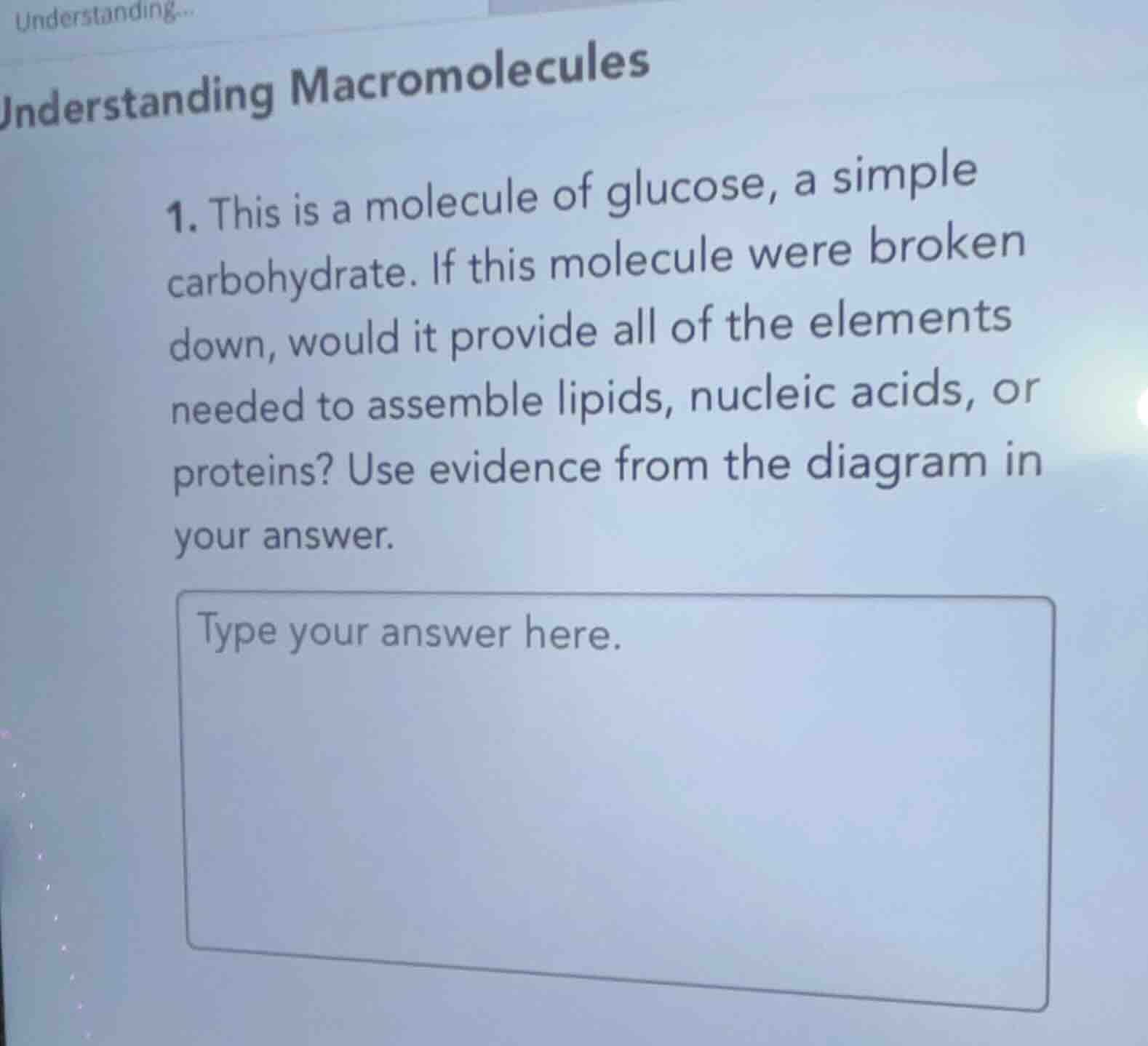
- this is a molecule of glucose, a simple carbohydrate. if this molecule were broken down, would it provide all of the elements needed to assemble lipids, nucleic acids, or proteins? use evidence from the diagram in your answer.
type your answer here.
Glucose has elements C, H, O. Lipids also have C, H, O (some have P, but basic lipids can use glucose's elements as glucose can be converted to fatty acids/glycerol with C, H, O). Nucleic acids need P, N (glucose has no N/P), proteins need N (glucose has no N). So glucose can provide elements for lipids (since lipids’ core elements C, H, O are in glucose; even with P in some lipids, glucose - derived components can contribute to lipid synthesis). For nucleic acids/proteins, missing N/P (nucleic) or N (protein), so only lipids can be assembled with glucose - derived elements.

Snap & solve any problem in the app
Get step-by-step solutions on Sovi AI
Photo-based solutions with guided steps
Explore more problems and detailed explanations
Glucose (formula \(C_6H_{12}O_6\)) contains carbon (C), hydrogen (H), and oxygen (O). Lipids are primarily composed of C, H, O (some lipids also contain phosphorus, but the basic building blocks of lipids, like fatty acids and glycerol, can be synthesized using C, H, O from glucose). Nucleic acids require nitrogen (N) and phosphorus (P) in addition to C, H, O, and proteins require nitrogen (N) in addition to C, H, O. Since glucose lacks N and P, it cannot provide all elements for nucleic acids or proteins. Thus, glucose - derived elements (C, H, O) can provide the necessary elements to assemble lipids.