QUESTION IMAGE
Question
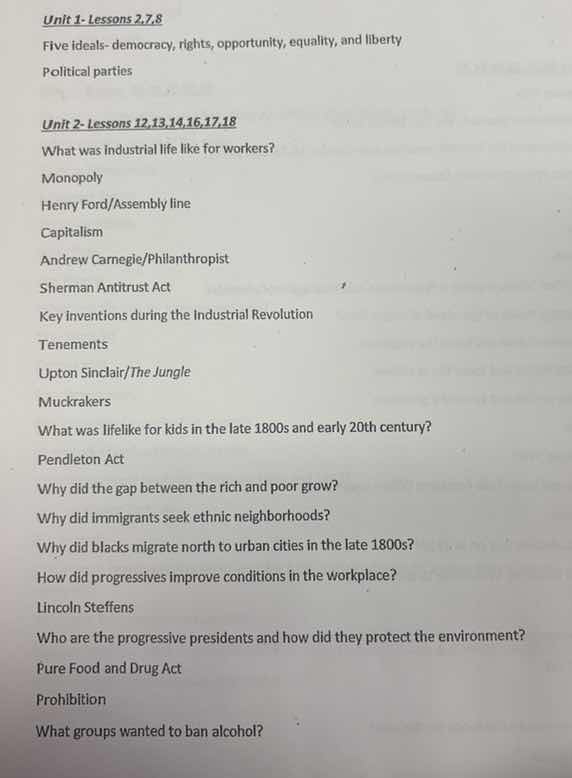
unit 1- lessons 2,7,8
five ideals- democracy, rights, opportunity, equality, and liberty
political parties
unit 2- lessons 12,13,14,16,17,18
what was industrial life like for workers?
monopoly
henry ford/assembly line
capitalism
andrew carnegie/philanthropist
sherman antitrust act
key inventions during the industrial revolution
tenements
upton sinclair/the jungle
muckrakers
what was lifelike for kids in the late 1800s and early 20th century?
pendleton act
why did the gap between the rich and poor grow?
why did immigrants seek ethnic neighborhoods?
why did blacks migrate north to urban cities in the late 1800s?
how did progressives improve conditions in the workplace?
lincoln steffens
who are the progressive presidents and how did they protect the environment?
pure food and drug act
prohibition
what groups wanted to ban alcohol?
Since the text provided is a list of topics related to history, industrialization, and social issues in the United States, and there's no specific question asked, I'll assume you might want to know the discipline and subfield this belongs to or get help with studying these topics.
Discipline and Subfield:
The topics here fall under the Social Science discipline, specifically the subfield of History (as it deals with historical events, periods, and social changes in the late 19th and early 20th centuries) and also touches on Sociology (due to questions about social classes, immigration, ethnic neighborhoods, and workplace conditions).
If you want help with a specific question (e.g., "What was industrial life like for workers?"):
To answer "What was industrial life like for workers?" during the Industrial Revolution (late 1800s - early 1900s):
- Working Conditions: Long hours (12 + hours/day, 6 days/week), low wages, dangerous machinery (high injury rates), poor ventilation, and unsanitary workspaces.
- Labor Rights: Few to no rights; no minimum wage, no worker's compensation, and anti - union sentiments (employers used "yellow dog contracts" to prevent unionization).
- Social Impact: Workers lived in tenements (overcrowded, unsanitary housing), faced health issues due to poor living and working conditions, and child labor was common (kids worked in factories, mines, etc., for low pay).

Snap & solve any problem in the app
Get step-by-step solutions on Sovi AI
Photo-based solutions with guided steps
Explore more problems and detailed explanations
Industrial life for workers was harsh: long hours (often 12 + hours daily, 6 days weekly), low wages, dangerous working conditions with unguarded machinery (high injury rates), unsanitary and poorly ventilated workspaces. They had few labor rights, lived in overcrowded tenements, and child labor was prevalent. Unions were suppressed, and employers used tactics like yellow dog contracts to prevent organization.