QUESTION IMAGE
Question
unit 2, module 2: intelligent design and evolution (natural selection)
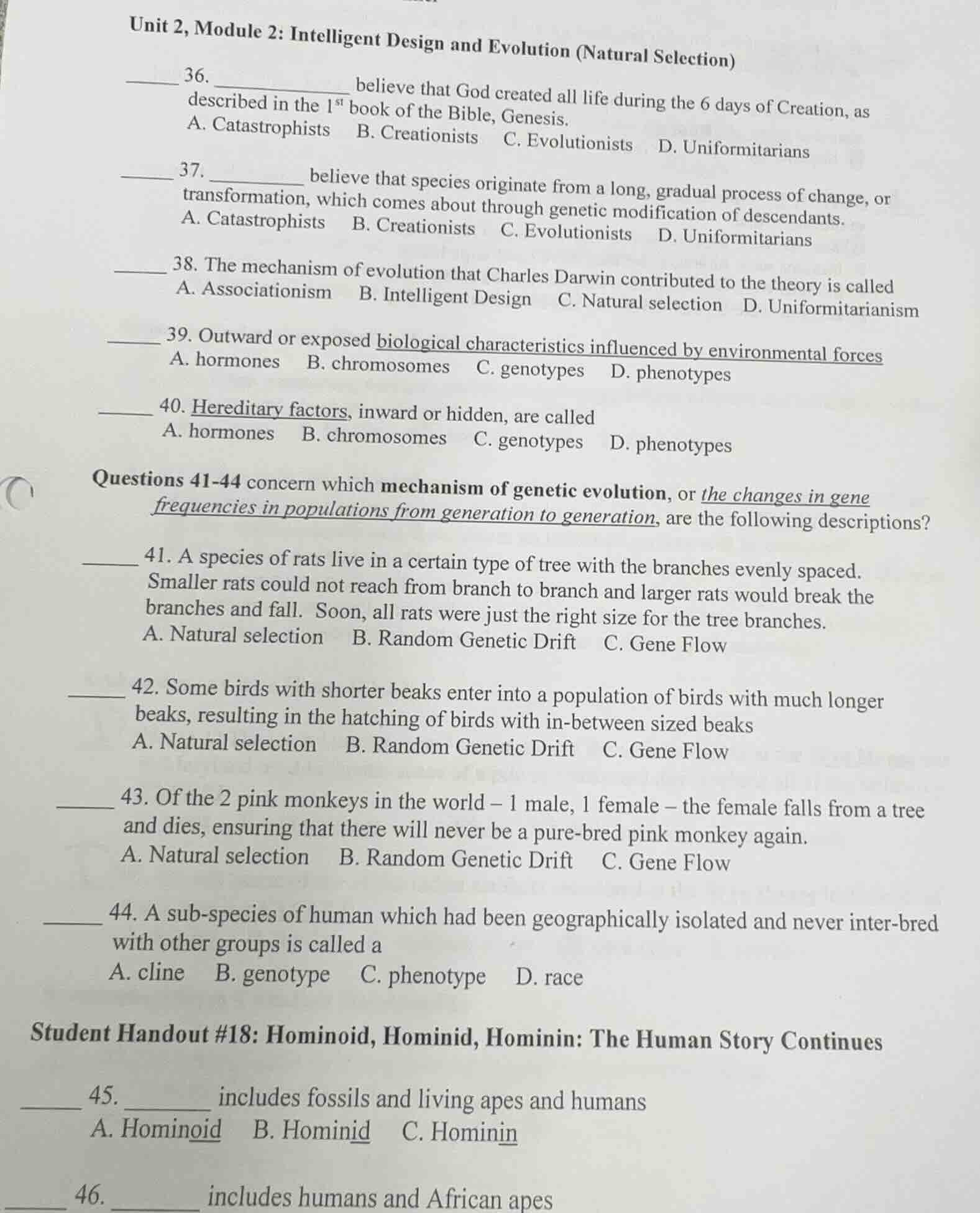
- _______ believe that god created all life during the 6 days of creation, as described in the 1st book of the bible, genesis.
a. catastrophists b. creationists c. evolutionists d. uniformitarians
- _______ believe that species originate from a long, gradual process of change, or transformation, which comes about through genetic modification of descendants.
a. catastrophists b. creationists c. evolutionists d. uniformitarians
- the mechanism of evolution that charles darwin contributed to the theory is called
a. associationism b. intelligent design c. natural selection d. uniformitarianism
- outward or exposed biological characteristics influenced by environmental forces
a. hormones b. chromosomes c. genotypes d. phenotypes
- hereditary factors, inward or hidden, are called
a. hormones b. chromosomes c. genotypes d. phenotypes
questions 41 - 44 concern which mechanism of genetic evolution, or the changes in gene frequencies in populations from generation to generation, are the following descriptions?
- a species of rats live in a certain type of tree with the branches evenly spaced. smaller rats could not reach from branch to branch and larger rats would break the branches and fall. soon, all rats were just the right size for the tree branches.
a. natural selection b. random genetic drift c. gene flow
- some birds with shorter beaks enter into a population of birds with much longer beaks, resulting in the hatching of birds with in - between sized beaks
a. natural selection b. random genetic drift c. gene flow
- of the 2 pink monkeys in the world – 1 male, 1 female – the female falls from a tree and dies, ensuring that there will never be a pure - bred pink monkey again.
a. natural selection b. random genetic drift c. gene flow
- a sub - species of human which had been geographically isolated and never inter - bred with other groups is called a
a. cline b. genotype c. phenotype d. race
student handout #18: hominoid, hominid, hominin: the human story continues
- _______ includes fossils and living apes and humans
a. hominoid b. hominid c. hominin
- _______ includes humans and african apes
- Creationists adhere to the biblical account of 6-day creation.
- Evolutionists propose species change via gradual genetic modification over time.
- Charles Darwin's key evolutionary mechanism is natural selection.
- Phenotypes are observable traits shaped by genetics and environment.
- Genotypes are the hidden hereditary genetic factors of an organism.
- This describes natural selection, where only well-adapted rats survive to reproduce.
- Gene flow occurs when new individuals with different traits join a population and interbreed.
- Random Genetic Drift is the random loss of genetic variation (here, the pink monkey gene pool is lost by chance).
- A geographically isolated human subspecies that does not interbreed is called a race.
- Hominoids include all living and fossil apes, as well as humans.
- Hominids include humans and African apes (chimpanzees, gorillas, bonobos).

Snap & solve any problem in the app
Get step-by-step solutions on Sovi AI
Photo-based solutions with guided steps
Explore more problems and detailed explanations
- B. Creationists
- C. Evolutionists
- C. Natural selection
- D. phenotypes
- C. genotypes
- A. Natural selection
- C. Gene Flow
- B. Random Genetic Drift
- D. race
- A. Hominoid
- B. Hominid