QUESTION IMAGE
Question
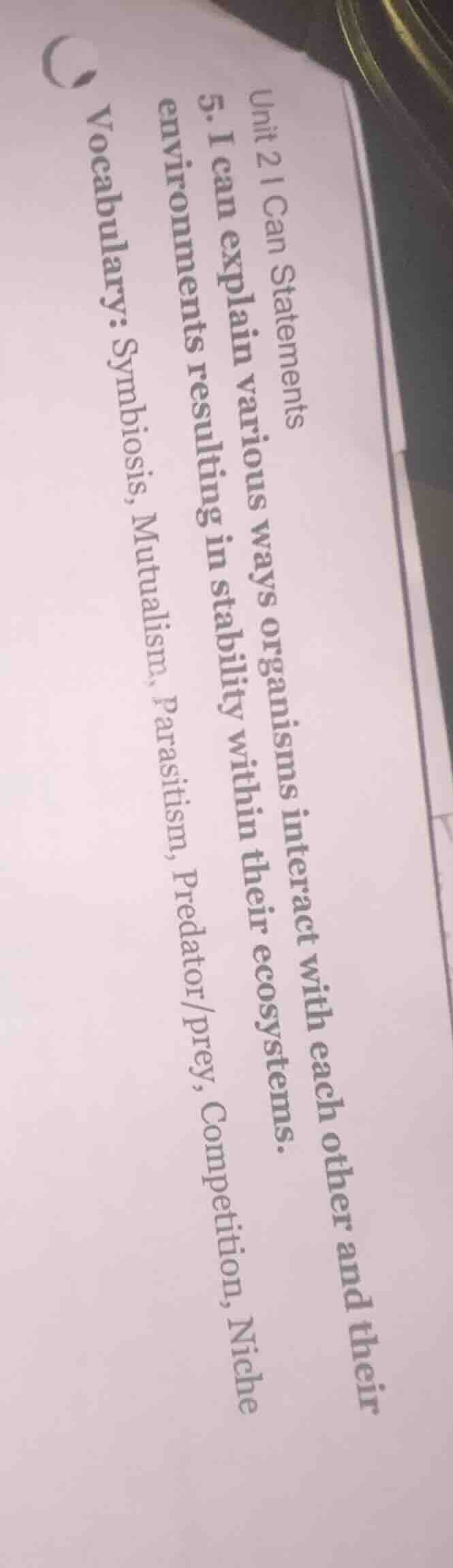
unit 2 i can statements 5. i can explain various ways organisms interact with each other and their environments resulting in stability within their ecosystems. vocabulary: symbiosis, mutualism, parasitism, predator/prey, competition, niche
Brief Explanations
Organism interactions are categorized as symbiotic or non-symbiotic, each driving ecosystem stability:
- Mutualism (Symbiosis): Both organisms benefit (e.g., bees pollinating flowers; bees get nectar, flowers get reproduction support). This increases survival rates of both species, maintaining population balances.
- Parasitism (Symbiosis): One organism (parasite) benefits at the host's expense (e.g., ticks on deer). Parasites regulate host populations, preventing overgrazing or overcrowding.
- Predator/Prey: Predators hunt prey (e.g., lions and zebras). This controls prey populations, preventing overconsumption of resources, and predator populations adjust with prey numbers to keep the system balanced.
- Competition: Organisms fight for limited resources (food, space). This filters out weaker individuals, ensuring only the most adapted survive, keeping ecosystem resource use sustainable.
- Niche: An organism's unique role (food, habitat, activity time). Niche partitioning reduces competition, allowing multiple species to coexist without depleting shared resources.
All these interactions prevent any single species from dominating, maintaining biodiversity and long-term ecosystem stability.

Snap & solve any problem in the app
Get step-by-step solutions on Sovi AI
Photo-based solutions with guided steps
Explore more problems and detailed explanations
Organisms interact and stabilize ecosystems through these key ways:
- Mutualism: A symbiotic relationship where both species gain benefits, boosting their survival and supporting balanced populations.
- Parasitism: A symbiotic relationship where a parasite benefits from a host, regulating host population sizes to avoid overcrowding.
- Predator/Prey Dynamics: Predators control prey populations, preventing overconsumption of resources, while prey availability limits predator numbers to maintain balance.
- Competition: Species compete for limited resources, selecting for more adapted individuals and ensuring sustainable resource use.
- Niche Specialization: Each species has a unique ecological role (niche), reducing competition and enabling diverse species to coexist, supporting overall ecosystem biodiversity and stability.