QUESTION IMAGE
Question
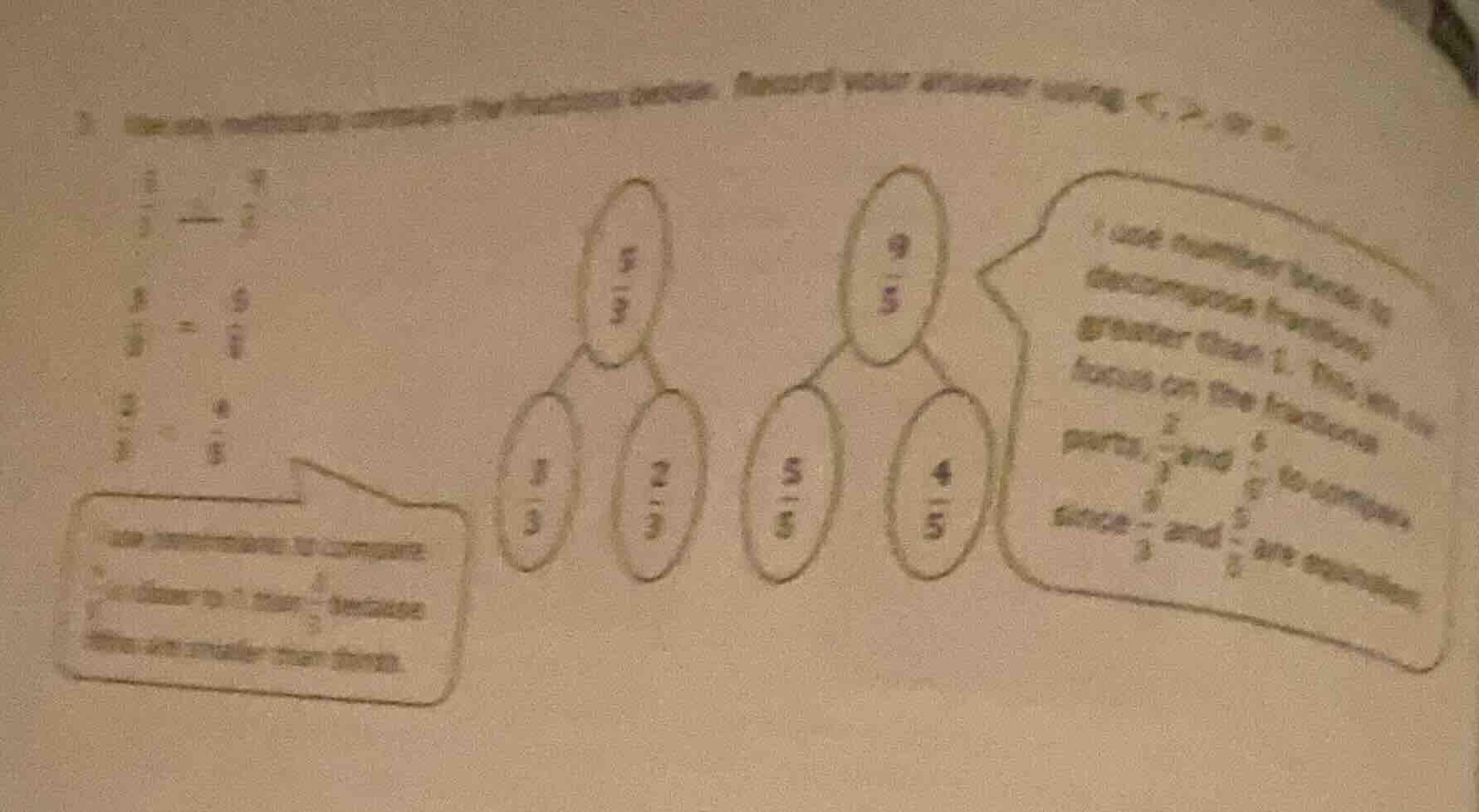
- use the method to compare the fraction pairs. record your answer using <, >, or =.
\\(\frac{8}{3}\\) __ (\frac{9}{5})
\\(\frac{8}{9}\\) __ (\frac{5}{8})
\\(\frac{2}{3}\\) __ (\frac{4}{5})
(note: the image contains fraction decomposition and comparison hints, such as decomposing (\frac{5}{3}) into (\frac{3}{3}) and (\frac{2}{3}), and (\frac{9}{5}) into (\frac{5}{5}) and (\frac{4}{5}), and hints about comparing fraction parts greater than 1 by focusing on the fractional parts.)
Step1: Analyze the first fraction pair $\frac{5}{3}$ and $\frac{9}{5}$
Decompose the mixed numbers (though here they are improper fractions, we can think of them as sums of whole and fractional parts or just compare the fractions). First, let's find a common denominator for $\frac{5}{3}$ and $\frac{9}{5}$. The common denominator of 3 and 5 is 15.
Convert $\frac{5}{3}$ to fifteenths: $\frac{5}{3}=\frac{5\times5}{3\times5}=\frac{25}{15}$
Convert $\frac{9}{5}$ to fifteenths: $\frac{9}{5}=\frac{9\times3}{5\times3}=\frac{27}{15}$
Now compare $\frac{25}{15}$ and $\frac{27}{15}$. Since $25 < 27$, we have $\frac{5}{3}<\frac{9}{5}$? Wait, no, wait. Wait, maybe the first pair is $\frac{5}{3}$ and $\frac{9}{5}$? Wait, looking at the diagram, the first decomposition is $\frac{5}{3}=\frac{3}{3}+\frac{2}{3}=1 + \frac{2}{3}$, and $\frac{9}{5}=\frac{5}{5}+\frac{4}{5}=1+\frac{4}{5}$. Now compare the fractional parts $\frac{2}{3}$ and $\frac{4}{5}$. Find a common denominator for 3 and 5, which is 15. $\frac{2}{3}=\frac{10}{15}$, $\frac{4}{5}=\frac{12}{15}$. Since $\frac{10}{15}<\frac{12}{15}$, then $1+\frac{10}{15}<1+\frac{12}{15}$, so $\frac{5}{3}<\frac{9}{5}$? Wait, but maybe the first problem is $\frac{5}{3}$ vs $\frac{9}{5}$? Wait, the user's problem has some fractions: let's re - examine.
Wait, the first fraction comparison is $\frac{5}{3}$ and $\frac{9}{5}$? Wait, the left - hand side has $\frac{5}{3}$ decomposed into $\frac{3}{3}$ and $\frac{2}{3}$ (since $\frac{3}{3}=1$, so $\frac{3}{3}+\frac{2}{3}=1+\frac{2}{3}=\frac{5}{3}$), and the right - hand side $\frac{9}{5}$ is decomposed into $\frac{5}{5}$ and $\frac{4}{5}$ (since $\frac{5}{5} = 1$, so $\frac{5}{5}+\frac{4}{5}=1+\frac{4}{5}=\frac{9}{5}$). Now, to compare $\frac{5}{3}$ and $\frac{9}{5}$, we can compare their fractional parts after the whole number 1. The fractional part of $\frac{5}{3}$ is $\frac{2}{3}$, and the fractional part of $\frac{9}{5}$ is $\frac{4}{5}$. Find a common denominator for $\frac{2}{3}$ and $\frac{4}{5}$. The least common denominator of 3 and 5 is 15. $\frac{2}{3}=\frac{2\times5}{3\times5}=\frac{10}{15}$, $\frac{4}{5}=\frac{4\times3}{5\times3}=\frac{12}{15}$. Since $\frac{10}{15}<\frac{12}{15}$, then $\frac{5}{3}<\frac{9}{5}$.
Step2: Analyze the second fraction pair $\frac{8}{5}$ and $\frac{5}{8}$
We can use cross - multiplication. For two fractions $\frac{a}{b}$ and $\frac{c}{d}$, we compare $a\times d$ and $c\times b$. For $\frac{8}{5}$ and $\frac{5}{8}$, $a = 8$, $b = 5$, $c = 5$, $d = 8$. Then $a\times d=8\times8 = 64$, $c\times b = 5\times5=25$. Since $64>25$, $\frac{8}{5}>\frac{5}{8}$.
Step3: Analyze the third fraction pair $\frac{2}{3}$ and $\frac{4}{5}$
Find a common denominator. The least common denominator of 3 and 5 is 15. $\frac{2}{3}=\frac{2\times5}{3\times5}=\frac{10}{15}$, $\frac{4}{5}=\frac{4\times3}{5\times3}=\frac{12}{15}$. Since $10 < 12$, $\frac{2}{3}<\frac{4}{5}$.

Snap & solve any problem in the app
Get step-by-step solutions on Sovi AI
Photo-based solutions with guided steps
Explore more problems and detailed explanations
For $\frac{5}{3}$ and $\frac{9}{5}$: $\frac{5}{3}<\frac{9}{5}$; For $\frac{8}{5}$ and $\frac{5}{8}$: $\frac{8}{5}>\frac{5}{8}$; For $\frac{2}{3}$ and $\frac{4}{5}$: $\frac{2}{3}<\frac{4}{5}$