QUESTION IMAGE
Question
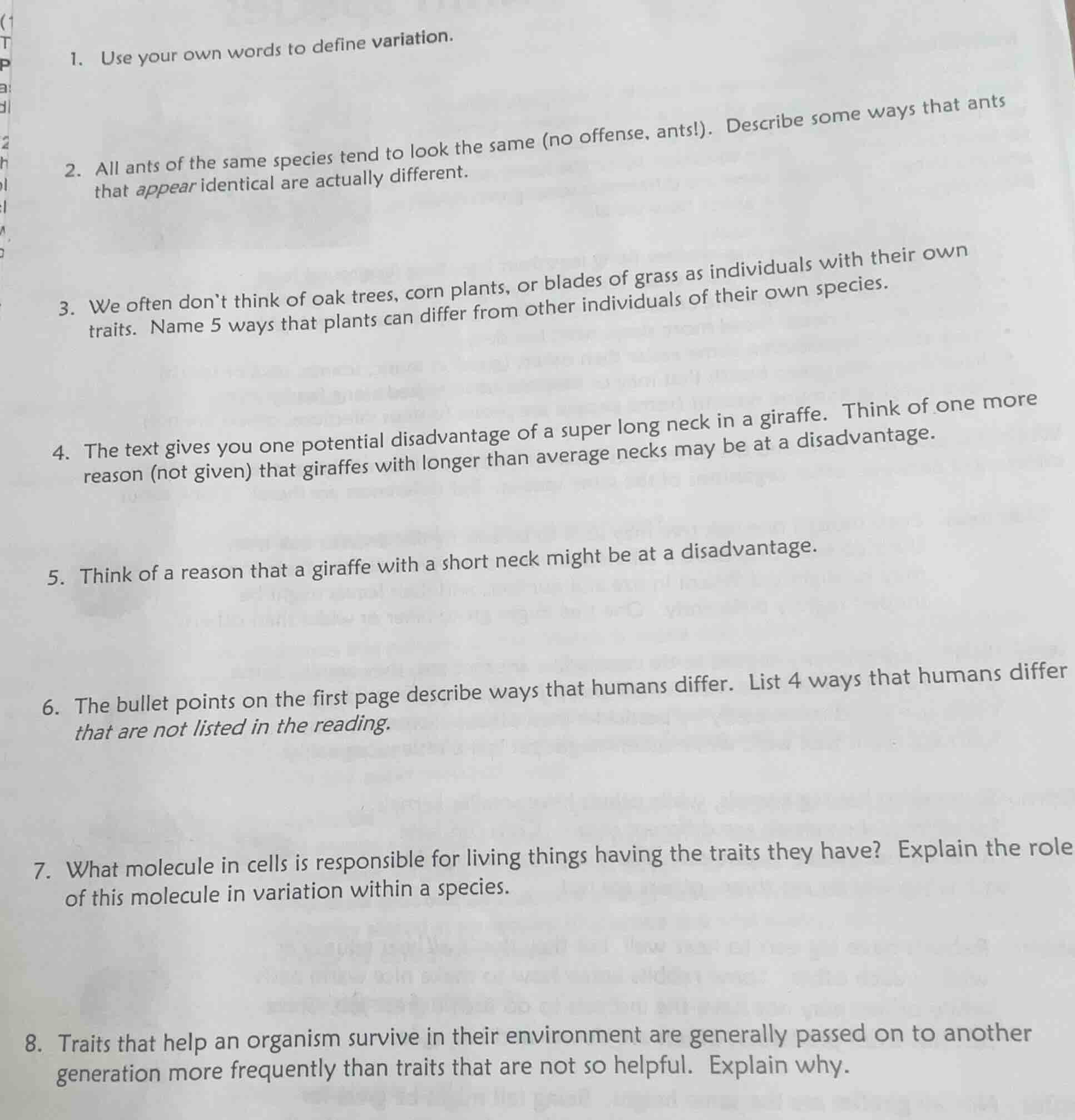
- use your own words to define variation.
- all ants of the same species tend to look the same (no offense, ants!). describe some ways that ants that appear identical are actually different.
- we often don’t think of oak trees, corn plants, or blades of grass as individuals with their own traits. name 5 ways that plants can differ from other individuals of their own species.
- the text gives you one potential disadvantage of a super long neck in a giraffe. think of one more reason (not given) that giraffes with longer than average necks may be at a disadvantage.
- think of a reason that a giraffe with a short neck might be at a disadvantage.
- the bullet points on the first page describe ways that humans differ. list 4 ways that humans differ that are not listed in the reading.
- what molecule in cells is responsible for living things having the traits they have? explain the role of this molecule in variation within a species.
- traits that help an organism survive in their environment are generally passed on to another generation more frequently than traits that are not so helpful. explain why.
Brief Explanations
- Defines variation as biological trait differences.
- Lists hidden differences in same-species ants.
- Identifies distinct plant trait variations.
- Proposes a new neck-length disadvantage for giraffes.
- Notes a short neck's survival downside for giraffes.
- Lists unmentioned human trait differences.
- Identifies the key genetic molecule and its variation role.
- Explains the evolutionary reason for beneficial trait inheritance.

Snap & solve any problem in the app
Get step-by-step solutions on Sovi AI
Photo-based solutions with guided steps
Explore more problems and detailed explanations
- Variation refers to the natural differences in physical, behavioral, or genetic traits between individual organisms of the same species.
- Ants of the same species can differ in: genetic makeup (unique DNA sequences), size (minor variations in body length/width), behavior (some may be more aggressive foragers), reproductive status (only a few are queens/drones, others are sterile workers), and minor coloration differences (subtle shifts in hue not visible to the naked eye).
- Five ways plants of the same species can differ:
- Height (some grow taller than others due to resource access)
- Flower/fruit production (some produce more blooms or fruits)
- Leaf shape/size (subtle variations in leaf morphology)
- Disease resistance (some are more resistant to fungi/bacteria)
- Root system depth (some develop deeper roots for water access)
- Giraffes with extra-long necks may have increased difficulty drinking water from ground sources, as they must spread their legs widely and lower their bodies to a vulnerable position that makes them easy targets for predators.
- A giraffe with a short neck will struggle to reach the high-growing leaves on acacia trees (their primary food source), leading to malnutrition and reduced survival chances compared to longer-necked individuals.
- Four unlisted ways humans differ:
- Taste sensitivity (some people are "supertasters" with stronger flavor perception)
- Fingerprint patterns (each person has a unique ridge pattern)
- Circadian rhythm type (some are early birds, others are night owls)
- Ability to roll the tongue (a genetic trait not shared by all humans)
- The molecule responsible is deoxyribonucleic acid (DNA). DNA contains the genetic instructions that code for an organism's traits. Small changes (mutations) in DNA sequences, combined with genetic recombination during reproduction, create unique genetic profiles in individuals, leading to variation within a species.
- This occurs due to natural selection: organisms with beneficial, survival-enhancing traits are more likely to live long enough to reproduce and pass those traits to their offspring. Organisms with less helpful traits have lower survival and reproductive success, so their traits are passed on less frequently. Over time, this leads to beneficial traits becoming more common in the population.