QUESTION IMAGE
Question
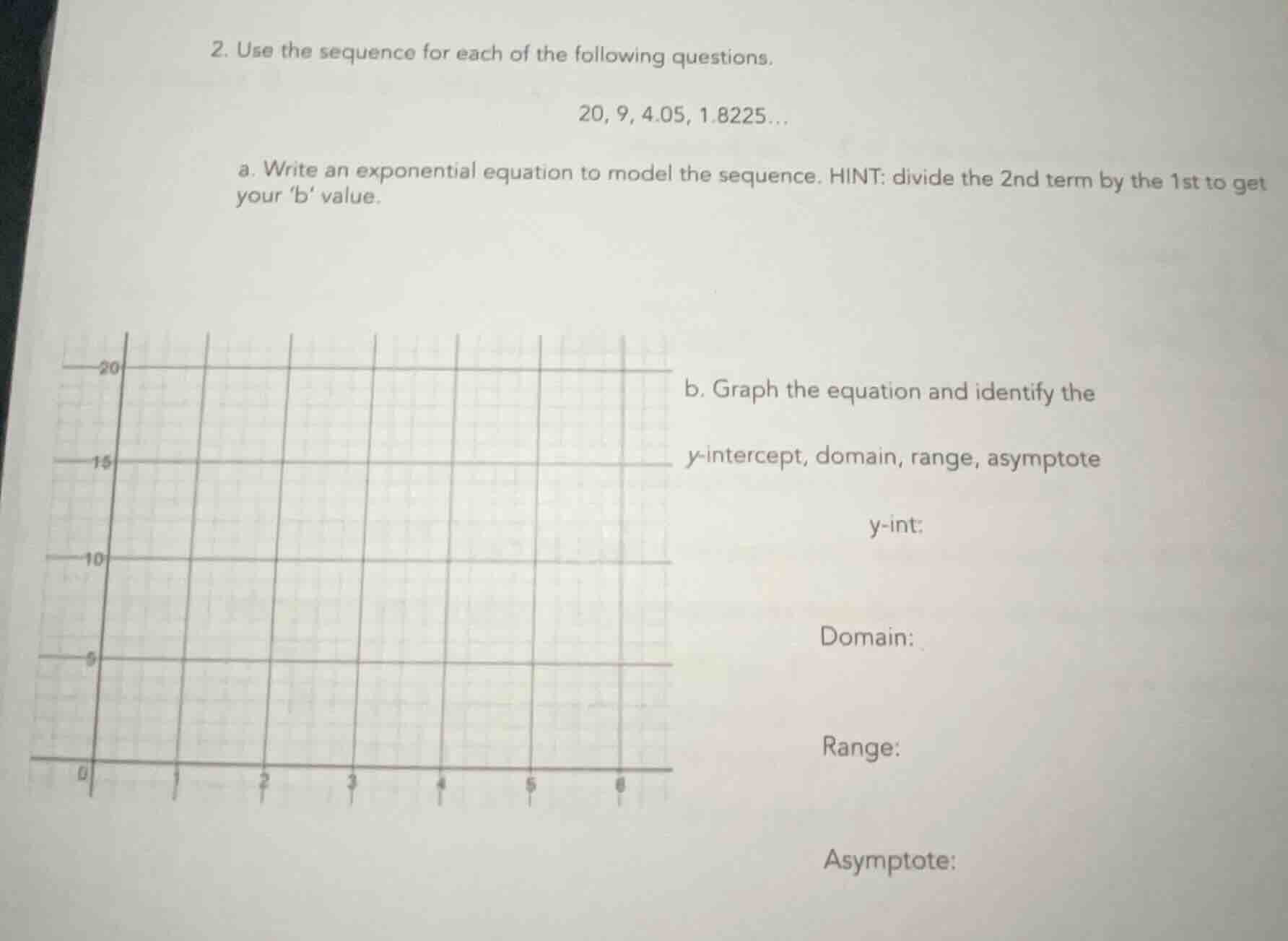
- use the sequence for each of the following questions.
20, 9, 4.05, 1.8225...
a. write an exponential equation to model the sequence. hint: divide the 2nd term by the 1st to get your ‘b’ value.
b. graph the equation and identify the
y-intercept, domain, range, asymptote
y-int:
domain:
range:
asymptote:
Step1: Find the common ratio $b$
$b = \frac{9}{20} = 0.45$
Step2: Write the exponential equation
The general form of an exponential sequence is $a_n = a_1 \cdot b^{n-1}$, where $a_1=20$.
$a_n = 20 \cdot (0.45)^{n-1}$
For a continuous exponential function, we can rewrite it as $y = 20 \cdot (0.45)^x$ where $x$ is a non-negative integer for the sequence, and extended to real numbers for graphing.
Step3: Identify y-intercept
The y-intercept occurs at $x=0$.
$y = 20 \cdot (0.45)^0 = 20 \cdot 1 = 20$
Step4: Identify domain
For the exponential function (extended to real numbers), the domain is all real numbers. For the sequence, domain is positive integers, but the graph of the equation uses all real numbers.
Step5: Identify range
Since the base $0.45$ is positive and $20>0$, $y$ is always positive.
Step6: Identify asymptote
As $x \to +\infty$, $(0.45)^x \to 0$, so $y \to 0$.

Snap & solve any problem in the app
Get step-by-step solutions on Sovi AI
Photo-based solutions with guided steps
Explore more problems and detailed explanations
a. $a_n = 20(0.45)^{n-1}$ (for the sequence) or $y = 20(0.45)^x$ (for the continuous function)
b.
y-int: $(0, 20)$
Domain: All real numbers ($(-\infty, \infty)$)
Range: All positive real numbers $(0, \infty)$
Asymptote: $y=0$ (the x-axis)
(Note: To graph the equation, plot points like $(0,20)$, $(1,9)$, $(2,4.05)$, $(3,1.8225)$ and draw a smooth curve approaching $y=0$ as $x$ increases.)