QUESTION IMAGE
Question
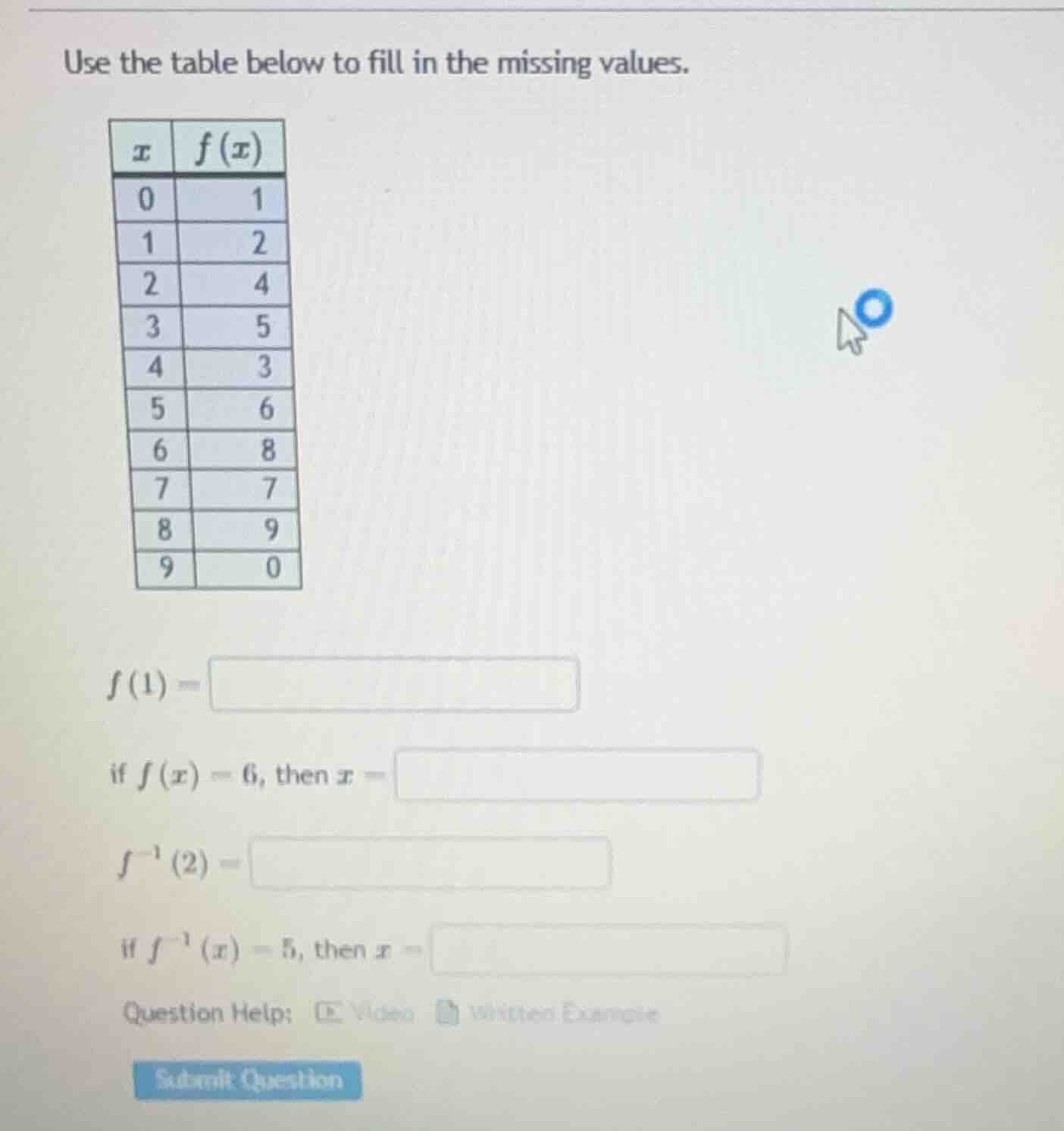
use the table below to fill in the missing values.
| $x$ | $f(x)$ |
|---|---|
| 1 | 2 |
| 2 | 4 |
| 3 | 5 |
| 4 | 3 |
| 5 | 6 |
| 6 | 8 |
| 7 | 7 |
| 8 | 9 |
| 9 | 0 |
$f(1) = \square$
if $f(x) = 6$, then $x = \square$
$f^{-1}(2) = \square$
if $f^{-1}(x) = 5$, then $x = \square$
question help: \\(\square\\) video \\(\square\\) written example
submit question
Step1: Find \( f(1) \)
Look at the table where \( x = 1 \). The corresponding \( f(x) \) value is 2.
Step2: Find \( x \) when \( f(x) = 6 \)
Search the table for \( f(x) = 6 \). The \( x \) value corresponding to \( f(x) = 6 \) is 5.
Step3: Find \( f^{-1}(2) \)
The inverse function \( f^{-1}(y) \) gives the \( x \) such that \( f(x) = y \). So we look for \( f(x) = 2 \), and the corresponding \( x \) is 1.
Step4: Find \( x \) when \( f^{-1}(x) = 5 \)
\( f^{-1}(x) = 5 \) means \( f(5) = x \). From the table, when \( x = 5 \), \( f(x) = 6 \), so \( x = 6 \).

Snap & solve any problem in the app
Get step-by-step solutions on Sovi AI
Photo-based solutions with guided steps
Explore more problems and detailed explanations
\( f(1) = 2 \)
if \( f(x) = 6 \), then \( x = 5 \)
\( f^{-1}(2) = 1 \)
if \( f^{-1}(x) = 5 \), then \( x = 6 \)