QUESTION IMAGE
Question
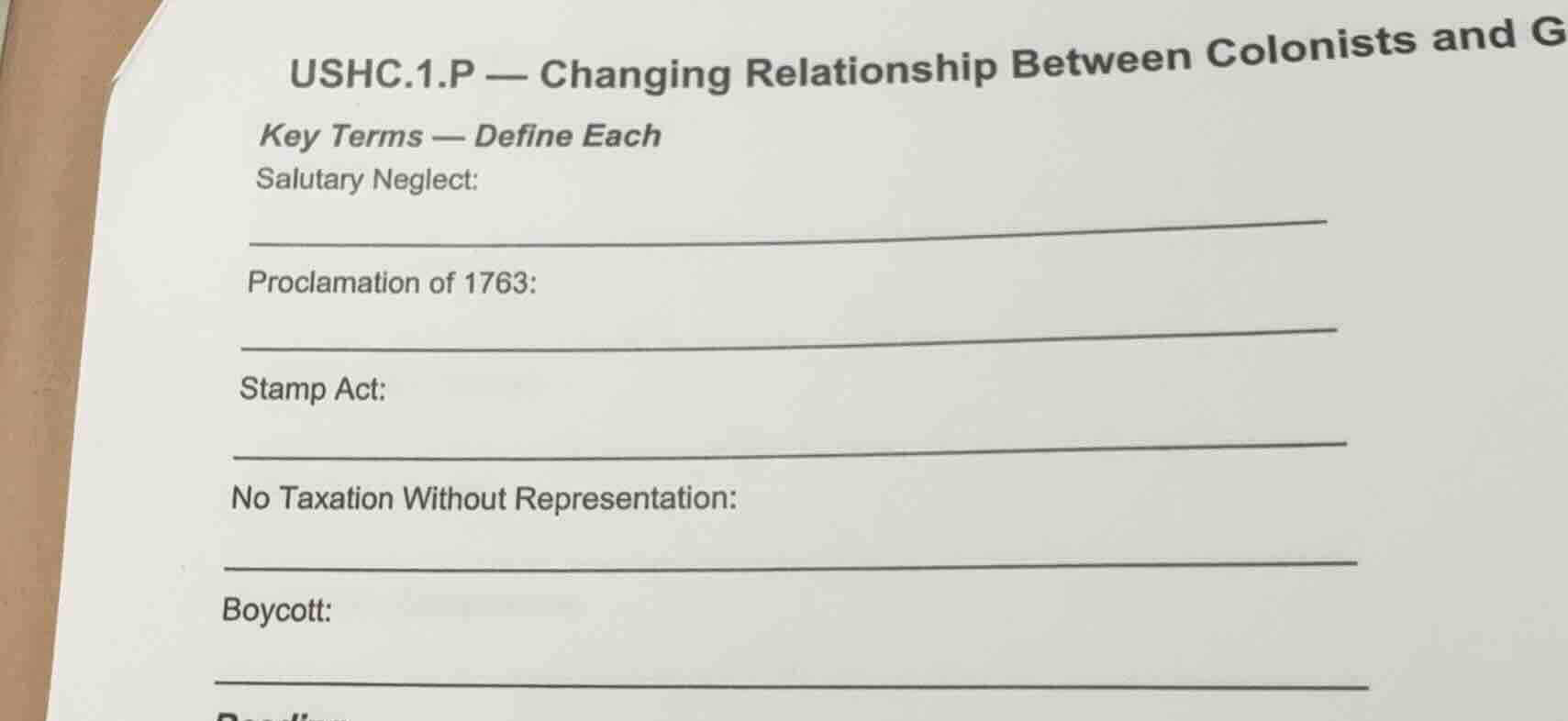
ushc.1.p — changing relationship between colonists and g
key terms — define each
salutary neglect:
_____________________________
proclamation of 1763:
_____________________________
stamp act:
_____________________________
no taxation without representation:
_____________________________
boycott:
_____________________________
Brief Explanations
- Salutary Neglect: British policy of loosely enforcing colonial trade laws, allowing colonies self - governance and economic growth.
- Proclamation of 1763: British edict after French - Indian War, forbidding colonists from settling west of Appalachian Mountains to avoid conflicts with Natives.
- Stamp Act: 1765 British law, taxed printed materials in colonies (newspapers, legal docs, etc.), first direct tax on colonists.
- No Taxation Without Representation: Colonial slogan, argued British couldn't tax them as they had no elected reps in Parliament.
- Boycott: Refusal to buy/use goods (e.g., British goods by colonists) to protest policies, economic pressure tactic.

Snap & solve any problem in the app
Get step-by-step solutions on Sovi AI
Photo-based solutions with guided steps
Explore more problems and detailed explanations
- Salutary Neglect: British policy of loosely enforcing colonial trade laws, allowing colonial self - governance and economic development.
- Proclamation of 1763: British edict post - French - Indian War, prohibiting colonial settlement west of the Appalachian Mountains to prevent conflicts with Native Americans.
- Stamp Act: 1765 British legislation that imposed a direct tax on printed materials in the colonies, including newspapers, legal documents, and playing cards.
- No Taxation Without Representation: Colonial protest slogan asserting that the British Parliament had no right to tax the colonies since colonists had no elected representatives in Parliament.
- Boycott: A deliberate refusal to buy, use, or engage with certain goods or services (often British goods by colonists) as a form of protest against policies.